
The Science Behind Chi Machine Therapy: What Research Actually Shows
- Chi machines create a side-to-side oscillation that moves the body passively, without muscle effort, at roughly 140 cycles per minute.
- Studies on side-alternating vibration and passive rocking motion show measurable increases in peripheral blood flow and lymphatic drainage.
- Research on lymphedema, deep oscillation massage, and rocking-chair exercise supports benefits for circulation, muscle relaxation, and mild pain relief in older or less mobile users.
- No large clinical trial has tested a chi machine by name, so most evidence is drawn from related passive-exercise and vibration research.
- People with active implants, epilepsy, recent fractures, or damaged skin should get medical clearance before use.
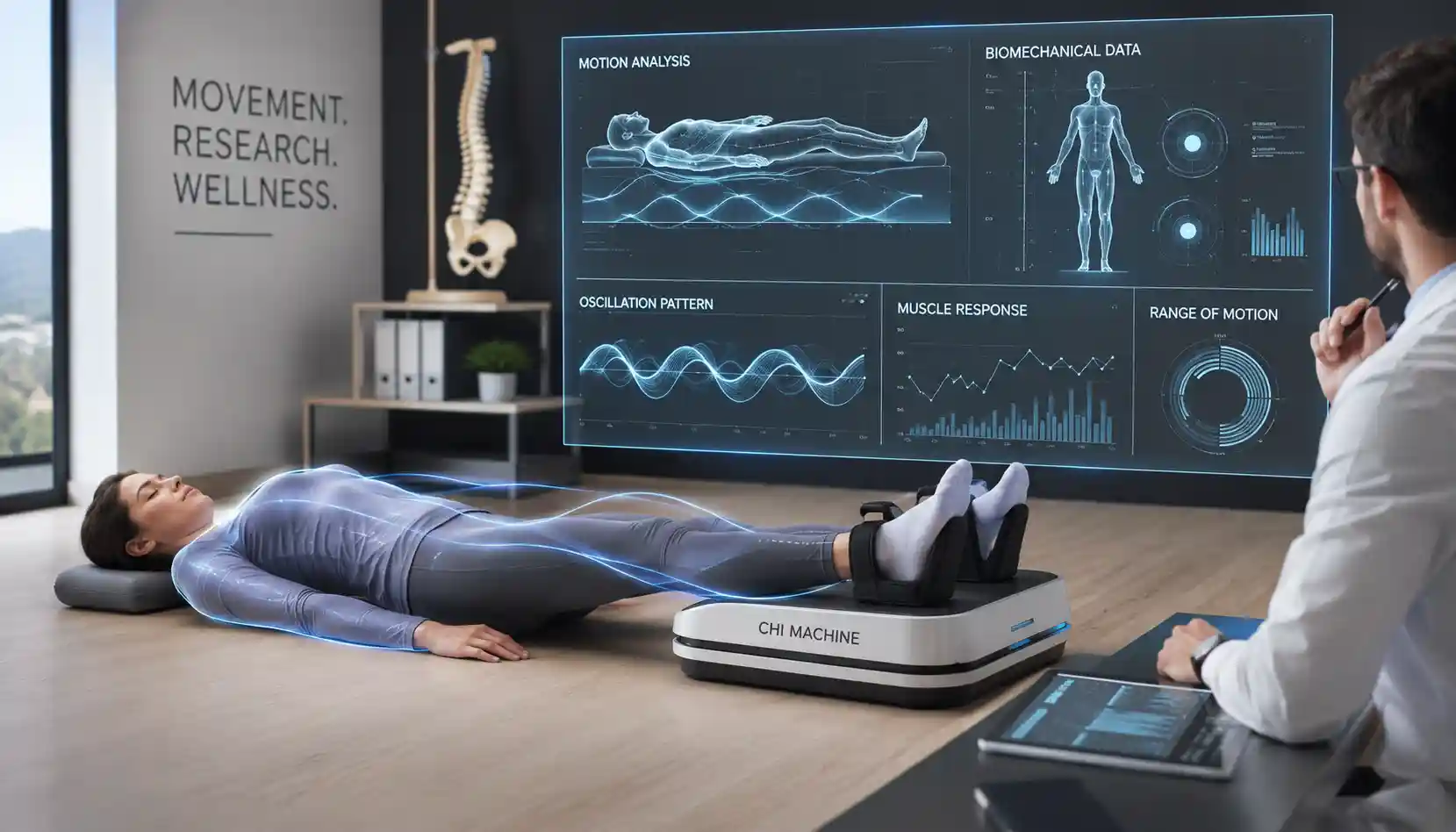
A chi machine works by cradling your ankles and swinging your legs side to side in a slow figure-8 motion, typically 140 times per minute, without you having to move a single muscle. If you’re wondering whether this passive rocking actually does anything measurable for your body, the honest answer is: partially, yes. No large trial has studied a branded “chi machine” directly, but the underlying mechanism — side-alternating oscillation — has been tested in adjacent research on vibration therapy, lymphatic drainage, and rocking-chair exercise in older adults, and those studies consistently show improved local blood flow, reduced leg swelling, and better lymph movement. This article walks through what that research actually says, where the evidence stops, and who should be cautious before starting.
What a Chi Machine Actually Does to the Body
The device itself is simple: a motorized cradle holds your ankles and swings your lower body from side to side while you lie on your back. This creates a passive, rhythmic motion similar to a fish swimming, which is why some manufacturers call it “aerobic exercise without effort.” Unlike active exercise, your muscles aren’t contracting to generate the movement — the machine does the work, and your body responds to it.
That distinction matters for older adults, people recovering from injury, or those with nerve damage who can’t tolerate weight-bearing activity. The motion mobilizes the spine, hips, and legs through a repeated range of motion without loading the joints, which is why physical therapy contexts often describe it as a form of passive exercise rather than true aerobic training.
The two physiological effects most often cited are increased local blood circulation and enhanced lymphatic drainage. Both are testable claims, and both have some supporting research — though not always from studies using a chi machine specifically.
The Oscillation Mechanism and Vibration Research
The closest scientific parallel to chi machine motion is side-alternating vibration therapy, which differs from the vertical vibration plates found in most gyms. A meta-analysis of whole-body vibration studies found that side-alternating vibration produced a large, statistically significant increase in peripheral blood flow, while vertical vibration showed no meaningful effect at all. This is a key distinction: the side-to-side swinging action, not vibration in general, appears to be what drives the circulatory response.
Separately, research on vibration therapy for chronic venous disease found that it increased venous blood flow and reduced edema, along with improvements in leg heaviness and fatigue — symptoms that overlap heavily with what older users of chi machines report. The proposed mechanism is mechanical: muscle contractions normally act as a pump that pushes lymph and venous blood upward against gravity, and rhythmic external movement can partially substitute for that pump action in people who can’t generate it themselves, such as those with limited mobility or nerve-related weakness.
Localized vibration massage studies on the area behind the knee have also shown short-term increases in blood flow immediately following treatment, supporting the idea that mechanical, passive movement has a real, measurable circulatory effect — even if it’s temporary.
Lymphatic Drainage: Where the Evidence Is Strongest
Of all the claims made about chi machines, the lymphatic drainage effect has the most direct supporting research. The lymphatic system relies almost entirely on external pressure — from muscle contraction, breathing, or manual massage — to move lymph fluid back toward the bloodstream, since it has no central pump like the heart. When that pumping mechanism is disrupted or underused, fluid pools in the tissues, most visibly in the legs.
Clinical case reports and small studies have examined home-based chi machine use specifically for chronic secondary leg lymphedema, a condition often caused by lymph node removal during cancer treatment. Combined with leg elevation, passive leg exercise using the machine showed measurable reductions in fluid buildup within weeks. Separately, research on cold-water immersion found that cold applied with pressure significantly increased lymph flow by causing lymph vessels to contract — a different mechanism, but it confirms that external mechanical stimulation can meaningfully influence lymphatic circulation, which supports the plausibility of vibration-based approaches doing something similar.
For someone managing lymphedema, unexplained leg swelling, or the fluid retention that often comes with reduced mobility in older age, this is the strongest evidence-backed benefit associated with the device.
What Rocking-Chair Research Tells Us About Passive Movement in Older Adults
Because chi machines are marketed heavily to elderly users, it’s worth looking at research on a much simpler form of passive rhythmic movement: rocking chairs. A randomized controlled pilot study of community-dwelling women aged 73 to 87 assigned participants to either a six-week home rocking-chair program or a control group. The rocking group did ten short sessions per week, and the results showed statistically significant improvements in balance scores, maximal knee extension strength, and walking speed compared to controls.
What makes this study relevant isn’t that a rocking chair and a chi machine are the same device — they aren’t — but that it demonstrates something important: low-effort, rhythmic, passive-leaning movement performed consistently at home can produce measurable physical performance gains in older adults, even without traditional exercise intensity. Three months after the study ended, 88.5% of participants had kept the rocking habit as part of their regular routine, suggesting this kind of low-barrier movement is genuinely sustainable for people who find conventional exercise difficult or unappealing.
This body of research supports the general principle behind chi machines — that passive, rhythmic motion has physiological value for older adults — even though it doesn’t validate the specific device.
Muscle Relaxation, Back Pain, and Nerve-Related Conditions
For users with chronic lower back pain or limited mobility from nerve conditions, the appeal of a chi machine is usually pain relief and muscle relaxation rather than fitness. The side-to-side motion is designed to let the spine settle into a more neutral curve while surrounding muscles are passively stretched and relaxed, rather than actively engaged.
Deep oscillation massage — a related vibration-based technique — has been studied for musculoskeletal pain conditions including fibromyalgia and sports injuries, with observational data showing good short-term tolerability and mostly mild, transient side effects. Reviews of this therapy note that most patients rated their sessions as good or very good for symptom relief immediately afterward, though methodological limitations in the underlying studies mean the evidence should be read as supportive rather than conclusive.
For people with conditions like spasticity, Parkinson’s-related rigidity, or post-stroke limb weakness who cannot move a limb independently, passive movement at a low intensity setting is sometimes used clinically as a way to maintain circulation and joint mobility without requiring active participation. This is consistent with how physical therapists describe the appropriate use case: not as a replacement for active rehabilitation, but as an option when active movement isn’t currently possible.
Does It Affect Metabolism or Help with Weight Management?
Some chi machine marketing implies a calorie-burning or metabolic benefit similar to aerobic exercise. The research on this is more cautious. Studies on excess post-exercise oxygen consumption (EPOC) — the phenomenon where metabolic rate stays elevated after a workout — consistently show that the effect scales with exercise intensity and duration. A 90-minute resistance session might elevate metabolic rate for over two hours; a 45-minute session in trained women raised resting metabolism by roughly 18% during a two-hour recovery window.
Since a chi machine involves no active muscle contraction and low mechanical intensity compared to these studied protocols, it’s reasonable to expect any metabolic effect to be far smaller and shorter-lived than what’s seen with active resistance or aerobic exercise. The honest takeaway for someone hoping to use it for weight loss is that it’s not a substitute for active movement — its documented strengths lie in circulation, lymphatic drainage, and passive muscle relaxation, not metabolic conditioning.
Who Should Be Cautious: Contraindications
Because the motion involves mechanical stimulation of the lower body and spine, certain groups should get medical clearance before using a chi machine, and some should avoid it entirely. Based on contraindication guidance used for related mechanical and electrical stimulation therapies, caution or avoidance is generally recommended for:
- People with active cardiac implants such as pacemakers or defibrillators
- Those with epilepsy or uncontrolled seizure conditions
- Anyone with a recent fracture, unhealed injury, or recently radiated tissue
- People with active infections, deep vein thrombosis, or haemorrhagic conditions
- Pregnant individuals, unless specifically cleared by their doctor
Skin conditions, impaired sensation, and undiagnosed swelling are also reasons to check with a healthcare provider first, since the person may not be able to reliably gauge whether the intensity or duration is appropriate for their condition. This is particularly relevant for elderly users or those with nerve damage who may have reduced sensation in the legs and feet, since they may not notice overuse or irritation as quickly as someone with full sensation.
What the Evidence Does Not Yet Show
It’s worth being direct about the limits of current research. No peer-reviewed randomized controlled trial has tested a commercially branded chi machine against a placebo condition in a large sample. Most of the supporting evidence comes from adjacent fields — side-alternating vibration studies, rocking-chair trials, deep oscillation massage research, and small case reports on lymphedema — that share a similar mechanism but aren’t the same device or protocol.
Regulatory bodies have also taken a firm stance on overstated health claims for devices in this category. The FDA has issued warning letters to device and supplement manufacturers for claims that go beyond what evidence supports, particularly around curing or treating specific diseases. Any product description that promises to cure a medical condition, rather than describing a supportive, adjunct effect on circulation or relaxation, should be treated skeptically regardless of the underlying mechanism’s plausibility.
Getting the Most Out of a Chi Machine Safely
For someone using the device at home, the research suggests a few practical takeaways. Short, consistent sessions appear more relevant than intensity — the rocking-chair study used just 15 minutes twice daily, and the lymphedema case data pointed to benefits building over weeks rather than in single sessions. Starting on the lowest setting is particularly important for anyone with reduced limb sensation, spasticity, or nerve pain, since passive movement at low intensity is what’s typically described in mobility-limited use cases.
Pairing sessions with leg elevation appears to compound the drainage effect based on the lymphedema research discussed earlier. And because none of this replaces active movement, viewing the chi machine as a complement to — not a substitute for — walking, physical therapy exercises, or other movement your doctor has recommended keeps expectations aligned with what the evidence actually supports.
Is there real scientific evidence behind chi machine therapy?
Direct trials on branded chi machines are limited, but the underlying mechanism — side-alternating oscillation — is supported by research on vibration therapy, lymphatic drainage, and passive rocking exercise showing improved circulation and reduced leg swelling.
Can a chi machine help with lymphedema?
Case data on home-based use combined with leg elevation showed reduced fluid buildup within weeks for chronic secondary leg lymphedema, making this one of the better-supported uses of the device.
Is chi machine therapy safe for elderly users?
It’s generally considered low-risk since it requires no active exertion, but people with pacemakers, epilepsy, recent fractures, infections, or impaired skin sensation should get medical clearance first.
Does using a chi machine burn calories or boost metabolism?
Any metabolic effect is likely small since the movement involves no active muscle contraction, unlike the resistance and aerobic protocols shown to meaningfully raise post-exercise metabolic rate.
How is chi machine motion different from a vibration plate?
Vibration plates typically use vertical vibration, which research shows has little effect on blood flow, while the side-alternating motion used in chi machines matches the type of vibration shown to significantly increase peripheral circulation.
Can a chi machine help with back pain or nerve conditions?
It may support muscle relaxation and passive mobility for people who can’t exercise actively, similar to how deep oscillation massage has shown short-term symptom relief, but it isn’t a treatment for the underlying nerve or spinal condition.
How often should someone use a chi machine?
Related passive-movement research used short daily sessions of around 15 minutes rather than long single sessions, suggesting consistency matters more than duration.
Who should avoid using a chi machine?
People with active cardiac implants, epilepsy, recent fractures, deep vein thrombosis, active infections, or unhealed/radiated skin should avoid use without medical clearance first.
Sources
- Ice Barrel — How Cold Water Immersion Impacts Lymphatic Circulation
- Austin Ozone — Chi Machine and its Important Benefits
- University of Queensland — Benefits of Home-Based Rocking-Chair Exercise RCT
- PMC — Whole-Body Vibration and Blood Flow and Muscle Oxygenation: A Meta-Analysis
- Vein Treatment Clinic — Do Vibration Plates Really Help Your Veins?
- PMC — Safety and Effectiveness of Vibration Massage by Deep Oscillations
See also