
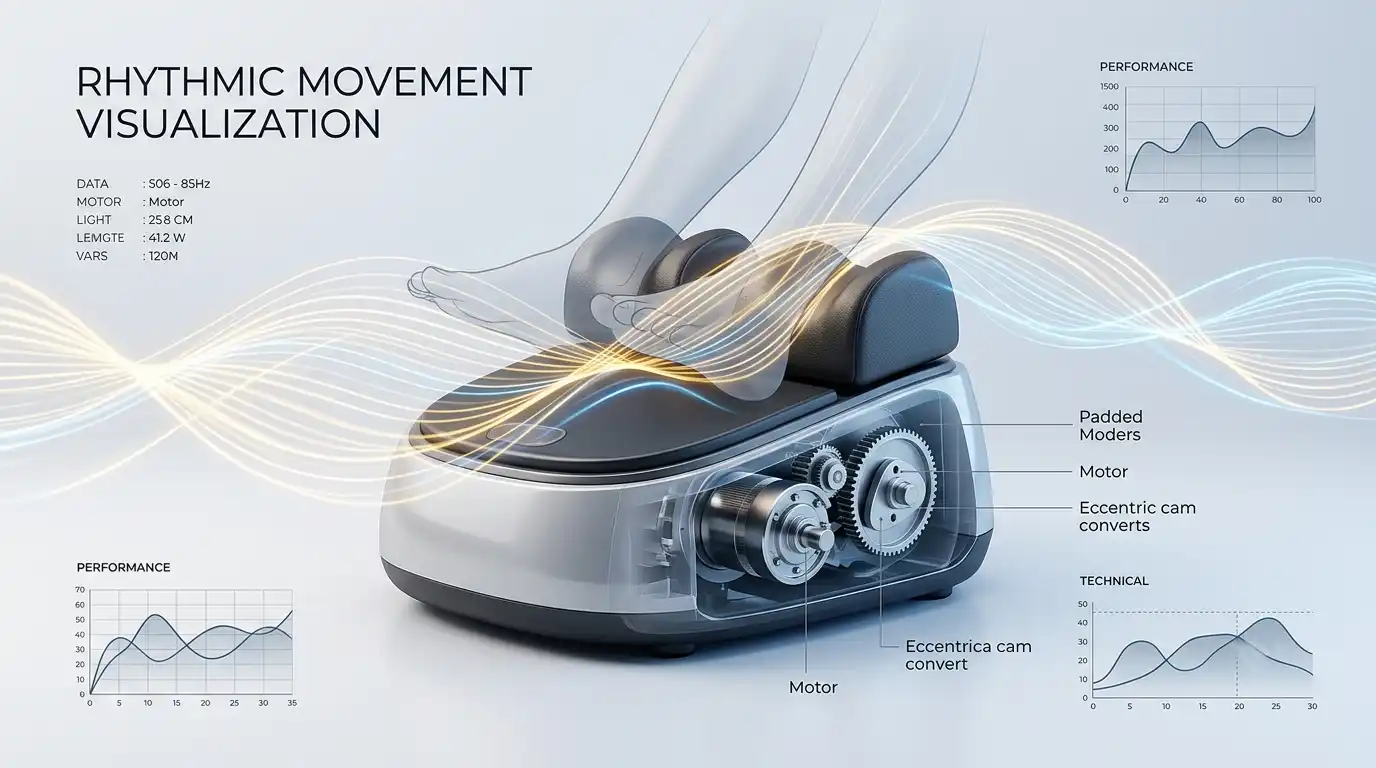
How Chi Machines Create Rhythmic Movement
- A small electric motor turns a geared-down shaft connected to an eccentric cam, and that off-center rotation is what produces the machine’s steady, repeating swing.
- The ankle cradle sits on a pivoting arm, so the cam’s circular motion is converted into a side-to-side sway rather than an up-and-down bounce.
- Most classic models run at a fixed 140 to 144 cycles per minute, with a swing travel of roughly 1.5 inches and a wing angle near 12 degrees; newer machines offer adjustable speeds, often 40 to 180 RPM.
- The claimed physiological benefits — circulation, lymphatic movement, muscle relaxation — are built on the idea that rhythmic lateral compression at the ankles can substitute, in part, for the muscle-pump action the body normally gets from walking.
- The mechanism itself is well documented; the physiological claims built on top of it deserve a more careful look, which is where the companion piece on the science behind Chi Machine therapy comes in.
If you’ve ever lain down, placed your ankles in the cradle of a Chi Machine, and felt your legs swept gently side to side, the sensation raises an obvious question: what, mechanically, is actually happening inside the base of the machine to produce that motion? The short answer is that a small motor drives an off-center rotating cam, and a pivoting cradle arm converts that rotation into lateral sway at a fixed, repeating rate — typically somewhere close to 140 cycles per minute. The rest of this article breaks down each part of that chain: the motor and drive mechanism, how rotation becomes a side-to-side wave, why the speed lands where it does, and what that specific pattern of movement is claimed to do for circulation and muscle tension.
What’s Actually Inside the Base
Underneath the padding and plastic housing, a Chi Machine is a fairly simple piece of mechanical engineering built around three components: a small electric motor, a speed-reduction stage, and a cam or crank assembly that turns rotation into swing.
The motor itself typically spins at a much higher speed than the cradle actually needs. A gear reduction stage sits between the motor shaft and the output that drives the cradle, stepping that speed down to a usable range. In a standard reduction gearbox, a small gear (the pinion) attached to the motor shaft meshes with a larger gear on the output side; the ratio between the two gear diameters determines how much the speed drops. A motor spinning at roughly 1,400 RPM connected through a 10:1 reduction, for example, will produce an output shaft turning at about 140 RPM — which is not a coincidence, since that output speed maps closely onto the cycle rate the cradle eventually delivers. Some designs stack more than one reduction stage to reach the target speed smoothly and quietly rather than relying on a single large gear pair.
From there, the reduced-speed shaft connects to an eccentric cam — a disc mounted off-center from its axis of rotation, rather than through its middle. As the cam spins, any follower riding against its edge doesn’t move at a constant distance from the center; it rises and falls (or, depending on orientation, swings side to side) in a smooth, repeating pattern as the high point of the disc sweeps past. This is standard cam-and-follower design, the same basic principle used in everything from vintage sewing machines to industrial packaging equipment: a plain rotating disc, positioned off-axis, turns simple rotary motion into a predictable back-and-forth or side-to-side displacement without needing electronics or programmed motion control. Some patented Chi Machine and passive-exerciser designs use a variation on this — an eccentric cam disc paired with a linkage arm — specifically to produce a wider, smoother oscillation than a bare cam-and-follower pair would give on its own.
From Spinning Cam to Side-to-Side Sway
The reason a Chi Machine sways your legs sideways rather than jiggling them up and down comes down to how the cam is oriented relative to the cradle arm.
The ankle cradle isn’t bolted rigidly to the base — it sits on a pivot point, usually toward the rear of the unit, so that the front end (where your ankles rest) is free to sweep through an arc. A connecting rod links this pivoting arm to the eccentric cam. As the cam completes each rotation, it pushes the connecting rod first one way, then the other, and because the cradle can only move by rotating around its pivot, that push-pull motion translates into the cradle swinging left, then right, then left again — a continuous, smooth oscillation rather than a jarring back-and-forth snap.
Because the cradle is swinging through an arc rather than sliding on a straight track, the ankles don’t trace a simple straight line — they trace a slightly curved path each time the cradle reaches the edge of its swing. Repeated over and over, this is what gives the movement its commonly used nickname: a “figure-eight” or “fish-tail” motion, since the combined side-to-side sweep plus the slight curve at each end resembles the tail motion of a swimming fish. The effect isn’t confined to the ankles, either. Because the pelvis and lower spine aren’t rigid, the lateral push transmitted through the ankles and legs continues upward as a wave, so a well-tuned machine produces a ripple that runs from the feet up through the hips and into the lower back rather than stopping abruptly at the knees.
Cycle Speed: Why It Lands Near 140–144 Per Minute
Ask why the classic Chi Machine speed sits so consistently in the 140 to 144 cycles-per-minute range, and the answer is a mix of mechanical convenience and a physiological argument the original designers built the product around — not an arbitrary number.
Mechanically, a gear reduction that lands an output shaft at roughly 140–144 RPM is easy to achieve reliably with a small, quiet, low-cost motor, which matters for a device meant to sit beside a bed and run for ten or fifteen minutes at a stretch without excessive noise or heat. Physiologically, the number was chosen because it sits close to double an average adult resting pulse of around 70–72 beats per minute, and because some designers described it as a multiple of a much slower rhythm — cited at roughly 12 cycles per minute — that has been associated with cerebrospinal fluid movement. Whether that specific physiological reasoning holds up under closer scrutiny is a separate question from the mechanical fact of the speed itself, and it’s one better addressed in a dedicated look at the science behind Chi Machine therapy rather than here.
What’s changed since the original single-speed design is that newer machines increasingly offer adjustable speed control. Where a classic Sun Ancon-style unit ran at one fixed rate, contemporary passive exercisers commonly advertise a broader range — some spanning roughly 40 to 180 RPM — controlled by a dial or remote, letting a user choose a gentler, slower sway or a brisker one depending on comfort, time of day, or how sensitive their back or joints feel that session. For someone managing nerve pain or a stiff lower back, that adjustability matters more than the exact number on the dial: a slower cycle rate produces a smaller, more contained swing that’s easier to tolerate than the brisker classic setting.
Swing Travel and Angle: How Far the Cradle Actually Moves
Cycle speed only tells you how often the cradle swings, not how far. The second number worth knowing is swing travel — the physical distance the cradle moves from one side to the other — and the wing angle, the degree of tilt the cradle reaches at each extreme.
On a standard classic-style unit, the cradle typically travels about 1.5 inches (roughly 37mm) from center to each side, reaching a wing angle of around 12 degrees at full extension. In practical terms, that’s a modest, contained sway — enough to be clearly felt through the ankles, knees, hips, and lower back, but not a wide or jarring displacement. Machines marketed for a gentler or more therapeutic feel sometimes reduce this travel distance, while models marketed for a more vigorous “passive aerobic” experience may extend it. When comparing models, swing travel and wing angle are a more concrete point of comparison than marketing language like “gentle” or “invigorating,” since they describe an actual measured range of motion rather than a subjective impression.
The Physiological Chain: Why Lateral Movement Specifically
Understanding the mechanism raises the next question: why would side-to-side ankle movement, of all things, be linked to circulation or lymphatic effects rather than any other kind of passive motion? The reasoning connects two separate physiological systems.
Venous and lymphatic return normally depend on active muscle contraction. Blood returning from the legs to the heart, and lymph fluid draining through the lymphatic vessels, both rely partly on external compression from surrounding muscle. Lymph movement in particular depends on a combination of intrinsic contraction within the lymphatic vessel walls and extrinsic compression from adjacent tissue — meaning that when nearby muscles contract and relax, as they do during walking, they physically squeeze the vessels and help push fluid along. When someone spends long stretches sitting or lying still — a real concern for older adults or people managing back pain who may be less mobile day to day — that external compression effectively stops. Blood flow slows, less tissue fluid is formed, and lymph flow becomes sluggish because there’s less pressure to distend the vessels and trigger their own contraction wave.
The proposed mechanism is that rhythmic lateral compression at the ankles substitutes, at least partly, for that muscle-pump action, without requiring the user to exert any effort. As the cradle sways, the lower legs are alternately compressed and released against the padded cradle surface, and the wave of movement that travels upward through the hips is proposed to create a similar rhythmic compression-and-release cycle through the tissue further up the leg. That’s the mechanical logic behind marketing terms like “lymphatic massager” applied to these devices — not that the machine pumps fluid directly, but that its cyclical squeeze-and-release pattern mimics, in a passive form, what an active muscle contraction does.
It’s worth being precise about the limits of that logic, though. Research on lymph flow notes that passive movement alone can help temporarily, but continued passive movement without any active muscle engagement will, over time, exhaust the available tissue fluid that feeds the lymph system — active movement is what continuously replenishes it by increasing blood flow and forming fresh tissue fluid. In other words, a Chi Machine session is not mechanically equivalent to a walk, even if the two both involve rhythmic leg movement; the honest version of the claim is that passive oscillation may offer a short-term assist to a stagnant system, not a substitute for active circulation over the longer term.
The second physiological thread is less about fluid mechanics and more about the nervous system. Rhythmic, repetitive movement — rocking in particular — has been studied for its effect on the autonomic nervous system, with research on rocking motion showing measurable changes in respiration patterns consistent with a shift toward the parasympathetic, “rest and relax” side of the nervous system rather than the sympathetic “alert” side. Slower, deeper breathing and reduced muscle tension are the kind of effects that would plausibly follow from steady, predictable lateral movement delivered at a comfortable pace — which may explain why many users describe the sensation as calming or muscle-loosening independent of any circulatory claim. For someone managing chronic back tension or nerve-related discomfort, that relaxation effect, mediated through the nervous system rather than through fluid mechanics, may be the more consistently reported part of the experience.
A Brief, Honest Note
None of the mechanical explanation above should be read as proof that a Chi Machine measurably improves circulation or clears lymphatic congestion the way structured exercise does — the engineering behind the swing is well documented and straightforward; the physiological claims layered on top of it are a separate matter with a much thinner evidence base, and they’re covered in more depth in the companion piece on the science behind Chi Machine therapy. What’s described here is simply how the device produces its motion and the mechanical logic offered for why that specific motion is targeted at circulation and relaxation.
What’s the actual mechanical difference between a cam and a crank in a passive exerciser?
Both convert rotation into repeating linear or arc-shaped motion, but a cam relies on the varying distance from center to edge of an irregular (eccentric) disc pushing against a follower, while a crank uses a fixed-length arm pinned off-center to a rotating shaft. Chi Machines and similar passive exercisers commonly use eccentric cam or cam-plus-linkage designs because they can be tuned to produce a smoother, more gradual displacement than a simple crank arm.
Why does the cradle move side to side instead of up and down?
It comes down to how the cam and connecting rod are oriented relative to the cradle’s pivot point. Because the cradle is mounted to swing on a horizontal arc rather than slide vertically, the cam’s rotational push is converted into lateral sway rather than a bouncing motion.
Is 140 to 144 cycles per minute the same across every model?
No. That range describes the fixed speed used by classic single-speed designs. Many newer machines offer adjustable speed control, with some ranges spanning roughly 40 to 180 RPM, letting the user choose a slower or brisker cycle rate rather than being locked to one setting.
Does a faster cycle speed mean a stronger effect?
Not necessarily. A faster cycle rate mainly changes how quickly the sway repeats, not how far the cradle travels — that’s governed separately by swing travel and wing angle. A higher speed can feel more brisk or vigorous, while a slower speed produces a gentler, more contained sensation, which is often preferable for sensitive backs or joints.
Does the swinging motion really move lymph fluid the way walking does?
Not in the same way. Lymph flow depends heavily on active muscle contraction sustaining blood flow and tissue fluid formation over time. Passive movement, including a Chi Machine’s oscillation, may offer a short-term assist to a stagnant system, but research indicates that passive movement alone eventually runs short on the fluid supply that active movement continuously replenishes.
Why does the movement sometimes feel like it travels up my spine?
Because the lower body isn’t a rigid structure. The lateral push delivered at the ankles has to go somewhere, and since the hips and lower spine can flex slightly, that energy continues upward as a wave rather than stopping at the knees — which is why users often describe the sensation as running through the hips and lower back rather than staying confined to the legs.
Can the mechanism be adjusted for someone with a sensitive lower back?
Yes, on machines with adjustable speed. Choosing a slower cycle rate produces a smaller, gentler displacement per cycle, which is generally more tolerable for someone easing into passive movement or managing existing back or nerve sensitivity than the classic fixed higher-speed setting. Understanding what’s happening mechanically inside the base — the motor, the gear reduction, the eccentric cam, and the pivoting cradle — makes it easier to compare models on real specifications (cycle speed rang