
How Does a Chi Machine Work?
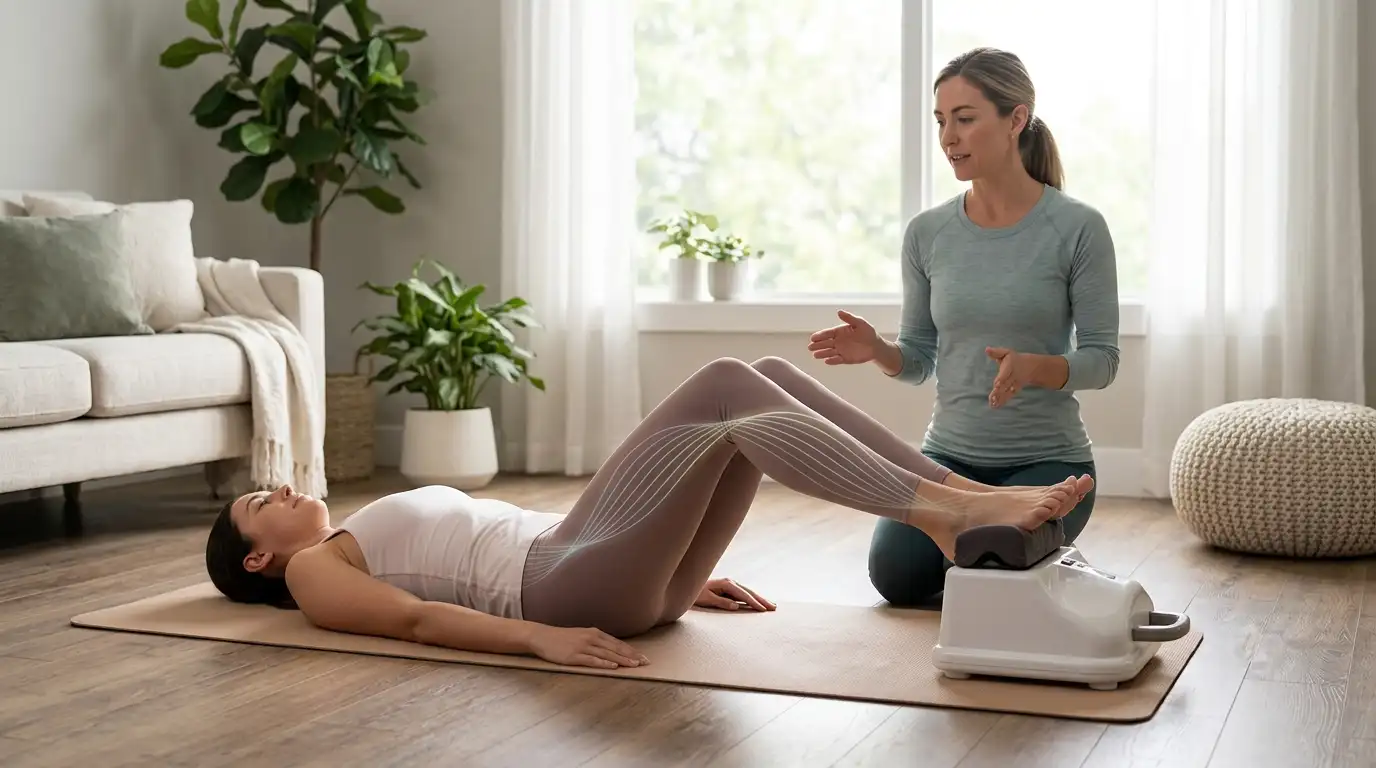
- A Chi Machine cradles your ankles on a padded rest and swings your lower body side to side in a figure-eight pattern, at a steady rhythm of roughly 140-144 cycles per minute.
- You stay lying down and passive the whole time — the motor does the moving, which is why this is classified as passive exercise rather than active exercise.
- The oscillation is claimed to encourage blood oxygenation, support lymphatic drainage, and gently mobilize the spine, though these effects are described as complementary rather than medically proven.
- The device traces back to 1990s Japan, where Dr. Shizuo Inoue designed the “goldfish exercise,” drawing on the earlier spinal-movement principles of Katsuzo Nishi.
- Most of the benefit claims are anecdotal or come from manufacturer material — a Chi Machine is not a weight-loss tool, and any relief it may offer should be treated as a comfort measure, not a treatment.
A Chi Machine works by resting your ankles on a motorized, padded cradle that rocks your legs and hips side to side in a smooth figure-eight arc, usually at a constant pace of about 140 to 144 cycles per minute. You lie flat on your back, let your body go loose, and the machine supplies all the movement — your muscles aren’t doing the work, which is why the experience is often described as “passive exercise.” The rest of this article breaks down exactly how that mechanism functions, what physiological effects are commonly claimed for it, where the device actually came from, and — just as importantly — what’s realistic to expect from it if you’re older or dealing with back or nerve issues and considering one for gentle daily movement.
The Mechanism: Oscillation and the “Goldfish” Motion
The core of a Chi Machine is deceptively simple. A small electric motor sits inside the base unit and drives a padded cradle back and forth. You lie on the floor or a mat, slide your ankles into the cradle, and switch the machine on. From there, the device takes over: it swings your legs — and by extension your hips and lower spine — from side to side in a motion that traces a figure eight rather than a flat, straight arc.
That figure-eight pattern is deliberate. A simple left-right rocking motion would just shunt your body back and forth in a straight line. The figure-eight path instead introduces a slight rotational component at each end of the swing, so the movement ripples up through the pelvis and lower spine rather than stopping abruptly at the ankles. Manufacturers and practitioners commonly call this the “goldfish motion,” because the undulating side-to-side ripple resembles the way a fish moves its body and tail to swim.
Speed matters here too. Chi Machines are built to run at a fixed, steady cadence — typically cited at around 140 to 144 cycles per minute. That’s fast enough to feel like continuous, gentle motion rather than a slow rock, but slow enough that it never feels jarring or effortful. The constant, unvarying rhythm is part of the design intent: an even cadence is what allows the whole body, not just the legs, to settle into the motion and sway along with it rather than resist it.
Sessions are typically short, often somewhere in the 5-to-15-minute range, precisely because the motion is continuous and rhythmic rather than something you need to build up to gradually the way you would with a walk or a workout.
The cradle itself is usually padded and shaped to hold the ankles securely without pinching, since the whole design depends on your legs staying comfortably in place while the rest of your body is free to sway. Most units are used flat on the floor, often with a mat or thin cushion underneath the shoulders and head, so that the hips and lower spine are the parts of the body doing the actual moving rather than the neck or upper back. Arms are typically left resting naturally at the sides or across the chest — they’re not part of the mechanism, and there’s nothing for them to actively do.
What tends to surprise first-time users is how far up the body the motion travels. Because the oscillation isn’t confined to the ankles and lower legs, a well-designed session produces a gentle ripple that reaches the pelvis and lower back within the first few cycles, and many people describe the sensation as similar to being rocked rather than shaken or vibrated. That distinction — rocking versus vibrating — is part of why the goldfish motion is associated with a calming, low-stimulation experience rather than an energizing one.
Passive Exercise: What the Term Actually Means
The phrase “passive exercise” comes up constantly around Chi Machines, and it’s worth being precise about what it means, because it’s easy to assume it’s just a softer synonym for “light exercise.” It isn’t.
In active exercise — walking, cycling, swimming, resistance training — your own muscles contract to produce the movement, your heart rate rises in response to that muscular work, and your cardiovascular system is directly engaged because it needs to supply oxygen to working tissue. Passive exercise flips that relationship. With a Chi Machine, the external device supplies the motion entirely; your muscles stay relaxed rather than contracting to move your limbs. You are moved, rather than moving.
This distinction is the honest starting point for understanding what a Chi Machine can and can’t be expected to do. Because your muscles aren’t actively engaging, a Chi Machine session isn’t a substitute for the cardiovascular or muscle-strengthening benefits of active exercise — it doesn’t build strength, and it isn’t going to raise your heart rate the way a brisk walk would. What it offers instead is movement without exertion: a way to get your body swaying rhythmically without your joints or muscles having to do any of the work of producing that motion. That’s precisely why it tends to appeal to people who find active movement difficult, painful, or fatiguing, rather than to people looking to build fitness.
The Claimed Physiological Effects: Circulation and Lymphatic Drainage
The two effects most consistently associated with Chi Machine use are circulatory and lymphatic. The reasoning offered for both centers on the ankle angle and the rocking motion working together.
Because your ankles sit slightly elevated and angled in the cradle while your body rocks side to side, the claim is that this combination helps encourage blood flow back toward the heart and increases oxygenation of the blood as it circulates. The lymphatic system — the network of vessels that drains excess fluid and waste products from tissue — doesn’t have its own pump the way the circulatory system has the heart; it relies largely on muscle movement and gentle pressure changes to keep fluid moving. The rocking motion of a Chi Machine is claimed to provide exactly that kind of gentle, rhythmic pressure change, which is the basis for describing the device as supportive of lymphatic drainage.
Some manufacturer material extends this further, describing the side-to-side rocking as promoting spinal movement or even spinal realignment, on the logic that the oscillation gently mobilizes the vertebrae and surrounding soft tissue along the length of the lower back.
It’s worth being direct about what kind of claims these are: they’re physiological reasoning about why the motion might help, not clinical findings that it does. They describe a plausible mechanism — rhythmic movement supporting fluid circulation is a reasonable physiological concept — rather than a documented, measured outcome. That distinction matters, and it’s the subject of the next section.
It also helps to separate the two effects conceptually, since they’re often mentioned together but rest on slightly different reasoning. The circulation claim leans on the idea that gentle, repeated positional change in the legs and lower body can support venous return — the process of blood traveling back toward the heart from the lower extremities, which normally relies partly on muscle contraction during walking or standing. The lymphatic drainage claim leans on a related but distinct idea: that the lymphatic system, lacking its own central pump, benefits from any external rhythmic pressure that encourages fluid movement through its vessels. Both are plausible physiological mechanisms in the abstract. Neither has been established through the kind of controlled clinical study that would let anyone say, with confidence, how much of an effect a Chi Machine session actually produces in a given person.
Where the Chi Machine Came From
The Chi Machine isn’t a recent wellness-industry invention — its origin actually predates most of the passive-exercise devices sold today. It was created in Japan in 1990 by Dr. Shizuo Inoue, who named the motion the “goldfish exercise” after the fish-like undulation of the movement itself.
Inoue’s design didn’t emerge in isolation. It drew directly on the earlier work of Katsuzo Nishi, a Japanese health theorist whose broader system of exercises, developed decades before Inoue’s machine, included spinal oscillation movements aimed at supporting posture and circulation through rhythmic side-to-side motion of the body. Inoue essentially mechanized and refined that earlier spinal-movement concept, building a device that could reproduce a consistent, controlled version of the goldfish-style oscillation without requiring the user to perform the movement themselves.
That lineage — a manual exercise concept from Nishi’s system, mechanized by Inoue into the motorized goldfish exercise — is the throughline that connects the Chi Machine you’d find in a wellness studio or clinic today back to its original design intent more than three decades ago: to make a gentle, rhythmic spinal-oscillation movement accessible to people who couldn’t easily perform it actively on their own.
Being Honest About the Evidence
This is the part of the conversation that gets skipped in most marketing copy, and it deserves to be front and center rather than buried.
The circulatory, lymphatic, and mobility claims made about Chi Machines are largely anecdotal, and much of what circulates online about the device’s benefits originates from manufacturer and retailer material rather than independent clinical research. That doesn’t automatically mean the claims are false — but it does mean they haven’t been established the way a proven medical treatment would be, and they should be treated with that context in mind.
A few things are worth stating plainly. A Chi Machine is not a weight-loss tool, and it isn’t marketed or intended as one by anyone being straightforward about it — passive movement at this intensity simply doesn’t burn meaningful calories or replace the metabolic effect of active exercise. The benefits most commonly described — support for circulation, general mobility, and comfort for people managing arthritis or limited mobility — are best understood as complementary or comfort-oriented effects, not medical treatments. A Chi Machine may help someone feel more mobile or relaxed after a session; it is not a documented cure or clinically validated therapy for any condition.
The safest way to think about a Chi Machine, in other words, is as a low-exertion way to introduce gentle rhythmic movement into your day — something that may help circulation or is claimed to ease stiffness — rather than as a device with proven therapeutic outcomes. If you’re managing a specific back condition, nerve issue, or circulatory concern, that framing should guide the conversation you have with a healthcare provider before adding one to your routine, rather than the device’s own marketing.
Who Tends to Consider a Chi Machine
Given that a Chi Machine trades exertion for gentle, externally supplied motion, it tends to draw interest from a fairly specific group of people: those for whom active movement is uncomfortable, tiring, or simply inaccessible on a given day. Older adults looking for a way to keep their lower body moving without joint strain are a common example. So are people managing chronic back discomfort or nerve-related sensitivity, who may find that rhythmic, low-impact motion feels more tolerable than a walk or a stretching routine, precisely because no muscular effort or weight-bearing is required to produce the movement.
If you’re curious about exactly how that rhythmic side-to-side motion is engineered inside the machine — the mechanics of the motor, the cradle, and the timing that produce the goldfish effect — that’s covered in more depth in how Chi Machines create rhythmic movement, which goes further into the engineering side of the device than this overview does.
For most people in this group, the appeal isn’t a promised cure. It’s a low-effort, few-minutes-a-day way to get some rhythmic movement into a body that doesn’t always tolerate more active options well — with realistic expectations about what that movement can and can’t do.
How long should a Chi Machine session last?
Most sessions run somewhere between 5 and 15 minutes. Because the motion is continuous and rhythmic rather than something that needs to be built up gradually, there’s typically no need for longer sessions to feel the rocking effect.
Do I need to do anything while the machine moves my legs?
No. The whole point of the design is that you stay passive — lying down with your muscles relaxed — while the motorized cradle supplies all of the side-to-side movement through your ankles.
Is a Chi Machine the same as a vibration plate?
No. Vibration plates use rapid, small-amplitude vibration transmitted through the feet while standing, engaging muscles to stabilize the body. A Chi Machine uses a slower, wider oscillating swing while you lie down, with your muscles staying relaxed rather than engaged.
Can a Chi Machine help me lose weight?
No. It is not designed or marketed as a weight-loss tool, and passive movement at this intensity doesn’t burn meaningful calories the way active exercise does. Any benefits described are unrelated to weight management.
Why is the motion called the “goldfish” exercise?
The name comes from the way the figure-eight oscillation ripples through the body from the ankles up through the hips and lower spine, resembling the undulating side-to-side motion a fish makes while swimming.
Is it safe for someone with back or nerve issues to use a Chi Machine?
Because the motion is gentle and passive, many people with back discomfort or nerve sensitivity find it tolerable, but individual conditions vary widely. Anyone with a specific back or nerve condition should check with a healthcare provider before starting, since a general wellness device isn’t a substitute for medical guidance tailored to that condition.
Where did the Chi Machine originate?
It was invented in Japan in 1990 by Dr. Shizuo Inoue, who based the design on the “goldfish exercise” concept and drew on the earlier spinal-oscillation exercises developed by Katsuzo Nishi.
Is there strong scientific evidence behind the circulation and lymphatic drainage claims?
Not in the sense of established clinical proof. Most of what’s claimed comes from anecdotal reports and manufacturer material rather than independent research, so these effects are best understood as plausible but unproven rather than medically confirmed.
Sources
Background facts on the mechanism, cadence, and claimed effects referenced in this article were drawn from Austin Ozone’s overview of the Chi Machine and its benefits, Trace The Body’s explanation of passive exercise and evidence caveats, and historical background from Wellness Therapy Center’s page on the Chi Machine treatment and Energy For Health’s page on where the Chi Machine concept originated.