
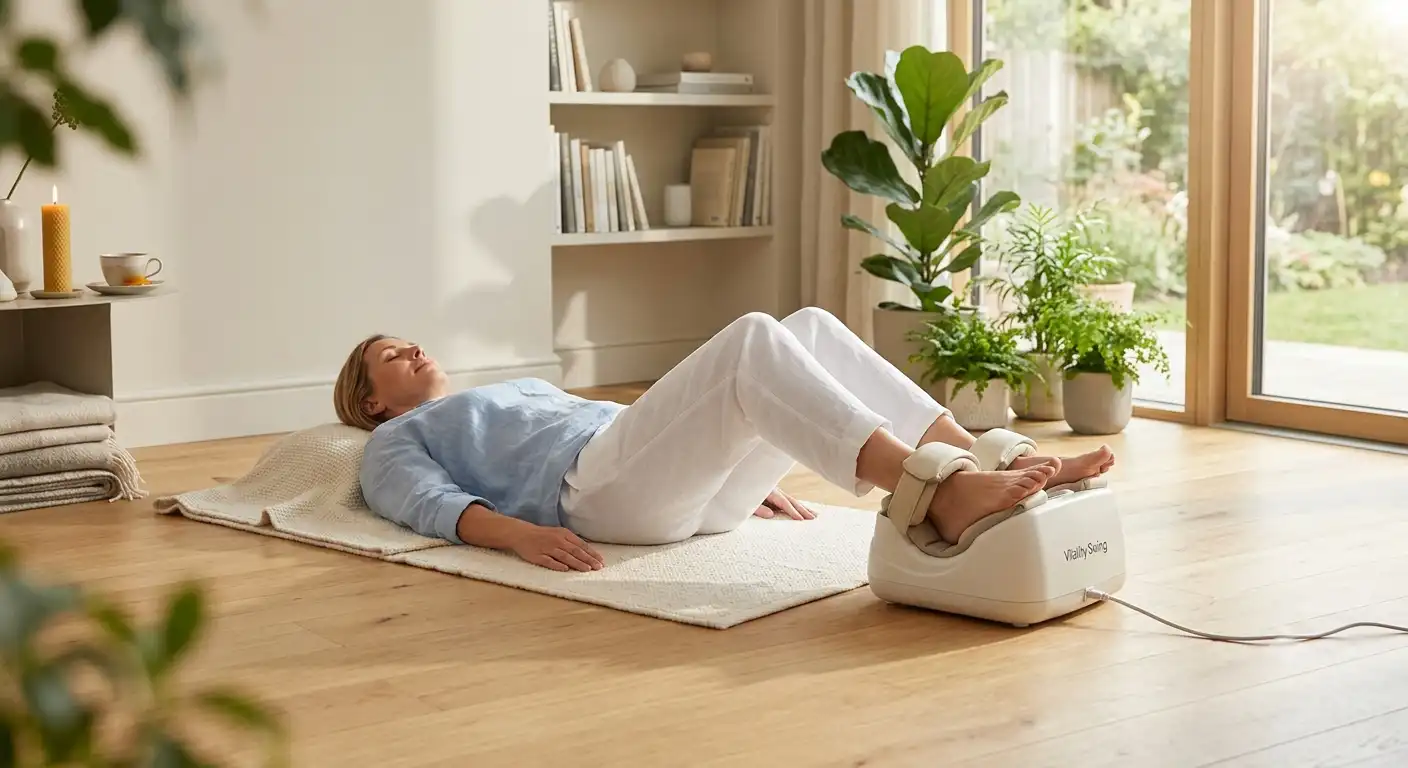
How Chi Machines Support Relaxation and Balance
- A chi machine moves your legs and hips in a passive, side-to-side oscillation (roughly 144 cycles per minute) that requires no effort from you
- The rhythmic motion helps shift the nervous system toward a calmer, parasympathetic state, similar to the effect seen in slow, repetitive practices like Tai Chi
- Regular use can support core and hip stability, which plays a role in balance and fall prevention for older adults
- Because it’s done lying down with no bending or twisting, it’s often considered a gentler option for people managing back pain or nerve sensitivity
- Most people start with short 5-15 minute sessions and build up gradually rather than expecting instant results
If you’re dealing with a tense lower back, restless nights, or a growing worry about losing your footing, you’re probably looking for something gentle that won’t ask more of your body than it can give. A chi machine answers that need directly: you lie on your back, place your ankles in the cradle, and the machine oscillates your legs from side to side in a smooth, wave-like motion — no muscle effort, no impact, no bending required. That passive rocking is what makes it relevant to both relaxation and balance. It relaxes tight muscles and calms an overactive nervous system while also engaging the hips and core in a way that supports the stability older adults and people with nerve-related conditions often need to work on. Here’s how the mechanism works, what the supporting research says, and how to use one sensibly.
What Happens in Your Body During a Chi Machine Session
When you lie down and rest your ankles on a chi machine, the device swings your legs left and right at a steady, fixed pace — commonly cited at around 144 cycles per minute — creating a rhythmic, fish-like motion that travels up through the hips and spine. Because the movement is passive, your muscles don’t have to contract to produce it; instead, they’re carried through a repeated range of motion while staying relaxed.
This has two immediate physical effects. First, the oscillation encourages blood flow through the legs and lower body, since the alternating compression and release acts a bit like a gentle pump. Second, the swinging motion mildly massages the muscles along the spine, hips, and abdomen, which is where a lot of people carry chronic tension without realizing it. Because none of this requires you to hold a position or push against resistance, it’s accessible even on days when standing exercise feels like too much.
How the Rhythmic Motion Promotes Deep Relaxation
The relaxation effect of a chi machine isn’t just about loosening tight muscles — it’s also about what steady, repetitive movement does to the nervous system. Research on mind-body practices with a similar rhythmic quality, such as Tai Chi, has found that slow, coordinated movement can help activate the parasympathetic nervous system, the branch responsible for rest-and-digest functions, while dialing down the fight-or-flight response that keeps so many people in a low-grade state of tension.
A chi machine works on a related principle, but it removes even the small cognitive load of coordinating movement yourself. You simply lie still and let the rocking motion happen, which many users describe as similar to being gently swayed — a passive input that’s easier to sink into than active exercise, especially if joint pain or fatigue makes traditional workouts unappealing. Ten to fifteen minutes of this steady motion is often enough to feel a noticeable drop in muscular tension by the end of a session.
Balance, Vestibular Function, and Why It Matters As You Age
Balance isn’t a single skill — it’s the coordinated output of your vestibular system (inner ear), proprioception (your body’s sense of position), and muscle strength around the hips and core. As people age, these systems tend to become less finely tuned, which is a major reason falls remain such a common cause of injury among older adults.
Balance training research offers a useful frame here: one study on older adults found that structured balance work over 11 to 12 weeks, done three times a week, meaningfully improved postural control by reducing overactive proprioceptive feedback and helping restore more accurate vestibular orientation. A chi machine doesn’t replace dedicated balance training, but its rhythmic hip and pelvic motion does engage some of the same stabilizing muscles — particularly through the core and hips — in a low-risk, seated-or-lying position where there’s no danger of losing your footing. For someone who is hesitant to attempt standing balance exercises alone, this can be a reasonable way to keep those muscles engaged while building confidence toward more active balance work later.
Chi Machines and Sleep Quality
Poor sleep and muscle tension tend to feed each other — a tight back or restless legs make it harder to fall asleep, and poor sleep in turn leaves muscles more reactive to stress the next day. This is one reason many chi machine users report using it in the evening rather than the morning.
Direct clinical research on chi machines and sleep is limited, but the underlying mechanism has support from related research on rhythmic, low-impact movement. A 12-week randomized controlled trial on Tai Chi found that its slow, repetitive movement improved slow-wave activity during deep sleep in older adults with mild insomnia, likely by calming cortical excitability and shifting the nervous system toward rest. A chi machine’s passive oscillation draws on a similar rhythmic principle, which is why a short session before bed is often used as a wind-down ritual rather than a stimulating workout.
A Gentle Option for Back Pain and Nerve Sensitivity
For people managing chronic back pain or nerve-related discomfort — sciatica, neuropathy, or general nerve sensitivity — many conventional exercises are ruled out simply because they involve bending, twisting, or bearing weight through a painful area. A chi machine sidesteps that problem almost entirely: you lie flat, your spine stays neutral, and the only motion is a gentle side-to-side sway carried by the machine itself.
This matters because the oscillation still delivers a mild massaging effect along the lower back and hips without asking the spine to flex or rotate — the movements that most often aggravate an already sensitive back or pinched nerve. It’s worth being clear-eyed about the limits here: a chi machine won’t correct a structural back problem, and anyone with a diagnosed spinal condition, recent surgery, or acute nerve pain should check with a doctor or physical therapist before adding it to a routine. Used as a supplementary relaxation tool rather than a treatment, though, it fills a gap that few other gentle options address as directly.
How to Use a Chi Machine for Relaxation and Balance Support
Getting the most out of a session comes down to a few simple habits rather than any complicated routine.
Start with shorter sessions of 5 to 10 minutes, particularly in the first couple of weeks, and let your body signal whether it’s ready for more. Lie flat on your back with your arms relaxed at your sides or resting on your abdomen, and place your ankles securely in the cradle so the swing feels smooth rather than jerky. Breathing slowly through the session — rather than holding your breath or tensing in anticipation of the motion — helps the parasympathetic response kick in faster.
Evening use tends to suit people focused on sleep and tension relief, while a short morning session can help ease stiffness before the day starts. Either way, consistency matters more than duration: a daily 10-minute habit tends to produce more noticeable relaxation and stability benefits than one long session used sporadically.
What to Expect in the First Few Weeks
It’s worth setting realistic expectations from the start. Most people notice the relaxation effect first — a looser lower back, less tension across the shoulders, or an easier time falling asleep — often within the first one to two weeks of regular use. Balance-related benefits tend to develop more gradually, since they depend on the hips and core adapting to repeated engagement over time rather than a single session producing a noticeable shift.
If you’re using a chi machine specifically to support balance alongside age-related concerns, it’s reasonable to pair it with dedicated balance exercises — single-leg stances, heel-to-toe walking, or a program recommended by a physical therapist — rather than relying on it as a standalone fix. Think of the chi machine as the gentle, low-effort layer of a broader routine, not a replacement for targeted strength or vestibular work when that’s what’s actually needed.
How long should a chi machine session last for relaxation?
Most people start with 5 to 10 minutes and gradually extend to 15 minutes as their body adjusts. Longer isn’t necessarily better — short, consistent daily sessions tend to produce more reliable relaxation than occasional long ones.
Can a chi machine help with balance problems in older adults?
It can support the hip and core muscles involved in balance, but it works best alongside dedicated balance exercises rather than as a standalone solution for diagnosed balance disorders.
Is a chi machine safe to use with chronic back pain?
Many people with back pain find it comfortable because it doesn’t require bending or twisting, but anyone with a diagnosed spinal condition or recent injury should check with a doctor before starting.
How often should I use a chi machine each week?
Daily short sessions of 10 minutes are generally more effective for relaxation and gradual balance support than infrequent, longer sessions.
Can a chi machine improve sleep quality?
Many users find that an evening session helps them wind down and fall asleep more easily, likely through the same nervous-system-calming effect seen with other slow, rhythmic movement practices.
Does a chi machine work like Tai Chi for relaxation and balance?
The two share a similar principle — slow, repetitive movement that calms the nervous system — but a chi machine is fully passive, while Tai Chi actively trains balance and coordination through movement you control yourself.
Are there any side effects of using a chi machine?
Some people feel mildly dizzy or nauseated after their first few sessions, which usually settles as the body adjusts; starting with shorter sessions helps minimize this.
Sources
- Chi Machine and its Important Benefits (Austin Ozone)
- Balance Training Enhances Vestibular Function and Reduces Overactive Proprioceptive Feedback in Elderly
- Tai Chi exercise improves sleep quality in older adults with mild insomnia (Frontiers in Physiology)
See also