
Chi Machine Technology Explained: How the Swing Motion Actually Works
- A Chi Machine oscillates the ankles side to side in a figure-eight motion, at speeds ranging from roughly 90 to 160 swings per minute depending on the model.
- The original design ran at a fixed 140–144 swings per minute; newer digital models let you adjust speed manually or shift automatically through a session.
- Comfort features — padded rubber ankle cradles, quiet motors, and 15-minute auto shut-off timers — make the technology gentler on aging joints and sensitive nerves than active exercise equipment.
- Build quality varies widely between brands, so motor durability, cradle padding, and timer precision are the real technical differences worth comparing.
- Session length should start at 2–3 minutes and increase gradually, which is a direct result of how the oscillation mechanism affects the inner ear and spine.
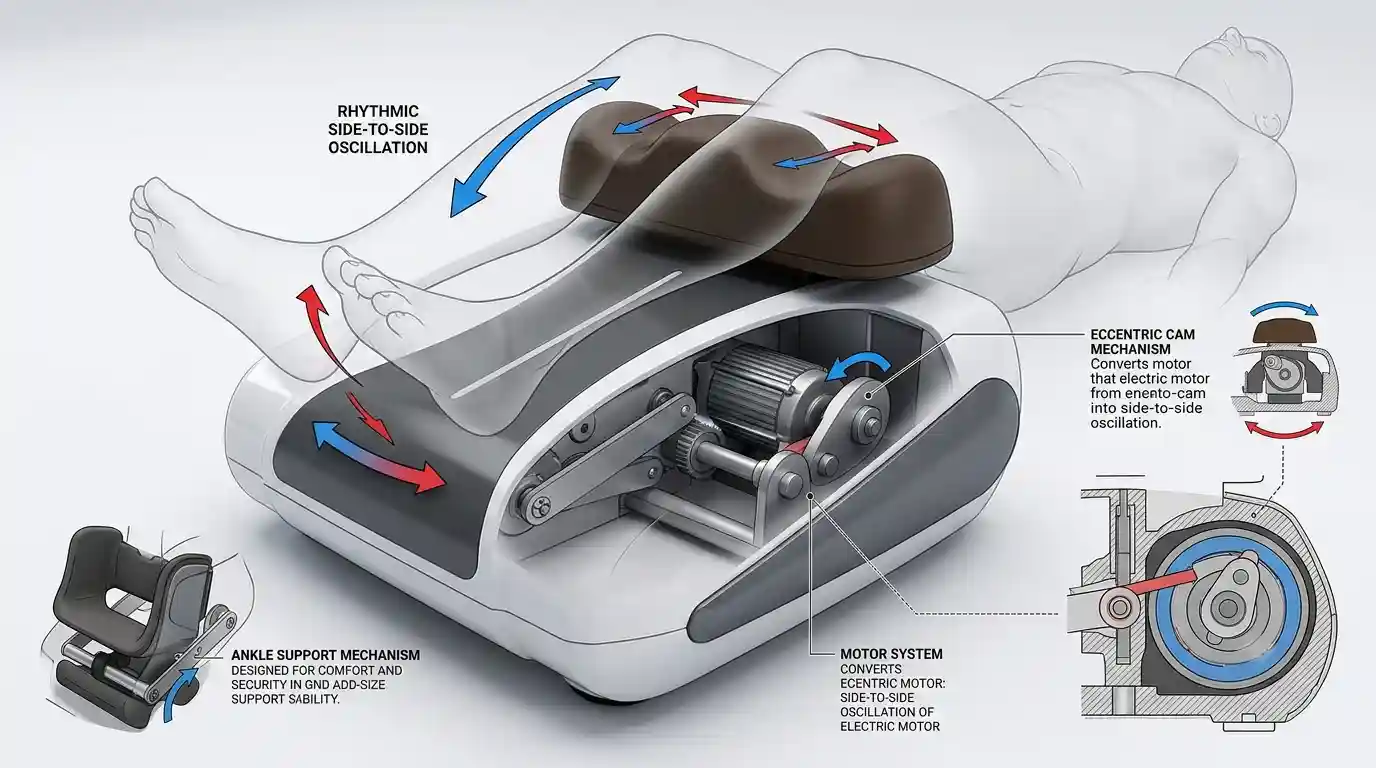
A Chi Machine works by mechanically swinging your ankles from side to side while you lie on your back, producing a wave-like motion that travels up through the legs, hips, and spine without any muscular effort on your part. The technology behind this movement — a motor-driven cradle, an adjustable oscillation speed, and a figure-eight swing pattern — is what separates a good Chi Machine from a cheap imitation, and it’s also what determines whether the machine feels relaxing or jarring for someone with back pain, nerve sensitivity, or age-related joint stiffness. This article breaks down exactly how the mechanism is built, what the speed settings mean in practice, and why the engineering choices matter more than the marketing language around “chi” and “energy.”
What a Chi Machine Actually Does, Mechanically
Strip away the branding and a Chi Machine is a compact motorized cradle, roughly the size of a briefcase, that holds your ankles and moves them left and right in a rhythmic pattern. You lie flat on the floor or a mat, rest your ankles in the padded cradle, and the motor takes over. There is no pedaling, no muscle contraction, and no impact — the machine does 100% of the work.
The motion is not a simple side-to-side rock. It’s engineered as a figure-eight swing, sometimes described in Japanese wellness circles as the “goldfish” motion because it resembles a fish flexing its tail. This shape matters mechanically: a straight lateral swing would only move the hips, but the figure-eight pattern transmits motion up through the pelvis and lumbar spine, which is why users describe the sensation as a full-body wave rather than just leg movement.
The Motor and Drive Mechanism
Inside the housing sits an electric motor connected to a crank or cam mechanism that converts continuous rotation into the back-and-forth swinging motion of the ankle cradle. Motor power on well-built units is typically in the 40-watt range — enough torque to move an adult’s legs smoothly without straining or overheating during repeated daily use.
The quality of this drive system is the single biggest differentiator between a Chi Machine that lasts for years and one that fails within months. Cheaper units use lighter plastic gears that wear down under the constant back-and-forth load, producing a grinding noise or an uneven swing after a few months of regular use. Better-built models pair the motor with reinforced gearing and often carry a multi-year warranty as a signal of that durability — some manufacturers back their units for two years, which is a reasonable benchmark when comparing machines.
Speed Settings and What They Mean
The original Chi Machines, including the classic Sun Ancon design, ran at a single fixed speed of around 140 to 144 swings per minute. That number wasn’t arbitrary — it was chosen because it approximated a natural walking or breathing rhythm — but a fixed speed also meant the machine was too fast for some users and too slow for others, with no way to adjust.
Modern digital models solve this with variable speed dials, typically offering a range from about 90 swings per minute at the slowest setting up to 160 at the fastest. On many machines, the mid-range setting (often labeled around speed 16 on a 20-point dial) reproduces the original 140-swing-per-minute rhythm, while lower settings are aimed specifically at people who find that pace jarring on the lower back or hips.
Some units go further with automatic speed variation: rather than holding one constant speed, the machine gradually cycles through different speeds over the first several minutes of a session, starting at the slowest setting and building up. This is meant to let the body adjust before reaching a more vigorous swing, which is particularly relevant for anyone whose nervous system is sensitive to sudden repetitive motion.
Why this matters for older users: a slower swing (90–110 per minute) produces a gentler, lower-amplitude sway that is easier to tolerate for people with vertigo sensitivity, spinal fusion, or general frailty, while a brisker pace suits people using the machine for circulation and want a more stimulating session.
Timer Technology and Automatic Shut-Off
Early Chi Machines used mechanical, ticking egg-timer style controls, which some users found distracting during what was supposed to be a relaxation session. Current models have largely replaced this with silent digital timers, most commonly set to a 15-minute session with automatic shut-off.
The auto shut-off serves two purposes beyond convenience. First, it prevents overuse — Chi Machine sessions are meant to be short and are not designed for continuous use over long periods. Second, it removes the need for the user to remember to turn the machine off, which matters for an audience that may have memory difficulties or simply falls into a relaxed, drowsy state during use. On better models, the digital timer also allows speed changes mid-session or an early stop, without needing to reset the whole cycle.
Ankle Cradle Design and Build Materials
The ankle cradle is the only point of physical contact between the user and the machine, so its design directly affects comfort during a session. Standard cradles use molded, padded rubber shaped to cup the ankle and heel without pinching. Higher-end models offer removable, washable covers — some brands now offer optional sheepskin covers as an add-on for extra cushioning, which matters for users with thin skin, poor circulation, or sensitivity around the ankle bone.
The frame itself is generally a rigid plastic or metal housing designed to stay stationary on the floor while the internal cradle mechanism moves. A stable, non-slip base is a small but important detail: a machine that shifts or rocks on hard flooring during use undermines the whole point of a smooth, controlled swing, and can be a genuine fall or strain risk for a user getting up afterward.
From Fixed-Speed Originals to Digital Bodywave Models
It helps to think of Chi Machine technology in two generations. The first generation — models like the original Sun Ancon and early Daiwa units — used a single motor speed, mechanical timers, and a simpler swing arm. These machines are still sold and used today, valued for their mechanical simplicity and lower price point.
The second generation, sometimes marketed under names like “Bodywave” or “Vitalizer,” added the features described above: variable speed dials, digital silent timers, automatic speed progression, and remote controls that let a user adjust the session without bending down or reaching for the unit. For someone with limited mobility or back pain, a wired or wireless remote is a genuinely practical upgrade — it means adjusting the machine doesn’t require getting up or twisting to reach a control panel on the unit itself.
Why This Technology Suits Seniors and People with Back or Nerve Conditions
The appeal of Chi Machine technology for older adults and people managing back or nerve pain comes down to one design principle: it produces movement without effort or impact. Unlike a treadmill, stationary bike, or resistance exercise, nothing here requires the user to push, pull, balance, or bear weight. You lie down, place your ankles in the cradle, and the mechanism handles the entire motion.
This passive design is why the technology is often recommended as a way to encourage circulation and gentle mobility for people who cannot tolerate standard exercise — someone recovering from a joint replacement, living with fibromyalgia, or dealing with age-related frailty can use the machine while fully supported on the floor or a bed, with zero load on the spine or knees.
That said, the same passive, repetitive motion that makes the technology accessible is also why manufacturers build in caution. Because the machine actively moves the body rather than the body moving itself, it’s not free of contraindications: it should be avoided in the weeks following surgery or a bone fracture, during pregnancy, or in the presence of a serious infection, bleeding injury, or heart condition, and anyone with an existing health concern should check with a physician before starting regular sessions.
How to Use the Technology Correctly
Getting the benefit from a Chi Machine — and avoiding dizziness or soreness — depends on how you introduce your body to the motion, not just which model you buy. First-time users are generally advised to keep sessions to 2 to 3 minutes, or under a minute for anyone in poorer health, and to increase duration gradually in small increments of about 2 minutes as the body adapts to the swing. Using the machine on the slowest available speed setting for the first several sessions lets the inner ear and spine acclimate before moving to a faster swing.
Two short sessions per day — for example, one in the morning and one in the evening — is a commonly recommended pattern once a user is accustomed to the motion, rather than one long session. This also fits naturally with the 15-minute auto shut-off built into most digital models, which effectively caps a single session at a sensible length without any extra thought required from the user.
What to Actually Compare When Choosing a Model
Marketing copy around Chi Machines tends to emphasize “chi,” “energy flow,” and vague wellness language, but the technical specifications are what actually determine whether a machine performs well and lasts. When comparing models, focus on four concrete things: the speed range and whether it’s adjustable, the type of timer (silent digital versus mechanical), motor build quality and warranty length, and the ankle cradle padding and stability of the base. A machine with a wide adjustable speed range (roughly 90–160 swings per minute) gives far more flexibility for a household where one user is elderly and another wants a brisker session, compared to a fixed-speed unit that only offers the traditional ~140-swing pace.
How many swings per minute does a Chi Machine use?
Most Chi Machines operate somewhere between 90 and 160 swings per minute, with the traditional fixed-speed models running at around 140 to 144 swings per minute. Adjustable models let you choose a slower or faster pace within that range.
What is the figure-eight motion in a Chi Machine?
It’s the specific swing pattern the ankle cradle follows, resembling the shape of a figure eight rather than a simple straight side-to-side rock. This shape is designed to transmit the motion up through the hips and lower spine, not just the legs.
How long should a Chi Machine session last?
First-time users should start with about 2 to 3 minutes, or under a minute if in poor health, and increase gradually in roughly 2-minute increments as the body adjusts. Most digital models are built with a 15-minute automatic shut-off as a practical upper limit per session.
Is a variable-speed Chi Machine better than a fixed-speed model?
For most users, yes, because it allows the swing pace to be matched to the individual rather than forcing everyone into the same 140-swing-per-minute rhythm. This is particularly relevant for elderly users or anyone with back sensitivity, who often prefer a slower setting.
What safety features does Chi Machine technology include?
The main safety features are a silent digital timer with automatic shut-off, usually after 15 minutes, and on some models an automatic speed progression that starts slow and gradually increases rather than starting at full speed. Padded ankle cradles also reduce pressure on the ankle joint during use.
Who should avoid using a Chi Machine?
People should avoid the machine in the weeks following surgery or a bone fracture, during pregnancy, or if they have a serious infection, a bleeding injury, or a heart condition. Anyone with an existing medical condition should check with a physician before starting regular use.
How often can you use a Chi Machine?
A common pattern is two short sessions per day, such as once in the morning and once in the evening, rather than one long session. This fits naturally with the short, timer-limited sessions the technology is designed around.
Sources
- Chi Machine | Yogareal
- Chi Machine and its Important Benefits — Austin Ozone
- Chi Swing Machine Benefits for Health and Wellness — Dr. Hugh Wegwerth
- How to Use the Chi Machine — wikiHow
- The 9 Best Chi Machines of 2026 — PickBest
See also