
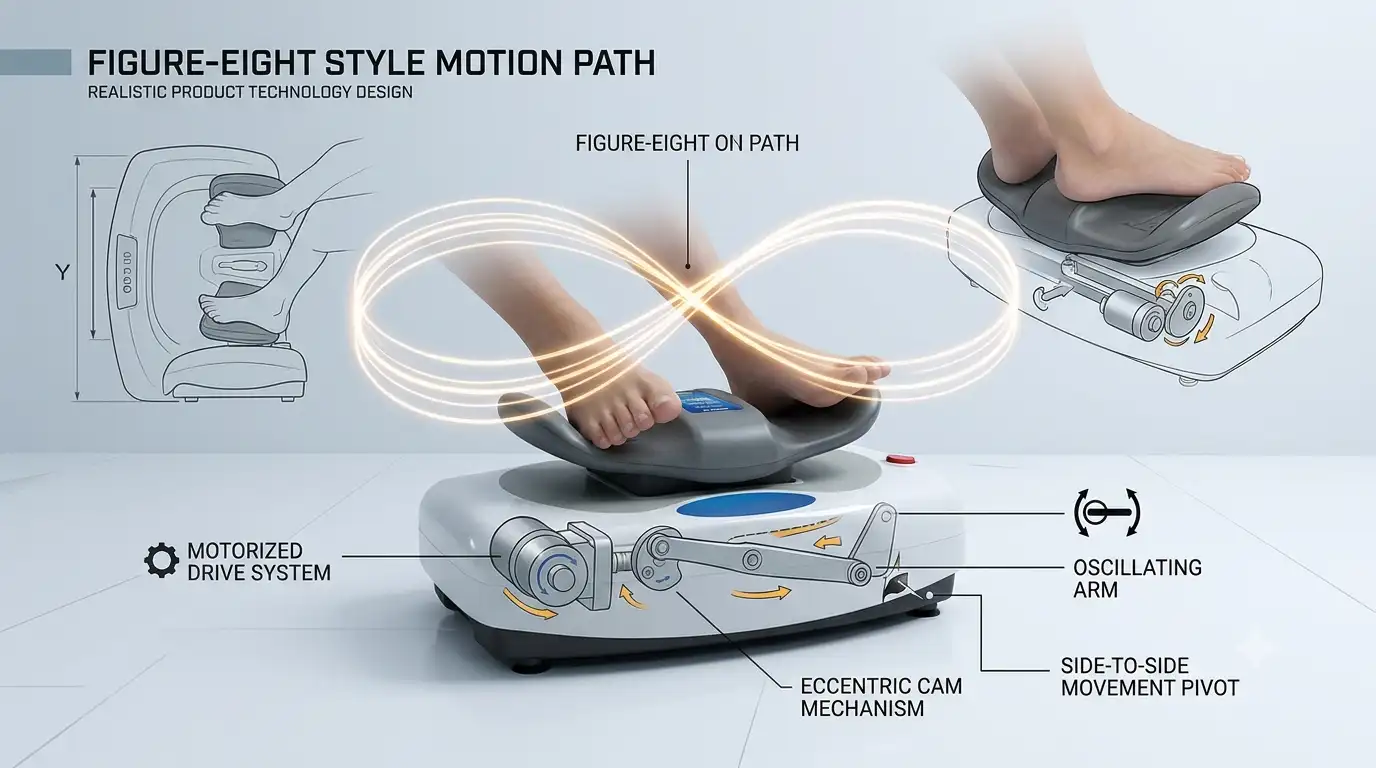
How Chi Machine Oscillation Works: The Figure-Eight Motion Explained
- Chi Machine oscillation moves the body in a figure-eight pattern, side to side, at roughly 140-144 cycles per minute.
- The motion is rooted in the Goldfish Exercise (Kingyo Undo), a spinal technique developed by Katsuzo Nishi in the 1920s.
- Unlike standing vibration plates, the Chi Machine works while you lie flat, so joints and the spine stay fully supported.
- The rocking rhythm is associated with a shift toward the parasympathetic (“rest and digest”) nervous system response.
- Because there is no muscular effort involved, the movement is often chosen by older adults and people managing back or nerve-related discomfort.
Chi Machine oscillation is the side-to-side, figure-eight swinging motion produced when the ankles rest on the machine’s padded cradle and it moves the lower body at a steady, constant cycle rate — generally cited between 140 and 144 cycles per minute. The user lies flat on the back the whole time, so the movement passes through the hips and spine without any muscle contraction, joint loading, or impact. That combination — a fixed rhythm, a fully supported lying position, and zero effort required from the user — is why this specific kind of motion is worth understanding on its own, separately from general “chi machine benefits” claims. The rest of this article breaks down where the motion comes from, how the speed and amplitude are controlled, and what that means for people who cannot tolerate high-impact movement, including older adults and those with back or nerve-related conditions.
What “Oscillation” Actually Means on a Chi Machine
Oscillation, in this context, describes a repetitive back-and-forth movement around a central point rather than a continuous motion in one direction. On a Chi Machine, the ankle cradle swings the legs — and by extension the hips and lower spine — from one side to the other in a repeating cycle. The direction reverses at each end of the swing, which is what produces the characteristic wave-like sensation running up through the body.
This differs from linear movement (like walking) and from purely vertical vibration (like a vibration plate). The Chi Machine’s oscillation has a lateral, rocking component built into a figure-eight path, meaning the ankles don’t just move left and right in a straight line — they trace a looping pattern that mimics the way a fish moves its tail through water. That figure-eight shape is intentional: it was designed to distribute the motion evenly through the ankles, hips, and spine rather than concentrating stress at a single joint.
The Figure-Eight Motion, Step by Step
When someone lies down with their ankles resting in the machine’s cradle, the device moves the legs through a continuous figure-eight arc. As the legs swing right, the hips rotate slightly and the lower spine curves in response; as the legs swing left, the same happens in reverse. Because the motion is continuous and cyclical, the body never comes to a full stop between repetitions — it flows from one side of the arc into the next.
This is often compared to the “goldfish” movement seen in some martial arts and Japanese health traditions, where the body ripples from side to side the way a fish’s tail moves through water. The comparison is not incidental — it traces directly back to the exercise that inspired the machine in the first place, covered in the next section.
The key detail for anyone evaluating whether this type of motion suits them is that the figure-eight path keeps movement horizontal and low to the ground. There is no vertical bounce, no jarring stop-start pattern, and no requirement to brace or stabilize with the core or limbs. The body is simply carried through the arc by the machine.
Where the Motion Comes From: The Goldfish Exercise
The oscillating motion used in Chi Machines did not originate with the machine itself. It traces back to Katsuzo Nishi, who developed a system of health exercises in Japan in the 1920s known as Nishi Shiki. One of its core movements, Kingyo Undo — literally the “Goldfish Exercise” — involved lying flat and shaking the body horizontally from side to side to mimic a goldfish swimming, with the goal of correcting spinal alignment and stimulating circulation along the length of the spine.
Nishi developed this system after recovering from a serious illness in his youth, and the Goldfish Exercise became one of its foundational practices. The movement was later adopted into martial arts training, including aikido, through practitioners who had studied under Nishi’s method.
The idea of mechanizing this movement — so a person could receive the same fish-like spinal motion without doing the exercise manually — is credited to Dr. Shizuo Inoue, who had worked closely with Nishi. That concept was later engineered into a physical device by Keiichi Ohashi, whose designs were patented and eventually commercialized by a Japanese manufacturer. In other words, the oscillation you feel on a modern Chi Machine is a mechanical reproduction of a nearly century-old spinal exercise, not a movement pattern invented for the device itself.
Cycle Speed: Why It Stays Constant
Most Chi Machines are set to oscillate at a fixed speed, commonly cited as around 140 to 144 cycles per minute. This number represents how many full left-right cycles the machine completes in sixty seconds, and it is generally not something the user adjusts on a basic model — the rhythm stays constant throughout a session.
The reasoning behind a fixed, non-variable speed is straightforward: an inconsistent or fluctuating rhythm would disrupt the smooth, wave-like sensation the motion is meant to produce, and could make the movement feel jarring rather than rhythmic. A steady cycle rate keeps the swing predictable from the first second of a session to the last, which matters for anyone who is sensitive to sudden changes in movement, including people managing vertigo, balance issues, or spinal discomfort.
Some higher-end or therapy-oriented models allow speed adjustment, letting the rhythm be slowed for a gentler experience or increased slightly for a brisker one. But even on adjustable units, the appeal of the technology rests on rhythmic consistency rather than variable intensity — this is a passive, steady-state motion, not an interval-style workout.
Amplitude Matters as Much as Speed
Cycle speed gets most of the attention, but amplitude — how far the ankles swing from one side to the other — also shapes how the motion feels and what it does. In whole-body vibration research more broadly, amplitude is defined as half the distance between the highest and lowest points of the moving platform, and it plays a measurable role in how much muscle activation and neuromuscular response a given vibration produces. Lower-amplitude, higher-frequency setups tend to produce a gentler stimulus with less abrupt muscle engagement, while larger swings create a more pronounced rocking sensation.
The Chi Machine’s oscillation sits on the gentler end of that spectrum by design. The swing is a smooth, contained arc rather than a wide, forceful throw of the legs, which keeps the sensation closer to a rocking motion than to a vigorous shake. This is part of why the device is frequently positioned as a passive, low-intensity option rather than a fitness or strength tool — the amplitude is calibrated for comfort and circulation rather than muscular output.
What Happens in the Body During Oscillation
The rocking motion travels from the ankles through the legs and into the hips and lower spine, and a few physiological responses are commonly associated with this kind of passive movement.
Circulation and lymphatic flow. Repetitive rhythmic movement through the legs is understood to support venous return — the process of blood moving back toward the heart from the lower body — and to encourage lymphatic drainage, since the lymphatic system relies on movement rather than a dedicated pump to circulate fluid. For someone who spends long periods sitting or lying down, this kind of passive movement offers a way to stimulate that flow without standing or exerting effort.
Spinal and muscular relaxation. Because the oscillation moves the hips and lower spine through a gentle side-to-side arc, it is associated with allowing tight muscles around the lower back to release tension gradually, rather than through active stretching or exercise. This passive quality is a large part of its appeal for people who cannot comfortably perform active spinal mobility work.
Nervous system response. Passive, rhythmic rocking is linked to a shift toward the parasympathetic nervous system — the branch of the autonomic nervous system responsible for the “rest and digest” state, as opposed to the sympathetic “fight or flight” response. This is the same mechanism behind why rocking chairs and gentle swaying are widely used to calm the body: predictable, repetitive motion signals safety to the nervous system, which can translate into reduced tension and a calmer physical state during and after a session.
None of these responses require any effort from the user — they are a byproduct of lying still and allowing the machine to move the body through its fixed rhythm.
Chi Machine Oscillation vs. Vibration Plate Vibration
Chi Machines and vibration plates are sometimes grouped together because both use mechanical movement to stimulate the body, but the type of motion is fundamentally different.
A vibration plate works while standing (or sometimes seated), sending rapid, mostly vertical vibrations up through the feet and legs. This requires the muscles of the legs, hips, and core to continuously stabilize the body against the vibration, which is part of why vibration plates are marketed for muscle activation and strength-adjacent benefits. Vibration plate frequencies used in research settings commonly fall in a range far higher than a Chi Machine’s cycle rate, and the intensity can vary significantly between consumer and research-grade devices.
A Chi Machine, by contrast, works entirely while lying down. The body remains fully supported by the floor or a mat, and the oscillation is horizontal and low-amplitude rather than vertical and rapid. There is no need to balance, brace, or stand, which removes the stabilization demand that vibration plates place on the legs and core.
For someone who cannot safely stand on a vibrating surface — because of balance concerns, joint pain, or limited mobility — this distinction is the deciding factor. The Chi Machine’s lying-down design allows the circulatory and relaxation effects of rhythmic movement to be accessed without any standing balance requirement at all.
Why This Type of Motion Suits Older Adults and People With Back or Nerve Issues
The specific characteristics of Chi Machine oscillation — constant speed, contained amplitude, horizontal direction, and a fully supported lying position — line up closely with what is generally recommended for people who need gentle, low-impact movement options.
No standing balance required. Because the entire session takes place lying flat, there is no risk of losing balance the way there might be on a standing platform. This matters directly for older adults, for whom fall risk is a significant concern with many exercise devices.
No active muscle bracing. People managing nerve-related discomfort — including sciatica-type nerve irritation or general nerve sensitivity — often find that active exercise aggravates symptoms because it requires sustained muscle contraction. Passive oscillation removes that requirement; the muscles are along for the ride rather than doing the work.
Predictable, non-jarring rhythm. A fixed cycle speed with a smooth figure-eight path avoids the sudden starts, stops, and impacts that can aggravate an already sensitive spine or joint. For someone recovering from a back injury or managing chronic lower back tension, this predictability can make the difference between a movement that feels safe and one that feels risky.
Support for circulation without exertion. For people with limited mobility, sitting or lying for extended periods without much movement can slow circulation. Passive oscillation offers a way to stimulate blood flow through the legs and lower body without requiring standing, walking, or active exercise.
This is not a substitute for medical treatment or physical therapy, and anyone with a diagnosed spinal condition, recent surgery, or nerve disorder should confirm with a healthcare provider before starting sessions. But as a category of movement, low-amplitude, lying-down oscillation is generally considered gentler than most alternatives that involve standing, bracing, or muscular effort.
What a Typical Oscillation Session Feels Like
A session usually starts with lying flat on the back — on the floor, a firm mat, or a bed — and placing both ankles into the padded cradle at the base of the machine. Once switched on, the machine begins its figure-eight swing at its fixed cycle speed, and the sensation travels upward from the ankles into the hips and lower back within the first few seconds.
Sessions are typically kept short, often in the range of a few minutes at a time, since the rhythmic motion can produce a mild sense of disorientation similar to being on a boat if continued for too long, particularly for first-time users. Starting with a brief session and a slower speed setting (where available) allows the body to adjust to the sensation before extending session length.
Throughout the session, the arms and upper body stay relaxed and still, with all the movement concentrated in the legs, hips, and lower spine. Because no muscular effort is involved, many users close their eyes and let the steady rhythm continue uninterrupted, which is part of what supports the calming, parasympathetic-leaning response discussed earlier.
What speed does a Chi Machine oscillate at?
Most Chi Machines run at a fixed cycle speed of roughly 140 to 144 cycles per minute. This rate typically stays constant throughout a session, though some higher-end models allow it to be adjusted.
What is the figure-eight motion on a Chi Machine?
It’s the looping side-to-side path the ankle cradle traces as it swings, which carries the hips and lower spine through a smooth wave-like arc rather than a straight left-right movement.
Is Chi Machine oscillation the same as vibration plate vibration?
No. A vibration plate produces rapid vertical vibration while you stand, requiring the legs and core to stabilize. A Chi Machine produces horizontal oscillation while you lie flat, with the body fully supported the entire time.
Where does the Chi Machine’s movement pattern come from?
It’s based on the Goldfish Exercise (Kingyo Undo), a spinal movement technique developed by Katsuzo Nishi in Japan in the 1920s as part of his broader Nishi Shiki health system.
Can Chi Machine oscillation help with back discomfort?
The gentle, passive rocking motion is associated with easing tension in the lower back muscles and supporting circulation without requiring active movement, which is why it’s often chosen by people who find standing exercise uncomfortable. It isn’t a treatment for diagnosed spinal conditions.
Is this type of oscillation safe for older adults?
The lying-down position and lack of standing balance requirement make it a gentler option compared to standing exercise equipment, which is part of why it’s commonly used by older adults. Anyone with a specific medical condition should check with a healthcare provider first.
How long should a session last?
Sessions are often kept short, especially at first, since the rhythmic swinging motion can feel mildly disorienting to new users. Starting with just a few minutes and building up gradually is the typical approach.
Does the amplitude of the swing matter, not just the speed?
Yes. Amplitude — how far the legs swing side to side — affects how strong the sensation feels and how much the surrounding muscles engage. Chi Machines use a contained, low amplitude by design, which keeps the motion gentle rather than forceful.
Sources
- Chi Machine and its Important Benefits — Austin Ozone
- Where did the Chi Machine concept originate? — Energy for Health
- History of the Goldfish Fish Exercise (Kingyo Undo) — Daiwa Felicity
- Nishi Shiki — Wikipedia
- The Clinical Utility of Whole Body Vibration — PMC
- Vibration Plates and Chi Machines Supporting Healing — Connective Integration Massage Therapy
- Use the Parasympathetic Nervous System to Lower Stress — HSS
See also