
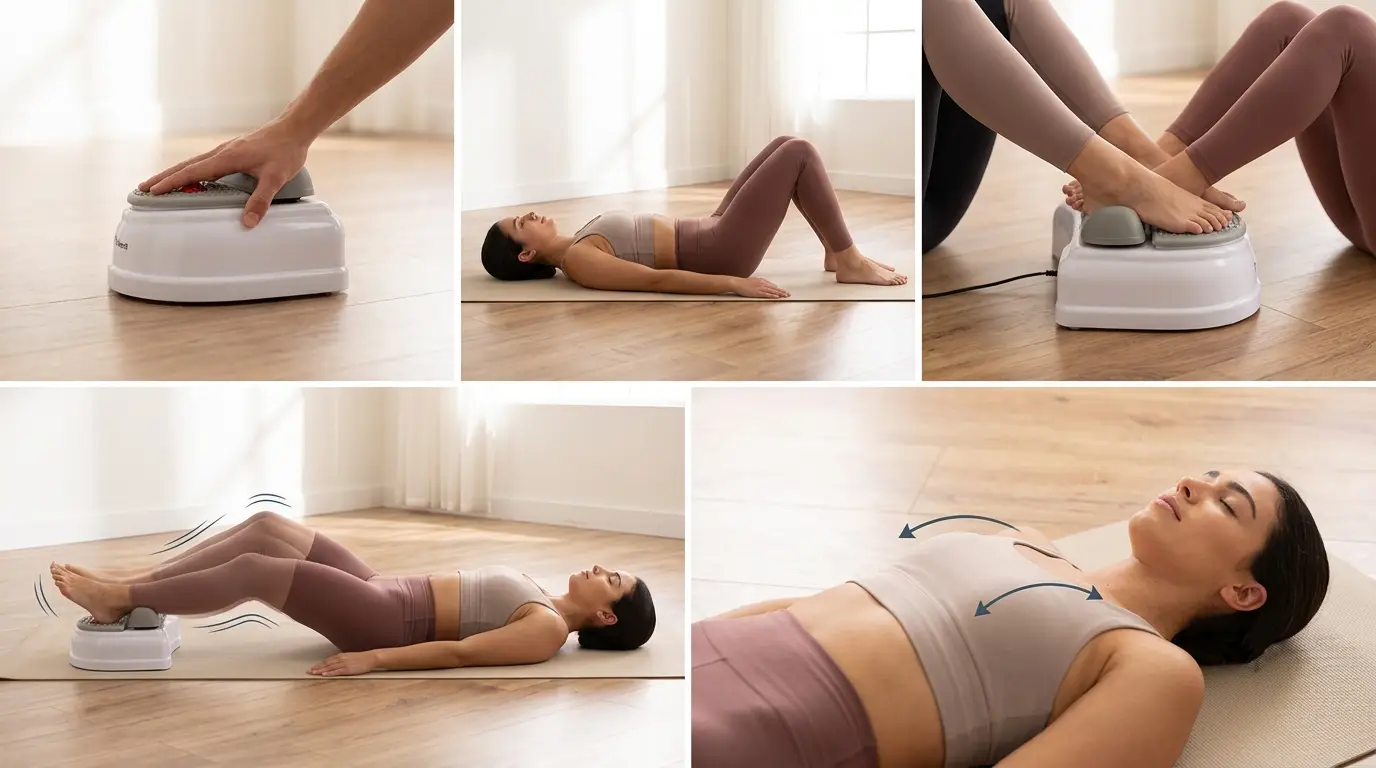
What Happens During a Chi Machine Session? Step-by-Step Guide
- A typical Chi Machine session lasts between 2 and 15 minutes, starting at 2-3 minutes for beginners
- You lie on your back, ankles resting on the cradle, while the machine gently swings your legs side to side
- The motion mimics a fish-like wiggle at roughly 140-144 cycles per minute, moving the whole spine without impact
- Most people feel warmth, tingling, or a light rush of energy in the legs once the machine stops
- People with back pain, nerve issues, or limited mobility often tolerate it well because it requires no muscular effort
During a Chi Machine session, you lie on your back with your ankles resting in a padded cradle while the device rocks your legs from side to side in a smooth, wave-like motion, usually for somewhere between 2 and 15 minutes. Nothing about the process demands strength, balance, or coordination: the machine does the movement, your body simply follows it. For someone dealing with a stiff lower back, sciatic pain, or age-related mobility limits, that passive quality is often the main appeal. Below is what actually happens minute by minute, what sensations to expect, and how the experience differs for first-time users versus those who have used the machine for weeks.
Before You Turn It On
A few small preparation steps shape how the session feels, and skipping them is the most common reason people report discomfort.
Start by drinking a small glass of water. This isn’t a wellness ritual for its own sake — the oscillating motion is thought to encourage lymphatic movement and circulation, and being adequately hydrated beforehand makes that process more comfortable. Place the machine on a firm, flat surface with the handle facing away from you, and check that there’s clear space underneath it for the mechanism to move freely.
Before lying down, take thirty seconds to stretch your lower back. If you have any knee or low back sensitivity, slide a pillow under your knees. It won’t interfere with the machine’s motion, and it removes a lot of the strain that comes from lying flat on a hard floor, which matters more for older adults or anyone with an already sensitive spine.
Getting Into Position
Lie down on your back and center your body with the machine, using the arrow or centerline marking as a guide, with a leg on each side. Rest the back of each calf on the cradle, just above the ankle bone — not directly on the joint itself — leaving your feet free to hang slightly over the edge so they can move without restriction.
Arm position is where sessions genuinely diverge depending on what you’re targeting:
- Stretched back position — both arms extended straight overhead, often chosen for shoulder tension or general muscle release
- Mid position — hands resting under the head, which slightly lifts the upper body and legs off the floor
- Goldfish position — arms resting flat at your sides, the most neutral and commonly recommended starting point, particularly for tension, sleep issues, or general relaxation
For someone new to the machine, or dealing with back pain, the goldfish position is usually the easiest to start from since it keeps the spine flat and the muscles as relaxed as possible.
The Machine Turns On
Once you switch on the timer, the cradle begins moving your ankles side to side in a steady, repeating arc. The motion travels up through the legs and hips into the spine, producing a gentle full-body sway often compared to the way a fish moves its tail — which is exactly the reference point used in the original design of the device.
The pace is fixed rather than adjustable in intensity on most models, running at a consistent rhythm of roughly 140 cycles per minute. That consistency is intentional: an uneven or variable speed would interrupt the wave pattern moving through the body and reduce the smoothness of the effect. Your job during this phase is simply to stay loose. Tensing your legs or trying to “help” the machine move actually works against it — the benefit comes from letting the motion pass through a relaxed body rather than resisting it.
Breathing matters here too. A commonly used pattern is inhaling for a count of seven, holding briefly for a count of four, and exhaling slowly for a count of eight. The exact numbers aren’t the point — what matters is keeping the breath slow and rhythmic rather than shallow, since shallow breathing tends to keep the shoulders and neck tense even while the legs are moving freely.
How Long a Session Actually Lasts
Duration is the single biggest variable between a first session and a tenth one.
First-time users are generally advised to keep the session to 2-3 minutes. If you’re currently dealing with a health condition or general fatigue, starting under 1 minute is reasonable. From there, increases happen gradually — typically in 2-minute increments — once your body has adjusted to the sensation of the swing.
Regular users often settle into sessions of 10-15 minutes, sometimes used twice a day. But there’s no benefit to rushing that progression. The point of starting short isn’t caution for its own sake — the first few sessions are also how you learn whether your particular back, hips, or nervous system tolerate the motion comfortably, and that’s information worth gathering slowly.
What You Feel While It’s Running
For most first-time users, the initial seconds feel unfamiliar rather than uncomfortable — a slightly odd side-to-side pull through the hips as the body figures out how to stay loose against the motion. That novelty tends to fade within the first minute as the muscles stop bracing.
Once relaxed into it, the sensation is generally described as a gentle, repetitive massage moving through the legs, hips, and lower spine — closer to being rocked than to being exercised. Some people notice a mild warming feeling in the calves and feet as blood flow increases in the area. Nothing about a properly positioned session should be painful; a sharp or worsening pain during the movement is a signal to stop and check your positioning rather than push through it.
The Moment It Stops
The final phase — right after the timer cuts off — is often the part people remember most. Many describe a distinct rush of sensation traveling up through the legs in the seconds after the swinging stops, a kind of release now that the muscles are no longer moving with the cradle. It’s typically described as pleasant rather than jarring, closer to the feeling of blood returning to a limb after sitting cross-legged for a while.
You’re not meant to get up immediately. Staying on the floor for another 2-3 minutes lets your nervous system settle and gives your spine a moment to reorient before bearing weight again. If your feet are still resting in the cradle, you can slide them out during this pause. When you do get up, stretch your spine and hips briefly, then roll onto one side before pushing up — standing straight up from flat on your back, especially for older adults, puts unnecessary strain on the lower back and core.
A glass of water afterward closes out the routine the same way it opened it.
Why This Works Well for Seniors and Back or Nerve Pain
The appeal of a Chi Machine session for older adults or people managing chronic back or nerve pain comes down to one structural fact: it’s a passive movement. Your muscles aren’t contracting to produce the motion, which means there’s no loading on joints, no balance requirement, and no risk of the kind of strain that comes from active stretching or exercise.
For people who cannot move their limbs independently, or who are managing conditions like Parkinson’s-related stiffness or recovery after a stroke, using the machine on its lowest setting can offer some of the circulatory benefit of movement without asking the body to generate any effort. Similarly, people with cold hands and feet from poor circulation sometimes notice a warming effect in the extremities during and after use, since the motion encourages blood flow toward areas that don’t get much movement otherwise.
None of this replaces medical treatment for a diagnosed nerve or spinal condition — but the sessions being low-effort and low-impact is precisely why they’re tolerated by people who can’t do more conventional forms of movement.
When a Session Doesn’t Go Smoothly
Occasionally a session feels off rather than relaxing, and it’s worth knowing what that usually means. Sharp or worsening pain during the motion typically points to a positioning issue — ankles resting too far forward or back on the cradle, or arms in a position that’s straining an already tense shoulder. Stopping, adjusting, and trying a shorter session afterward resolves most of these cases.
The machine is generally advised against for at least three months following surgery or a bone fracture, during an active infection or bleeding injury, for anyone with heart disease, during pregnancy, or within 30 minutes of eating a full meal. If you have an existing health condition and you’re unsure whether the motion is appropriate for your situation, checking with a physician before your first session is the safer route.
What a Few Weeks of Sessions Tend to Feel Like
The single-session experience described above doesn’t change dramatically with repetition, but the after-effects tend to become more noticeable. People who use the machine regularly often describe an easier time settling down in the evening, less tension carried in the shoulders and lower back by the end of the day, and a shorter runway to that relaxed, slightly warm feeling in the legs once the session ends. None of that requires a longer session — it’s more a matter of the body recognizing the pattern faster each time.
How long should my first Chi Machine session last?
Keep it to 2-3 minutes for your very first sessions, or under 1 minute if you’re currently unwell or very deconditioned. Increase in small increments, roughly 2 minutes at a time, only once the sensation feels familiar and comfortable.
Is it normal to feel a rush of energy in my legs after the machine stops?
Yes. Many users describe a warm, tingling sensation moving up through the legs in the seconds after the swinging motion ends, which is generally described as a pleasant release rather than something concerning.
What arm position should beginners use?
The goldfish position — arms resting flat at your sides — is the easiest starting point since it keeps the spine flat and the body as relaxed as possible during the first few sessions.
Should I get up right away when the timer stops?
No. Stay on the floor for 2-3 minutes after the machine stops, then stretch your hips and spine before rolling onto your side and standing up gradually, rather than sitting up straight from flat on your back.
Can someone with back pain or limited mobility use the machine safely?
Many people managing back pain, nerve-related stiffness, or reduced mobility tolerate it well because the motion is entirely passive — no muscular effort is required. Starting at the lowest setting and shortest duration, and checking with a physician beforehand if you have a diagnosed condition, is the sensible approach.
Why does the machine always move at the same speed?
Most models run at a fixed pace of roughly 140-144 cycles per minute. The consistency is intentional — an uneven rhythm would interrupt the wave-like motion moving through the spine and reduce its effectiveness.
What should I do if a session feels uncomfortable rather than relaxing?
Stop and check your positioning first — ankles placed too far forward or back on the cradle, or an arm position straining the shoulders, are the most common causes. Try a shorter session afterward, and avoid pushing through sharp or worsening pain.
Is it safe to use the Chi Machine after surgery or with a health condition?
It’s generally advised to avoid the machine for at least three months after surgery or a bone fracture, during an active infection or bleeding injury, with heart disease, during pregnancy, or within 30 minutes of eating. Check with a physician if you have any ongoing health concern.
Sources
- How to Use the Chi Machine — wikiHow
- How to Use the Chi Machine — YouTube Transcript
- Chi Machine and its Important Benefits — Austin Ozone
- Contemplating Chi Machines? — DrWeil.com
- Vibration Plates and Chi Machines Supporting Healing — Massage & Healing DFW
- Chi Machine Houston: Benefits & Myths — Trace the Body
See also