
How Chi Machine Movement Affects the Body: Spine, Circulation, and Nerve Relief
- Chi machine movement is a passive, rhythmic side-to-side oscillation, typically around 144 cycles per minute, that moves the legs, hips, and spine without any muscular effort from the user.
- Research on similar passive and reclined motions shows reduced lumbar spine compression and improved nutrient flow to intervertebral discs, which supports spinal comfort over time.
- Lateral rocking has been shown in EMG studies to increase back and lower-back muscle activity in ways associated with reduced pain, though it is not a substitute for active exercise.
- People with limited mobility, sciatica-related discomfort, or nerve-related circulation issues often report easier movement and comfort, but the device itself has not been validated through controlled clinical trials.
- Because the motion bypasses muscular effort entirely, it is generally considered gentle enough for older adults, though anyone with a spinal condition, pacemaker, or recent surgery should check with a doctor first.
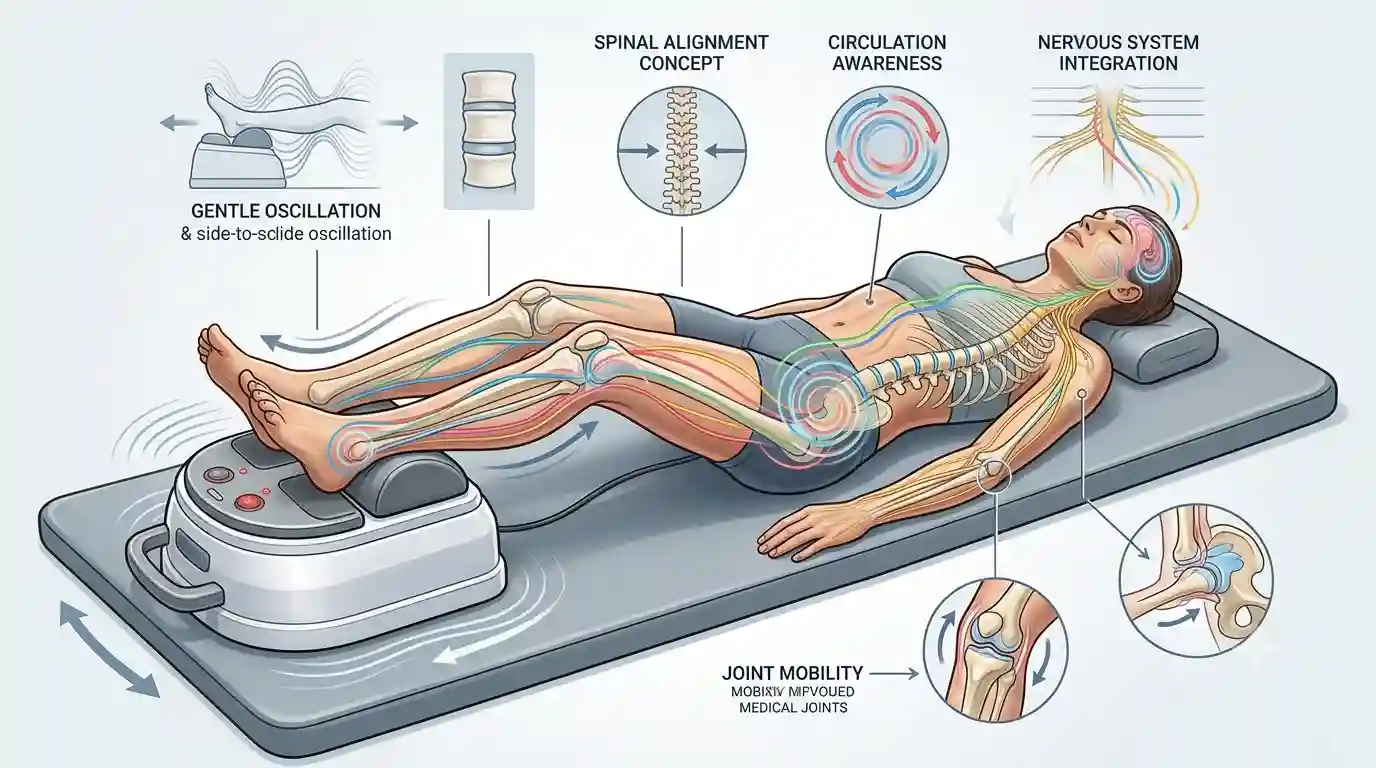
Chi machine movement affects the body by passively swinging the hips and legs from side to side, which carries a wave-like motion up through the lower back, spine, and torso. This oscillation, usually delivered at a steady pace of roughly 144 cycles per minute, requires no muscular effort from the user, which is why it is often described as a form of passive exercise. The immediate physical effects include a temporary reduction in pressure on the lumbar spine, gentle activation of stabilizing back muscles, and a rhythmic input that many people experience as calming to the nervous system. For older adults or those managing back pain, nerve discomfort, or reduced mobility, understanding exactly what this motion does — and does not do — helps set realistic expectations before adding it to a daily routine.
The Passive Rocking Motion, Explained
A chi machine works by cradling the ankles and swinging the legs left and right in a controlled, repetitive arc. Because the hips are the pivot point, the motion travels upward through the pelvis into the lumbar spine, creating a gentle lateral wave rather than a bounce or jolt. The user lies flat on the back and stays passive throughout — no muscles are contracted to produce the movement, which distinguishes it from active exercises like walking or swimming.
This distinction matters for people who cannot easily move on their own, including those recovering from a stroke, living with spasticity, or managing chronic joint pain. Passive movement of this kind does not build strength or cardiovascular fitness the way active exercise does, but it does provide mechanical input to the spine, hips, and legs that would otherwise be missing if someone spends most of the day seated or in bed.
The speed of the oscillation is kept constant by design. A steady, predictable rhythm avoids the uneven loading that can occur with jerky or inconsistent movement, which is part of why the motion is marketed as low-impact and appropriate for a wide range of ages and physical conditions.
What Happens to the Spine During the Movement
The most consistently documented effect of gentle, reclined, rhythmic motion on the spine involves a reduction in compressive load. When the body is upright, gravity continually compresses the vertebrae and the intervertebral discs between them. Early biomechanical research on reclined postures found that reclining reduces the load carried by the lumbar spine and the muscles running alongside it, compared to sitting or standing upright. Because chi machine sessions are performed lying flat, the spine starts from this lower-compression baseline before the oscillation is even added.
The side-to-side motion itself has been linked, in studies of similar passive and continuous motion, to improved nutrient flow into the intervertebral discs. Discs do not have their own direct blood supply; they rely on movement to pump fluid and nutrients in and waste products out. Research on continuous passive motion in reclined postures has documented this nutrient-pumping effect, which is part of why gentle, repetitive movement is generally considered supportive of long-term disc health, particularly for people who spend long stretches of the day immobile.
The combination of a reclined position and lateral oscillation is what separates this motion from simply lying still. Lying flat alone reduces compression, but adding rhythmic movement introduces the mechanical pumping action that static rest cannot provide. For someone with chronic lower back stiffness, this two-part effect — decompression plus gentle motion — is the core mechanism behind why the sensation is often described as relieving.
It’s worth being precise about what this does not mean. Reduced compression and improved nutrient flow are supportive effects, not corrective ones. A chi machine does not realign vertebrae, reverse disc degeneration, or replace treatment for a diagnosed spinal condition.
Effects on Muscles, Balance, and Core Stability
Beyond the spine itself, the rocking motion also engages the muscles that stabilize the trunk. Studies using electromyography (EMG) to measure lateral rocking on a tilting surface found that the rocking condition increased overall back and lower-back muscle activity, and this increase was associated with reduced reports of back and lower-back discomfort. The muscles are not working hard in the way they would during a strength exercise, but they are being asked to make small, continuous adjustments to keep the torso stable as it moves — a low-intensity form of activation that some researchers link to reduced stiffness.
This kind of rhythmic, side-to-side input also overlaps with movements studied in the context of vestibular and cerebellar activation — the brain systems responsible for balance and coordination. Rocking and rolling movements, even when performed passively, have been associated with improved spinal flexibility, core engagement, and stimulation of the balance-related structures in the brainstem and cerebellum. For older adults, whose balance and coordination naturally decline with age, this kind of gentle vestibular input may be one of the more practically relevant benefits, separate from any specific claims about the spine.
None of this replaces strength training. The core stabilization triggered by passive rocking is real but modest, and it works best as a complement to, not a substitute for, active movement like walking, stretching, or supervised strengthening exercises appropriate to the individual’s condition.
Circulation, Lymphatic Flow, and the Limits of the Evidence
Marketing materials for chi machines frequently describe the device as improving circulation, stimulating the lymphatic system, increasing oxygenation, and even aligning the spine. Some of these claims have a plausible mechanical basis — leg movement does encourage venous return, and gentle motion after long periods of stillness generally supports blood flow. Others go well beyond what has actually been tested.
Physician and wellness writer Dr. Andrew Weil reviewed these claims directly and noted that no scientific studies have validated — or disproved — assertions that the device improves organ function, strengthens the immune system, or delivers the equivalent of an extended walk in a short session. That gap between marketing language and controlled research still exists. The device is classified as a medical device in a small number of countries, including Japan, Australia, and Canada, but that classification reflects regulatory categorization, not a body of clinical trial evidence proving specific health outcomes.
The honest takeaway is that the passive motion itself has documented physiological effects — reduced spinal load, muscle activation, nutrient flow to discs — while broader claims about detoxification, organ massage, or metabolic changes remain unproven. Anyone considering a chi machine for a specific medical concern should treat it as a comfort and mobility aid, not a validated treatment, and should raise it with a healthcare provider rather than relying on it in place of medical care.
Nerve Pain, Sciatica, and Limited Mobility
For people managing sciatic nerve pain, limited mobility is often as frustrating as the pain itself. Nerve compression can make walking, stretching, or even shifting position uncomfortable, which creates a cycle where inactivity leads to further stiffness. Passive movement addresses this cycle differently than active exercise does: it introduces motion to the hips and lower back without requiring the person to bear weight or actively engage a painful area.
Clinics working with patients who have arthritis, lower back conditions, or reduced mobility describe passive movement at low intensity as a way to introduce circulation and gentle joint motion for people who otherwise cannot exercise independently — including those recovering from stroke or managing spasticity. The same gentle mechanical action is sometimes noted for people with cold hands and feet linked to poor peripheral circulation, since consistent low-level movement supports blood flow to the extremities.
This is not the same as treating the underlying cause of nerve pain. Sciatica typically stems from nerve root compression, disc issues, or muscular imbalance, and passive rocking does not address those root causes. What it can offer is a low-effort way to stay in gentle motion on days when more demanding movement isn’t realistic, which may help prevent the stiffness and deconditioning that often make nerve pain worse over time.
Rhythmic Movement and the Nervous System’s Stress Response
Independent of its mechanical effects on the spine, rhythmic movement has a well-documented relationship with the body’s stress response. Mindful, repetitive exercise is recognized as a way to trigger the relaxation response, and research on rhythmic interventions — including repetitive drumming and structured rhythmic exercise — has shown reductions in cortisol, the body’s primary stress hormone, regardless of the specific activity used.
Chi machine sessions share the core ingredients of these interventions: a steady, predictable, repetitive rhythm performed while lying still and breathing normally. For someone lying down for ten to twenty minutes with no other demand on their attention, the combination of physical rocking and enforced stillness elsewhere in the body can produce a similar calming effect to other rhythmic relaxation practices, even without any claim to a specific therapeutic mechanism.
This stress-reduction angle may be as relevant as the spinal effects for many users, particularly older adults for whom chronic pain and disrupted sleep often compound each other. Lower stress hormone levels are associated with reduced muscle tension, which can indirectly ease the very back and nerve discomfort that prompted someone to try the device in the first place.
Who Chi Machine Movement Is Best Suited For
Given what the mechanism actually does — reduce spinal compression, activate stabilizing muscles gently, support nutrient flow to discs, and provide calming rhythmic input — certain groups are more likely to notice a meaningful difference than others.
Older adults dealing with general stiffness, reduced mobility, or a sedentary daily routine are a natural fit, since the motion asks nothing of muscles that may have weakened with age. People managing chronic lower back discomfort from prolonged sitting may find the decompression effect particularly noticeable after a long day. Those with limited independent mobility, including some stroke survivors and people with spasticity, may benefit from passive movement as one of the few forms of physical stimulation available to them at a very low intensity setting. People with peripheral circulation issues, such as persistently cold hands and feet, may also notice a difference from the gentle, sustained leg movement.
It is a poorer fit as a primary tool for anyone expecting significant strength gains, weight loss, or a cure for a diagnosed spinal or nerve condition. In those cases, the device works best as one small piece of a broader plan that includes appropriate medical treatment and, where possible, active movement.
Safety Considerations Before You Start
Because the motion is passive and low-impact, chi machines are generally considered gentle, but “gentle” is not the same as “risk-free for everyone.” Anyone with a diagnosed spinal condition, a recent back or hip surgery, a pacemaker, severe osteoporosis, or a blood clotting disorder should speak with a doctor before using one, since even low-intensity motion can be inappropriate in specific medical situations.
Starting at the lowest speed and shortest duration is the safest approach for older adults or anyone with back or nerve sensitivity, with sessions gradually extended only if the motion continues to feel comfortable. Sessions are typically kept short, often in the ten-to-twenty-minute range, since the goal is gentle stimulation rather than prolonged exertion.
Finally, it helps to treat the device as a complement to medical care rather than a replacement for it. Persistent or worsening nerve pain, new numbness, or sudden changes in mobility should always be evaluated by a healthcare provider rather than managed solely through passive movement at home.
How many cycles per minute does a chi machine typically use?
Most chi machines operate at a fixed pace of around 144 cycles per minute, chosen to keep the oscillation smooth and consistent rather than variable in speed.
Can chi machine movement help with sciatica?
It cannot address the underlying nerve compression that causes sciatica, but the gentle motion may ease stiffness and support circulation for people whose mobility is otherwise limited by pain.
Does chi machine use reduce pressure on the spine?
Lying flat already reduces spinal compression compared to sitting or standing, and the added lateral rocking has been linked in research on similar passive motion to further reductions in lumbar load.
Is a chi machine safe for elderly users?
It is generally considered gentle since it requires no muscular effort, but older adults with osteoporosis, a pacemaker, recent surgery, or other medical conditions should check with a doctor before starting.
Can this type of movement replace physical exercise?
No. Passive rocking provides mechanical and circulatory benefits but does not build strength or cardiovascular fitness the way active exercise does, so it works best alongside, not instead of, appropriate physical activity.
Does the motion actually improve circulation?
The leg movement can support venous return and blood flow, particularly for people who are otherwise sedentary, though broader claims about detoxification or organ-level effects remain unproven.
How long should a session last?
Sessions are typically kept short, often ten to twenty minutes, with older adults or first-time users generally advised to start at the lowest speed and shortest duration.
Sources
- Promoting Healthy Movement and Natural Alignment — Herman Miller Research
- The effect of a tilting seat on back, lower back and legs — PubMed
- Contemplating Chi Machines? — Dr. Weil
- Chi Machine and its Important Benefits — Austin Ozone
- Chi Machine Houston: Benefits & Myths — Trace the Body
- Relaxation Techniques for Stress Relief — HelpGuide.org
See also