
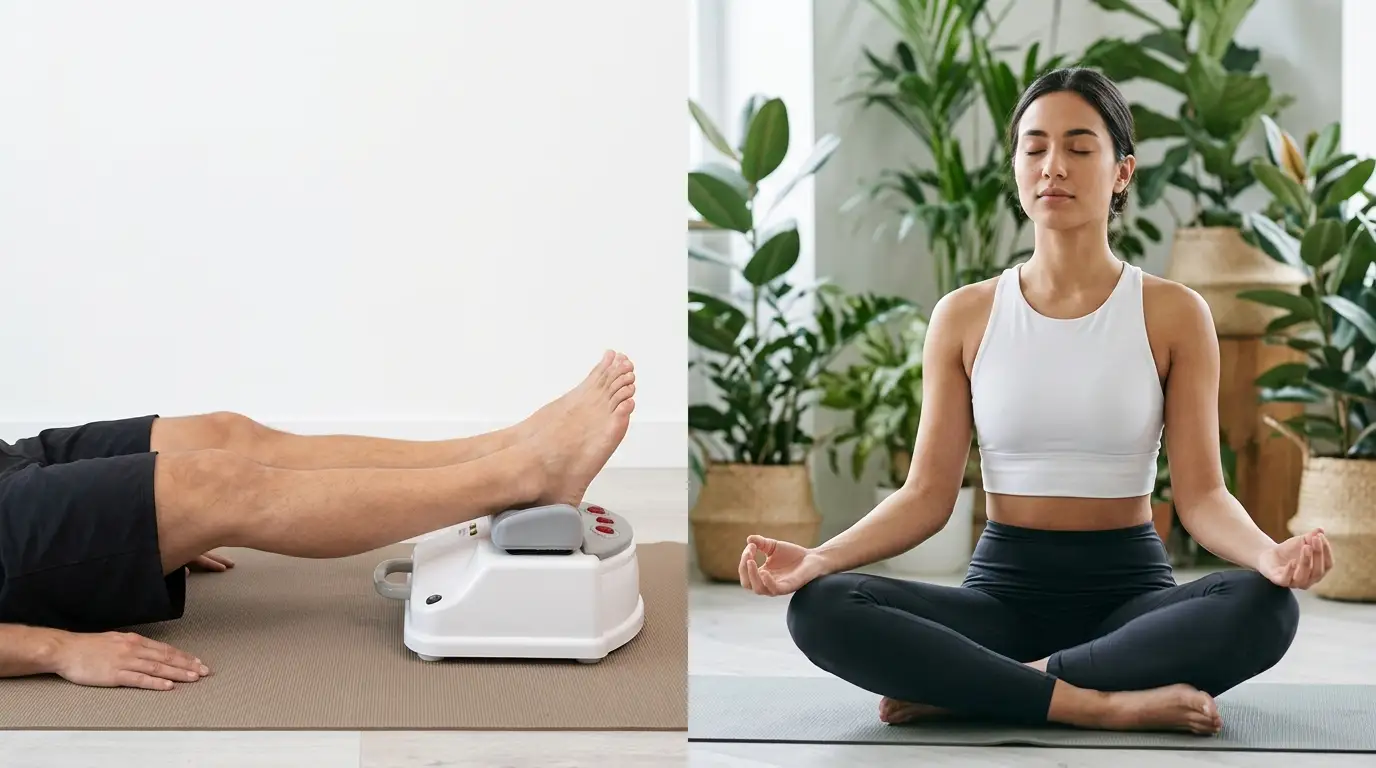
Chi Machine Therapy vs. Traditional Relaxation Methods: Which Suits You Best?
- A chi machine delivers passive, rhythmic side-to-side motion while you lie down, requiring no physical effort — ideal for people who cannot stand, sit, or exercise comfortably.
- Traditional relaxation methods (meditation, tai chi, yoga, massage) engage the mind or muscles actively, offering different benefits but demanding more mobility or focus.
- Massage therapy delivers similar circulation and relaxation benefits but at a recurring cost, while a chi machine session costs nothing once you own or can try the device.
- For seniors with back or nerve issues, passive options like the chi machine and guided breathing tend to be gentler starting points than yoga or structural massage.
- The best approach is often combining a chi machine with one active or mental practice rather than choosing only one method.
If you’re comparing chi machine therapy to meditation, massage, tai chi, or simple breathing exercises, the core difference comes down to effort: a chi machine moves your body for you, while traditional relaxation methods ask you to actively participate — physically or mentally. For older adults or people managing back pain and nerve sensitivity, that distinction matters more than it seems. A chi machine lets you lie down and let a rocking, fish-like motion work through your hips, spine, and legs at roughly 144 cycles per minute, encouraging circulation without straining joints or requiring balance. Meditation and tai chi, by contrast, ask for sustained posture or mental focus, and massage therapy requires a practitioner and a recurring fee. None of these methods is universally “better” — the right one depends on your mobility, budget, and what kind of relaxation you’re actually seeking.
What a Chi Machine Actually Does
A chi machine is a passive exercise device: you lie on your back, rest your ankles in the cushioned supports, and the machine oscillates your legs and lower body side to side. The motion is often compared to a goldfish swimming — smooth, continuous, and rhythmic rather than jarring. Because the machine sets a constant speed, the movement stays balanced and predictable, which is part of why it’s frequently offered in clinics and massage practices as a no-effort introduction to movement therapy.
The appeal for seniors and people with back or nerve conditions is straightforward: you don’t need to stand, hold a pose, or coordinate breathing with movement. The body stays fully supported by the floor or a mat while gravity and the machine’s motion do the work. This makes it a realistic option for people who’ve been told to avoid high-impact exercise, who have limited standing tolerance, or who simply find getting into a yoga pose intimidating.
That said, a chi machine is not a treatment for a specific diagnosis. It’s a comfort and circulation tool, not a substitute for physical therapy or medical care when there’s an underlying condition that needs direct treatment.
Chi Machine vs. Meditation
Meditation and chi machine therapy both aim to lower stress, but they work through entirely different channels. Meditation relies on breath control, mental focus, and stillness — you train attention rather than move the body. A chi machine relies on physical oscillation to relax muscles and encourage circulation, with no mental technique required.
For someone with nerve pain or chronic discomfort, sitting still for meditation can sometimes be uncomfortable, since stillness draws attention to the very sensations you’re trying to calm. A chi machine offers a middle ground: the body is gently occupied by motion, which can make it easier to settle the mind afterward rather than during. Some people find combining the two effective — a short chi machine session first to loosen the body, followed by a few minutes of quiet breathing once the muscles feel less tense.
Neither method requires special equipment beyond the machine itself (for chi therapy) or a quiet space (for meditation), and both are accessible regardless of fitness level. The main trade-off is that meditation builds a mental skill you can use anywhere, while a chi machine’s benefits are tied to the session itself.
Chi Machine vs. Massage Therapy
Massage therapy and chi machine sessions target similar goals — muscle relaxation, circulation, and stress relief — but differ sharply in cost and accessibility. A randomized controlled trial on chronic low back pain found that the massage treatments participants received would have cost around $540 in the community setting, reflecting the price of professional, hands-on sessions over a treatment period. A chi machine, by comparison, is often available for a free trial session in wellness clinics, and if purchased, becomes a one-time cost with no recurring fee per use.
Massage therapy has an advantage in precision: a trained therapist can target specific tight muscles, adjust pressure, and respond to what they feel under their hands. A chi machine offers a generalized, whole-body motion rather than targeted pressure, so it won’t replace hands-on work for a specific knot or injury.
For someone managing ongoing back pain on a limited budget, a chi machine can serve as a daily, no-cost complement to occasional massage sessions rather than a replacement — using the machine for regular gentle movement between less frequent professional treatments.
Chi Machine vs. Tai Chi and Yoga
Tai chi and yoga are both active practices that ask the body to move, stretch, or hold positions, which sets them apart from the fully passive chi machine. Tai chi tends to be the gentler of the two for older adults, since its slow, controlled movements build balance and confidence without demanding flexibility. Yoga, meanwhile, focuses more on stretching and range of motion, which can be harder to sustain for people with joint pain or significant mobility limitations.
A chi machine sits a step further down the effort scale than either practice. Where tai chi and yoga require you to stand, balance, or hold a posture, the chi machine requires only that you lie down — making it a realistic option on days when even gentle standing exercise feels like too much. For someone recovering from an injury, managing severe nerve pain, or simply having a low-energy day, alternating between tai chi (on good days) and a chi machine session (on harder days) can keep some form of movement in the routine without forcing consistency you can’t maintain.
The trade-off is that tai chi and yoga build strength, balance, and coordination over time in a way passive motion cannot. A chi machine won’t improve your balance or muscle tone — it’s designed for relaxation and circulation, not fitness gains.
Chi Machine vs. Passive Relaxation Techniques
Deep breathing, guided imagery, and progressive muscle relaxation are often grouped with meditation as “passive” mental techniques, since they require no equipment and can be done anywhere. Research on nature-based interventions for seniors found that passive relaxation programs actually produced slightly greater physiological improvements — including reductions in heart rate and increases in oxygen saturation — compared to more active programs, suggesting that gentle, low-exertion approaches can be just as effective for relaxation as more involved ones.
A chi machine fits naturally alongside these techniques rather than competing with them. Both are low-cost or free, both are accessible regardless of physical condition, and both avoid the exertion that can make active exercise unsuitable for people with back or nerve problems. The difference is sensory: breathing and imagery techniques work through mental focus, while a chi machine works through physical motion. Some people find it easier to relax the mind once the body has already been moved and released some tension, which is why practitioners sometimes suggest a short chi machine session before a breathing exercise rather than choosing one over the other.
Chi Machine vs. Rocking Chairs and Recliners
The soothing, repetitive motion of a chi machine has an everyday cousin: the rocking chair. Both rely on gentle, rhythmic movement to calm the nervous system, but they work on different parts of the body. A rocking chair moves the whole body through a seated back-and-forth motion, while a chi machine isolates the movement to the hips, legs, and lower spine while you lie flat, which changes how the relaxation is felt and where the benefit is concentrated.
A recliner, by contrast, doesn’t move rhythmically at all — it simply provides a reclined, supported resting position. It’s comfortable but static, offering none of the circulation-encouraging motion that a chi machine or rocking chair provides. For someone who spends long hours seated or lying down due to limited mobility, a recliner alone can leave the legs and lower back stiff, whereas a chi machine actively counters that stiffness with movement.
None of these three options should be seen as substitutes for each other. A recliner offers rest, a rocking chair offers gentle whole-body soothing while upright, and a chi machine offers targeted, supine movement — each has its place depending on whether you’re seeking stillness, comfort, or circulation.
Which Method Fits Your Situation
There’s no single “best” choice between chi machine therapy and traditional relaxation methods — the right fit depends on three practical factors: mobility, budget, and personal preference for physical versus mental relaxation.
If standing or balancing is difficult, a chi machine or breathing-based technique will generally feel more accessible than tai chi or yoga. If cost is the main concern, chi machine sessions and passive breathing techniques carry little to no ongoing expense compared to recurring massage appointments. And if the goal is specifically to build strength or balance over time rather than simply relax, an active practice like tai chi will do more than a passive device ever can.
For many people managing back pain, nerve sensitivity, or simply low energy some days, the most realistic answer isn’t picking one method permanently — it’s having two or three low-effort options on hand and choosing whichever matches how the body feels that day.
Is a chi machine as effective as meditation for stress relief?
They work differently rather than one being more effective. Meditation trains mental focus through breath and stillness, while a chi machine relaxes the body through physical motion. Many people use both together rather than choosing one.
Can a chi machine replace massage therapy?
No. A chi machine offers general, whole-body motion, while massage therapy provides targeted, hands-on pressure for specific muscles. A chi machine works well as a low-cost, everyday complement between massage sessions rather than a full replacement.
Is tai chi better than a chi machine for seniors?
Tai chi builds balance and strength through active movement, which a chi machine’s passive motion cannot replicate. However, a chi machine requires no standing or coordination, making it a gentler option on days when tai chi feels too demanding.
How does a chi machine compare to a rocking chair?
Both use rhythmic motion to calm the body, but a rocking chair moves you while seated upright, whereas a chi machine moves your hips and legs while you lie flat, concentrating the motion on circulation in the lower body.
Are passive relaxation techniques like deep breathing as good as a chi machine?
Both are low-effort and accessible. Breathing techniques work through mental focus, while a chi machine works through physical movement. Some people find it easier to relax mentally after the body has already been eased by the machine’s motion.
Does a chi machine help with back pain the way massage therapy does?
It can offer similar circulation and relaxation benefits, but without the targeted pressure a massage therapist applies to specific problem areas. It’s better suited as a gentle, regular complement rather than a direct substitute for treating localized pain.
Is a chi machine suitable for someone who cannot do yoga?
Yes. Since the chi machine requires only lying down with no stretching, balance, or posture holding, it’s typically more accessible than yoga for people with limited flexibility or joint pain.
What’s the main advantage of a chi machine over active relaxation methods?
It requires no physical effort, balance, or coordination, making it usable by people who cannot safely perform standing or floor-based exercises, while still delivering rhythmic movement that supports circulation and relaxation.
Sources
- Vibration Plates and Chi Machines Supporting Healing Gentle Movement and Wellness
- Chi Machine and its Important Benefits
- A Comparison of the Effects of 2 Types of Massage and Usual Care on Chronic Low Back Pain
- Tai Chi And Yoga For Older Adults
- Tai Chi vs. Yoga: What’s the Difference? – GoodRx
- Enhancing Self-Esteem, Well-Being, and Relaxation in the Elderly through Nature-Based Interventions
See also