
Benefits of Rhythmic Movement Therapy for Seniors, Back Pain, and Nerve Health
- Rhythmic movement therapy uses gentle, repetitive motion to calm the nervous system and shift the body toward a parasympathetic, “rest and digest” state.
- Research on older adults links regular rhythmic activity to better mood, sharper cognitive function, and improved quality of life.
- Passive rocking motion, the kind produced by a Chi Machine, can deliver these benefits to people who cannot tolerate standing exercise because of back pain or nerve conditions.
- Reflex-integration studies show rhythmic movement supports coordination, balance, and stress reduction across all ages, not just in children.
- Consistency matters more than intensity — a few minutes of gentle rhythmic motion daily tends to outperform occasional vigorous sessions.
If you’re dealing with chronic back pain, nerve discomfort, or simply the stiffness that comes with age, you may be looking for a way to move your body without straining your spine or joints. Rhythmic movement therapy — the practice of engaging in gentle, repetitive, side-to-side or rocking motion — is one of the few interventions with evidence behind it for exactly this situation. Unlike high-impact exercise, it doesn’t demand balance, strength, or standing tolerance. Studies on older adults show that regular rhythmic movement can improve mood, physical function, and cognitive performance, while research on the nervous system explains why the motion itself, independent of exertion, produces a calming effect. Devices like the Chi Machine were designed specifically to deliver this kind of movement passively, letting the body receive the rhythm while lying down. Below is what the research actually shows, and how it applies to people managing back and nerve issues.
What Rhythmic Movement Therapy Actually Is
Rhythmic movement therapy is not a single technique but a family of approaches built around one idea: repetitive, patterned motion communicates safety to the brain and body. This can take the form of rocking, swaying, structured dance, or the passive side-to-side oscillation produced by a machine. What unites these approaches is rhythm itself — a predictable, repeated sensory input that the nervous system can lock onto.
The clinical roots of this idea trace back to work by Swedish psychiatrist Dr. Harald Blomberg, who in the 1980s began systematically studying how rhythmic, infant-like movements affect brain development and emotional regulation. His observations built on earlier work by Swedish body therapist Kerstin Linde, who had used rhythmic movement with children with neurological disorders. Their combined findings pointed to something adults have since confirmed in their own recovery from back pain, anxiety, and stress: the same gentle, repetitive motion that helps regulate a developing nervous system can also help regulate an adult one, particularly under chronic stress or pain.
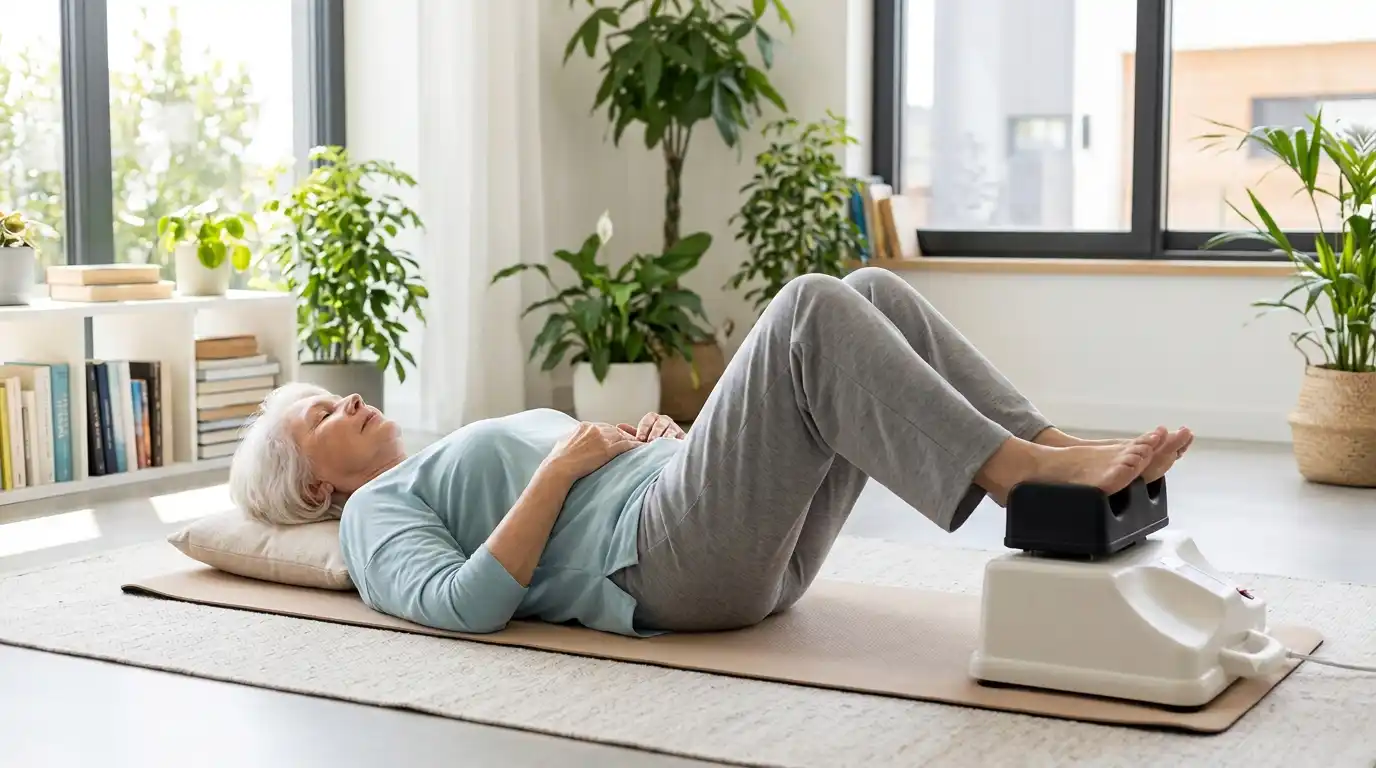
For someone with a compromised back or nerve pain, this matters because rhythmic movement therapy doesn’t require the load-bearing effort of traditional exercise. A Chi Machine, for instance, moves the legs and hips in a gentle side-to-side wave while the user lies flat, letting the spine stay supported and neutral throughout the session.
How Rhythmic Motion Calms an Overactive Nervous System
Chronic pain and aging both tend to keep the nervous system in a heightened, defensive state — what’s often described as being stuck in “fight or flight.” Rhythmic movement appears to interrupt that pattern directly. Gentle, repetitive motion sends a predictable sensory signal to the brain, and predictability itself is calming: the brain reads a steady rhythm as evidence that nothing threatening is happening right now.
This shifts the body away from the sympathetic (alert) nervous system response and toward the parasympathetic “rest and digest” state, where muscles relax, breathing slows, and pain signaling tends to soften. This is the same mechanism behind why a rocking chair feels soothing or why swaying instinctively helps someone in distress. The effect doesn’t require vigorous effort — in fact, gentle, slow rocking while seated or lying down is often cited as more effective for activating this relaxation response than fast or forceful movement.
For people with nerve-related pain, where the nervous system itself is often part of the problem — hypersensitized, overreactive, prone to flare-ups — this down-regulating effect is arguably the whole point. A rhythmic practice doesn’t just distract from pain; it changes the physiological state the pain is happening within.
What the Research Shows for Older Adults
The most relevant evidence for an aging audience comes from studies on rhythmic physical activity in older populations. A 2023 review found that rhythmic physical activity can meaningfully improve depression, anxiety, and quality of life in this age group. A separate 2023 study on rhythmic movement specifically found that regular practice likely improves physical function, global cognitive function, and quality of life in healthy older adults — not just mood, but measurable gains in how the body and brain perform day to day.
Long-term care research reinforces this from a practical angle. Handbooks used in dementia and memory care settings list a consistent set of outcomes tied to rhythmic activity programs: reduced agitation and anxiety, improved emotional expression, better sense of time and orientation, increased social interaction, and gains in both gross and fine motor skills. Notably, these programs report benefits even for residents who can no longer actively participate — passive engagement through being rocked, moved, or exposed to rhythm still produces measurable improvement in mood and calm.
This is a meaningful distinction for anyone whose mobility is limited by back pain or nerve damage. You don’t need to be the one generating the movement for it to have an effect. A passive device that produces the rocking motion for you, like a Chi Machine, sits squarely in this category of intervention — closer to being rocked than to doing an aerobic workout.
Rhythmic Movement and Back Pain
Traditional exercise recommendations for back pain often run into a wall: many of the activities shown to help — walking, swimming, strength training — require a level of tolerance that someone in an acute flare simply doesn’t have. Rhythmic movement therapy offers a different entry point because it can be done lying down, with the spine supported and no weight-bearing load on the discs or joints.
The gentle wave-like motion produced by devices like the Chi Machine moves the hips and lower spine through a natural side-to-side pattern similar to how the body moves during walking, but without the impact of footfall. This can help loosen tight paraspinal muscles and improve circulation to the lower back without the risk of aggravating an already irritated area. For people whose back pain flares with standing or bending, this passive rhythmic option can serve as a bridge — a way to keep the body moving on bad days until more active exercise is tolerable again.
It’s worth being clear-eyed about what this does and doesn’t do. Rhythmic movement isn’t a substitute for medical evaluation of back pain, particularly if there’s nerve involvement, numbness, or progressive weakness. But as a gentle, low-risk way to reduce muscular tension and calm the pain-amplifying effects of nervous system stress, it fits well alongside other approaches your doctor or physical therapist may recommend.
Rhythmic Movement for Nerve-Related Discomfort
Nerve pain — whether from sciatica, peripheral neuropathy, or age-related nerve compression — responds differently to movement than muscular pain does. Sudden or jarring motion can aggravate an irritated nerve, which is one reason many people with nerve issues avoid exercise altogether. Rhythmic, low-amplitude movement sidesteps this problem because it’s slow, predictable, and doesn’t involve sudden stretching or impact.
The nervous-system-calming effect described earlier is particularly relevant here. Nerve pain conditions often involve a degree of central sensitization, where the nervous system amplifies pain signals beyond what tissue damage alone would explain. Anything that shifts the body toward a parasympathetic state has the potential to turn down that amplification, even if it doesn’t address the underlying nerve issue directly. Gentle rocking, sway, or passive oscillation is frequently used in anxiety and stress-management protocols for exactly this reason — it is described as offering rapid grounding and nervous system stabilization within a matter of minutes, using the body’s own sensory comfort mechanisms rather than medication or willpower.
For someone managing chronic nerve discomfort, incorporating a few minutes of passive rhythmic movement — such as a session on a Chi Machine — into a daily routine can function as a nervous-system reset, distinct from and complementary to any direct treatment for the nerve condition itself.
The Brain-Body Connection Behind the Benefits
Some of the clearest explanations for why rhythmic movement works come from research into brain-body integration. Rhythmic, repetitive motion is thought to reinforce neural pathways involved in coordination, attention, and communication between the brain and the body’s motor systems. This is the same mechanism studied in reflex-integration work, where rhythmic movement helps mature and organize how the nervous system processes movement and sensory information.
While much of this research originated in child development, the underlying mechanism — that rhythmic input strengthens brain-body communication — doesn’t stop applying once someone reaches adulthood or old age. It’s part of why rhythmic movement shows up consistently across such different contexts: dance movement therapy for emotional expression, reflex-integration work for coordination, and rhythmic physical activity research for older adults’ cognitive and physical function. The common thread is that the brain uses rhythm as an organizing signal, and a body that receives consistent rhythmic input tends to respond with better regulation, whether that shows up as calmer emotions, steadier balance, or clearer thinking.
Building a Simple, Sustainable Practice
The research is fairly consistent on one point: consistency outperforms intensity when it comes to rhythmic movement. Programs that produced measurable benefits in cognitive and physical function studies were built around regular, moderate sessions rather than occasional intense ones. This is good news for anyone limited by back pain, nerve issues, or general fatigue, because it means the goal isn’t to push harder — it’s to show up more reliably.
A practical starting point is a short daily session, ideally at a consistent time, using a gentle rhythmic motion that doesn’t require standing or bearing weight through a painful area. This is where a passive device like a Chi Machine has a clear practical advantage: it removes the barrier of needing enough strength or stamina to generate the movement yourself, so the session happens regardless of how the body is feeling that day. Lying down with the legs resting on the footrest lets the machine produce the side-to-side wave motion while the spine stays supported and still.
As with any new movement practice, it’s worth starting with shorter sessions and paying attention to how the body responds, particularly if there’s an active nerve issue or a recent back injury. Checking with a physician or physical therapist before starting is a reasonable precaution, especially for anyone with a diagnosed spinal condition, a pacemaker, or a recent surgery.
What Results to Realistically Expect
Rhythmic movement therapy is not a fast fix, and the research bears that out. The improvements documented in older-adult studies — better mood, sharper cognition, improved physical function — were measured after sustained, regular practice, not a single session. Most people report the calming, nervous-system effect within minutes of a session, but the more durable benefits, like reduced background pain or better sleep, tend to build over weeks of consistent use.
It’s also worth setting expectations honestly: rhythmic movement works best as one part of a broader approach to managing back pain, nerve discomfort, or age-related decline, alongside medical care, appropriate strength work, and other lifestyle factors. Where it earns its place is as a low-barrier, low-risk practice that people can actually stick with, even on days when more demanding forms of exercise aren’t realistic.
What is rhythmic movement therapy?
It’s the practice of using gentle, repetitive motion — rocking, swaying, or structured rhythmic exercises — to calm the nervous system and support motor and cognitive function. It can be active or, as with a Chi Machine, delivered passively while lying down.
Can rhythmic movement therapy help with back pain?
It can help ease muscular tension and improve circulation in the lower back without weight-bearing strain, since it’s typically done lying down. It complements, rather than replaces, medical evaluation for persistent or worsening back pain.
Is rhythmic movement safe for older adults?
Yes, and it’s specifically studied in older-adult populations, with documented improvements in physical function, cognition, and quality of life. Passive options are especially suited to people with limited mobility or standing tolerance.
How does rhythmic movement help nerve pain?
It shifts the nervous system toward a calmer, parasympathetic state, which can reduce the amplification of pain signals common in nerve-related conditions, even though it doesn’t treat the underlying nerve issue directly.
How is a Chi Machine related to rhythmic movement therapy?
A Chi Machine produces a passive, side-to-side rocking motion through the hips and legs while the user lies down, delivering the same type of rhythmic input studied for its calming and regulatory effects without requiring active effort.
How often should rhythmic movement be practiced for benefits?
Research consistently favors regular, moderate sessions over occasional intense ones. A short daily session is a reasonable starting point, with benefits building over several weeks of consistent use.
Does rhythmic movement therapy improve mood and anxiety?
Yes, studies on rhythmic physical activity in older adults show meaningful improvements in depression, anxiety, and overall quality of life, and gentle rocking is specifically used as a rapid grounding technique for acute anxiety.
Sources
- Blomberg Rhythmic Movement Training — Rhythmic Movement: Unlocking Brain-Body Integration
- The History of Blomberg Rhythmic Movement Training
- PMC — The Impact of Rhythmic Physical Activity on Mental Health in Older Adults (Sánchez-Alcalá, 2023)
- ScienceDirect — The Effect of Rhythmic Movement on Physical and Cognitive Function (Ma, 2023)
- New York State Department of Health — Rhythmic Activities Handbook
- Wayfinder Wellness — Swaying or Rhythmic Rocking
- VOA Northern New England — The Quiet Power of a Rocking Chair
See also