
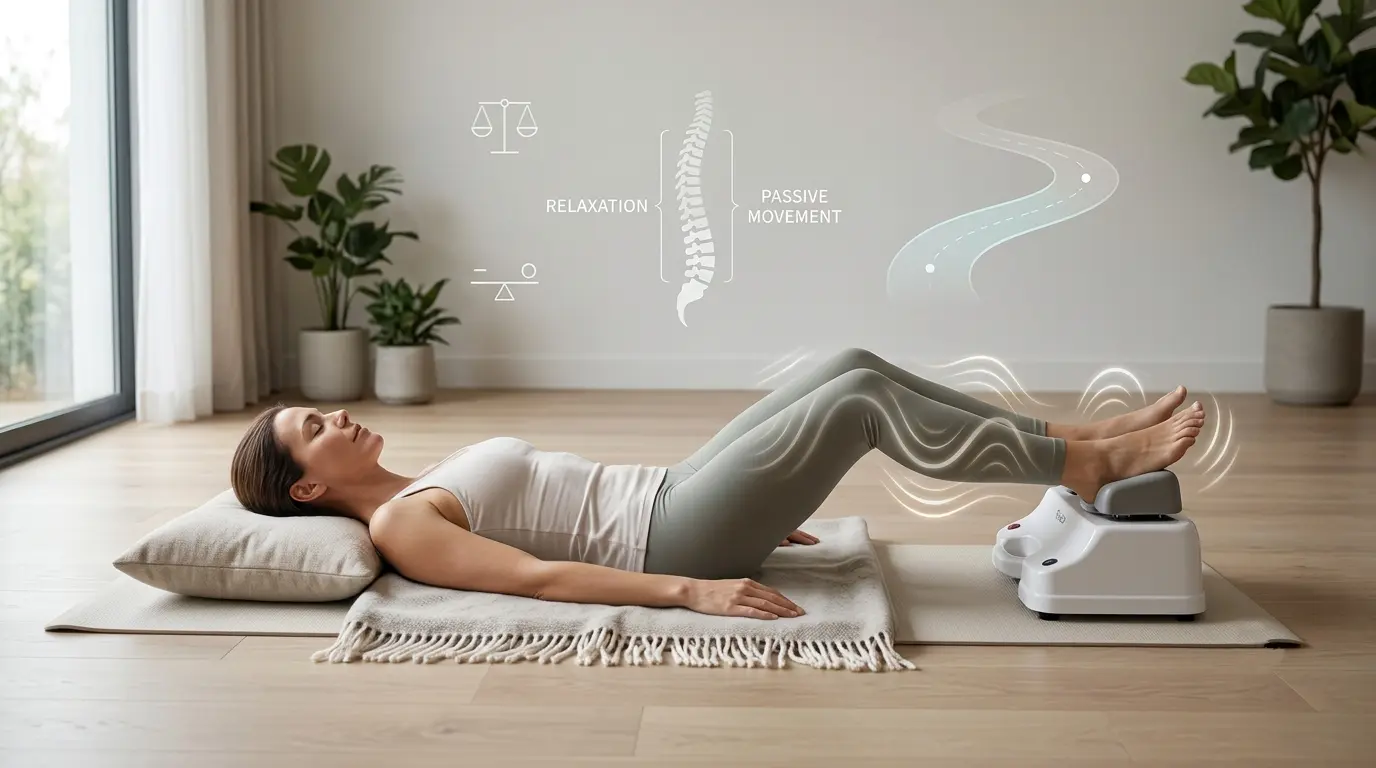
The Role of Passive Exercise in Chi Machine Therapy
- Passive exercise moves your body without requiring muscle effort from you — a Chi Machine oscillates your hips and legs while you lie still
- Research on similar passive-movement devices (CPM machines, passive cycle ergometers) shows real benefits for circulation, joint stiffness, and early-stage mobility, but minimal calorie or muscle-building effect
- Passive movement is most valuable during periods when active exercise isn’t possible or safe — after injury, during flare-ups, or for people with limited mobility
- It works best as a supplement to some form of active movement, not a replacement for it
- People with spinal hardware, recent fractures, severe osteoporosis, or acute nerve compression should get medical clearance before use
If you’re wondering whether a Chi Machine actually does anything, the short answer is: it depends on what you’re expecting it to do. A Chi Machine is a passive exercise device — it swings your hips and legs side to side while you lie on the floor, without any muscular effort on your part. That distinction matters. Passive exercise, by clinical definition, is movement performed on the body rather than by it, and the research on this category of therapy (which includes continuous passive motion machines used after knee surgery and passive cycle ergometers used in intensive care units) is fairly consistent: it helps with circulation, joint mobility, and comfort, but it does not replace the metabolic and strength benefits of moving your own muscles. For older adults or people managing back pain or nerve issues, understanding this line is what determines whether a Chi Machine becomes a genuinely useful tool or a source of unrealistic expectations.
What “Passive Exercise” Actually Means
In physiology, the word “passive” isn’t a synonym for “gentle” or “low-effort” — it has a precise meaning. Passive exercise is movement that occurs without voluntary muscle contraction from the person being moved. A physical therapist bending your knee through its range of motion is passive exercise. A continuous passive motion (CPM) machine cycling a joint after surgery is passive exercise. And a Chi Machine, which oscillates your lower body left and right while your muscles stay relaxed, falls into the same category.
Active exercise is the opposite: you generate the force, your muscles contract, and your body responds by increasing oxygen consumption, heart rate, and metabolic demand. This is not a minor technical distinction. Studies comparing the two show that active exercise drives a measurable increase in metabolic demand and blood flow, while passive exercise evokes only a minor increase in oxygen consumption. That gap is the reason passive exercise devices are described in medical literature as adjuncts to rehabilitation, not substitutes for structured physical activity.
Where the Chi Machine Fits in the Passive Exercise Family
The Chi Machine belongs to the same broad category as CPM machines and passive cycle ergometers, even though it’s marketed for wellness rather than post-surgical recovery. All three devices share the same working principle: an external motor moves a body segment through a repetitive range of motion while the user remains relaxed.
The clinical relatives of the Chi Machine have been studied in specific, narrow contexts. CPM machines are used after knee replacement to maintain range of motion during the non-weight-bearing recovery period. Passive cycle ergometers have been tested in ICU patients who are too weak or sedated to move on their own — one study of 19 ICU patients found that passive cycling could be performed safely and was associated with reduced markers of oxidative stress. What these studies have in common is the population: people whose ability to actively exercise is temporarily or severely limited. That’s the context in which passive movement earns its keep — not as a general fitness tool, but as a way to keep the body moving when moving yourself isn’t an option.
What Happens in the Body During a Passive Session
During a Chi Machine session, the side-to-side oscillation of the hips and legs produces a rhythmic, low-load movement through the ankles, knees, hips, and lower spine. Because there’s no voluntary contraction, the joints move through a comfortable range without the muscle bracing that often accompanies active movement in someone with a stiff back or an irritated nerve.
The physiological effects researchers have documented for passive limb movement include a mild increase in local blood flow and, in some cases, reduced markers of vascular stress — but these effects are consistently smaller than those seen with active movement, where increased metabolism drives blood flow and vascular adaptation together. In other words, a Chi Machine can gently encourage circulation and joint mobility, but it isn’t generating the training stimulus that builds cardiovascular fitness or muscle strength. Anyone using the machine with that expectation is likely to be disappointed.
What the Evidence Actually Supports
It helps to separate what passive movement is good at from what it isn’t, based on the research available on this category of devices:
- Maintaining joint range of motion when active movement is temporarily restricted, as shown with CPM machines after knee surgery
- Reducing stiffness and supporting early mobilization after injury or extended bed rest
- Providing a comfortable entry point to movement for people who find active exercise painful or exhausting
- Supporting circulation during periods of limited mobility, particularly for people who are largely sedentary
Where the evidence is much thinner, or points the other way, is calorie burn and muscle preservation. A large study using the gold-standard method for measuring energy expenditure found that daily calorie burn from movement plateaus well below the level most active exercise produces — and passive movement, which barely raises oxygen consumption, sits far below even that plateau. Similarly, when researchers looked at strategies to counter disuse muscle atrophy, resistance training consistently outperformed passive approaches, and passive limb movement was studied mainly as something to combine with active training, not as a stand-alone fix for muscle loss.
Why This Matters for Older Adults and People with Back or Nerve Issues
For someone managing chronic back pain, sciatica, or general nerve sensitivity, the appeal of a Chi Machine is understandable: it offers movement without the guarding, bracing, or pain flare-ups that active exercise can trigger. That’s a legitimate use case, and it lines up with how passive range-of-motion exercise is used clinically — as a way to keep joints mobile and prevent stiffness when active movement is limited by pain, weakness, or fear of re-injury.
Older adults face a related but distinct problem: the risk isn’t just discomfort during exercise, it’s the gradual loss of mobility and muscle mass that comes from moving less overall. Passive exercise can be part of the answer on days when joints are stiff or energy is low, but it shouldn’t become the entire routine. The research on disuse atrophy is clear that passive limb movement works best as an adjunct alongside some form of resistance or active movement, not as a replacement for it. A realistic way to think about the Chi Machine for this audience is as a low-barrier way to start or restart movement — something to do before or after a short walk or a few strengthening exercises, rather than instead of them.
Muscle, Circulation, and the Limits of a Passive-Only Routine
One of the more sobering findings from muscle-atrophy research is that passive movement alone, without any structured resistance work, does relatively little to protect muscle mass during periods of reduced activity. In one study, older adults recovering from a period of reduced movement did not regain lost muscle through passive reambulation alone — active, structured training was needed to reverse the loss.
This doesn’t make passive exercise pointless for muscle health; it makes it a supporting player. Passive movement can help maintain circulation and joint flexibility while someone works back up to active movement, which matters because stiff, poorly perfused joints make it harder to start moving actively in the first place. But if the goal is to rebuild or preserve strength — which matters enormously for fall prevention and independence in older age — passive movement on its own isn’t equipped to do that job.
Building a Realistic Routine Around the Chi Machine
The most useful way to use a Chi Machine is as one piece of a broader movement routine rather than the whole routine. A pattern that lines up with the research would look something like this: use the machine on days when pain, fatigue, or stiffness make active movement difficult, as a way to keep joints moving and circulation up without added strain. On better days, pair a short session with some active movement — walking, seated leg exercises, or whatever a physical therapist has recommended for a specific back or nerve condition.
Session length and intensity should stay modest. There’s no evidence that longer or more frequent passive sessions produce proportionally greater benefit, since the physiological effect is inherently capped by the lack of muscular effort. Consistency matters more than duration — a short daily session is more useful than an occasional long one, particularly for maintaining the mobility gains that passive movement is actually good at delivering.
Safety Considerations Before Starting
Passive movement is generally low-risk because it doesn’t require exertion, but that doesn’t mean it’s automatically appropriate for everyone. People with acute nerve compression, recent spinal fracture, severe osteoporosis, spinal hardware, or a recent hip or knee replacement should check with their doctor or physical therapist before using a Chi Machine, since the oscillating motion applies repetitive load to the lower spine and hips. Pregnant women and anyone with a pacemaker or other implanted device should also get clearance first.
For most healthy older adults and people managing ordinary back stiffness, the main risk is disappointment rather than injury — expecting a passive device to deliver the fitness or muscle benefits that only active movement can provide. Used with that expectation in check, it fits into a broader mobility routine reasonably well.
Is a Chi Machine considered passive or active exercise?
It’s passive exercise. The machine moves your hips and legs for you while your muscles stay relaxed, which is the defining feature of passive movement in clinical terms.
Can passive exercise replace walking or strength training?
No. Passive movement produces only a minor increase in oxygen consumption compared to active exercise, and research on muscle preservation consistently shows resistance-based active movement is more effective for maintaining strength.
Does a Chi Machine help with back pain?
It can help by offering gentle, low-strain movement that may reduce stiffness, which is consistent with how passive range-of-motion exercise is used clinically to maintain mobility. It isn’t a treatment for the underlying cause of back pain, and anyone with acute or worsening pain should see a healthcare provider.
Is passive exercise useful for elderly people with limited mobility?
Yes, particularly as a way to maintain joint flexibility and circulation on days when active movement isn’t feasible. It works best alongside, not instead of, whatever active movement a person can still manage.
Does using a Chi Machine burn calories?
Only marginally. Because passive movement doesn’t involve voluntary muscle contraction, it produces a much smaller increase in energy expenditure than active exercise of similar duration.
How often should I use a Chi Machine?
Short, consistent daily sessions are more useful than occasional long ones, since the goal is maintaining mobility and circulation rather than building fitness capacity.
Who should avoid passive exercise devices like a Chi Machine?
People with recent spinal fractures, severe osteoporosis, spinal hardware, acute nerve compression, or recent hip or knee surgery should get medical clearance first, since the device applies repetitive motion to the hips and lower spine.
Sources
- Physiological Impact and Clinical Relevance of Passive Exercise/Movement (PMC)
- Effects of Passive Exercise Training in Hemiplegic Stroke Patients
- Efficacy and safety of continuous passive motion and physical therapy in recovery from knee arthroplasty (PMC)
- Resistance exercise training improves disuse-induced skeletal muscle atrophy in humans (PMC)
- Disuse-induced skeletal muscle atrophy in disease and nondisease states in humans (American Journal of Physiology)
- Your Body Has a Calorie Ceiling. Can Exercise Change It? — FitChef (Pontzer et al. 2016)
See also