
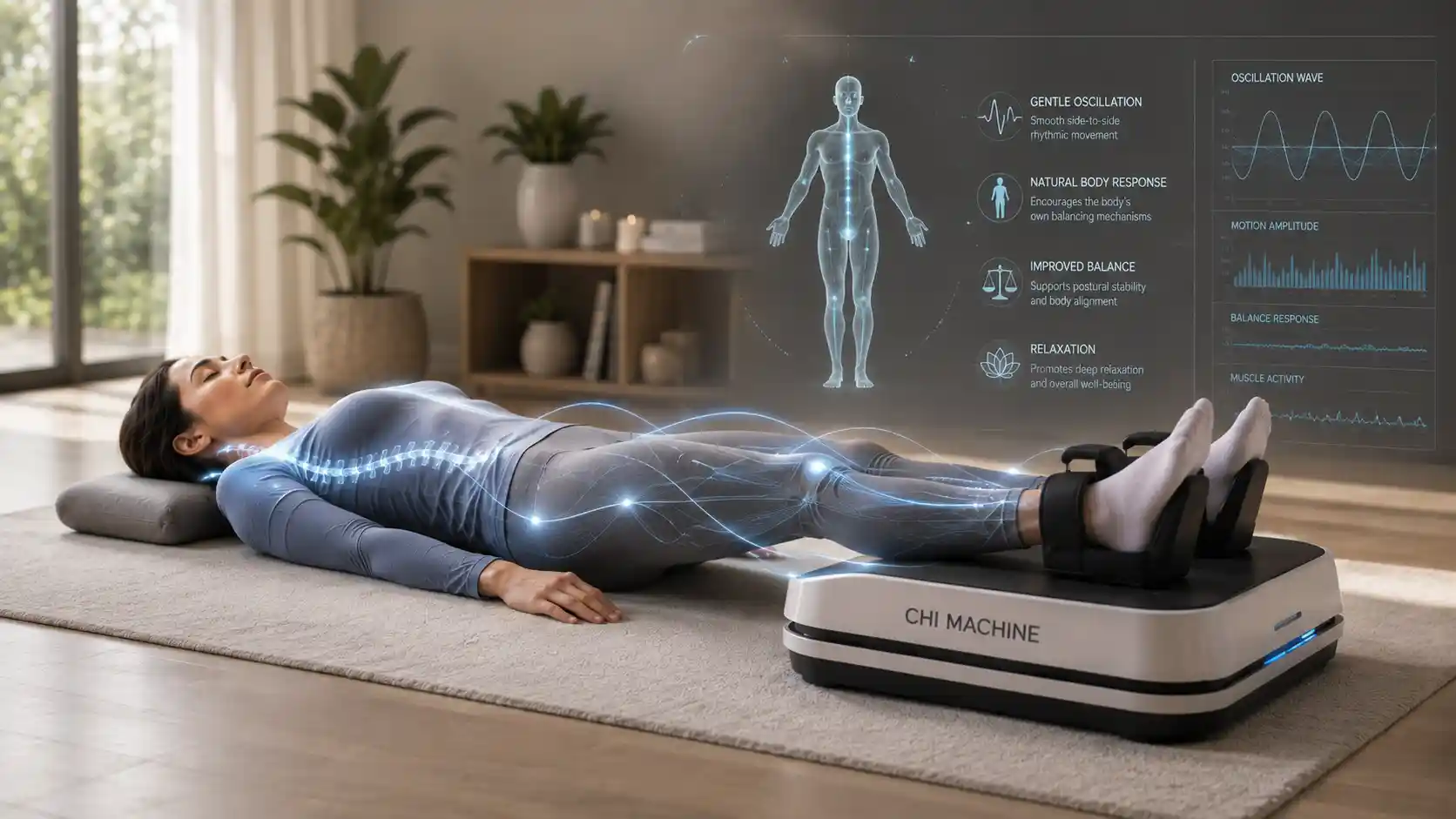
Chi Machine Benefits and Body Balance: What the Passive Motion Actually Does
- A Chi Machine moves the legs and hips in a side-to-side oscillation (often marketed as “goldfish motion”) at a set rhythm, without requiring any muscle effort from the user.
- Manufacturers describe this as restoring “body balance” through circulation and lymphatic drainage, but this is a marketing framework, not a clinical diagnosis.
- Independent research on passive limb movement shows measurable increases in blood flow and some brain-related effects, though few studies focus on the Chi Machine specifically.
- Claims that a Chi Machine burns meaningful calories or produces weight loss are not supported by the same evidence base as active exercise.
- Anyone with back injuries, nerve conditions, pacemakers, or recent spinal surgery should get medical clearance before using one, since passive spinal oscillation is not automatically safe for every condition.
If you’re searching for “chi machine benefits and body balance,” you’re likely trying to figure out whether this passive oscillation device does anything measurable for circulation, posture, or weight — or whether “body balance” is just wellness marketing language. The short answer: a Chi Machine mechanically rocks your legs and hips from side to side at a fixed rhythm while you lie still, and this motion does produce real physiological effects on blood flow and muscle relaxation. What it does not do is replicate active exercise, correct structural imbalances on its own, or serve as a substitute for medical treatment of back or nerve conditions. The rest of this article separates the mechanical facts from the marketing claims, and outlines who should check with a doctor before trying one.
What “Body Balance” Actually Means on a Chi Machine
The term “body balance” shows up constantly in Chi Machine marketing, but it’s worth being precise about what’s happening mechanically. The device places your ankles on two moving pads that swing left and right in a fixed, rhythmic pattern — commercial models typically cycle well over 100 times per minute, creating a wave that travels up through the ankles, hips, and spine while you lie on your back. Some manufacturers describe this as a “figure-8” motion; others compare it to a goldfish swimming, since the whole lower body sways in a continuous side-to-side arc.
That rocking motion is real and measurable: it moves the lumbar spine through a repeated range of side-bending, and it passively stretches muscles along the legs and lower back without the user contracting them voluntarily. This is where the “balance” language originates — the idea that symmetrical, rhythmic motion can help even out muscle tension between the left and right side of the body, since most people carry asymmetric tightness from standing, sitting, or old injuries.
What it doesn’t mean is that the machine diagnoses or corrects a structural imbalance like scoliosis, a leg-length discrepancy, or a herniated disc. The oscillation is passive and generic — it applies the same motion to everyone regardless of their specific anatomy, so any perceived improvement in symmetry is more accurately described as temporary muscle relaxation and increased local blood flow rather than a corrective realignment. Framing it as “energy balancing” in the traditional Chinese medicine sense (the word “chi” is a direct reference to that framework) is a marketing choice, not a claim backed by biomechanical measurement. The mechanical reality — rhythmic passive spinal oscillation — is the part that’s verifiable; the energetic framing is a metaphor layered on top of it.
What the Research on Passive Motion Actually Shows
Separating the Chi Machine brand from the broader category of passive limb movement is important, because most of the available research studies the category, not this specific device. A widely cited study from Western University found that passive movement of the limbs — in that case, legs pedaled by an external motor rather than by the user’s own effort — increased cerebral blood flow and produced executive-function improvements of a similar magnitude to active exercise, though the blood flow increase itself was significantly smaller than what active movement produces. That’s a meaningful finding for rehabilitation contexts, but it was conducted with pedal-based passive cycling, not a side-to-side ankle oscillator, so it should be read as supporting evidence for the broader mechanism rather than direct proof about Chi Machines.
Separately, physiological reviews of passive leg movement have documented genuine increases in local blood flow and vasodilation when a limb is moved externally, which lines up with the “improves circulation” language used in Chi Machine marketing — but again, this research generally isolates a single limb under laboratory conditions, not a full-body oscillation device used at home.
What’s largely missing is a well-powered, randomized clinical trial testing the Chi Machine itself against a placebo or control condition for outcomes like chronic pain, lymphedema, or “body balance.” The individual product pages and clinic websites that cite “clinical trials” rarely link to a peer-reviewed source, and the specific numbers vary between sellers. The honest summary is that passive oscillation has a real, if modest, physiological basis, while the Chi Machine’s specific brand claims mostly rest on user testimonials and manufacturer literature rather than independent trials.
Chi Machine Benefits and Body Balance for Weight Loss: Where the Claim Breaks Down
Because Chi Machines are sometimes sold alongside general wellness and fitness equipment, some buyers search for “chi machine benefits and body balance for weight loss” expecting the device to function like a passive workout. Mechanically, that expectation doesn’t hold up. Weight loss in the conventional sense requires a sustained caloric deficit, and calorie burn scales closely with active muscle contraction, heart rate elevation, and time under exertion — none of which a Chi Machine produces, since the user’s muscles stay relaxed while the machine moves the legs for them.
This is a meaningful distinction from “passive aerobic exercise,” a phrase some marketers use loosely. Genuine aerobic exercise raises heart rate and oxygen demand through voluntary muscular work; a Chi Machine session, by contrast, keeps the user still and relaxed, so any oxygenation or circulation benefit comes from passive movement, not from cardiovascular exertion. A 20-minute session does not produce a workout-equivalent calorie burn, despite some product descriptions comparing it to jogging distances.
Where the device may plausibly support a weight management routine is indirectly: users managing chronic pain, mobility limitations, or fatigue sometimes report that a short Chi Machine session helps them feel loose enough to attempt light walking or stretching afterward, and consistent light movement over time can support broader activity goals. That’s a very different claim than “the machine burns fat” or “the machine helps you lose weight” — it’s a secondary, self-reported effect, not a direct metabolic mechanism, and it should be described that way rather than marketed as a weight-loss method in its own right.
Circulation and Lymphatic Drainage: The Most Defensible Claims
Among the various benefits attributed to Chi Machines, the circulation and lymphatic drainage claims have the most plausible mechanical basis, even if the clinical evidence specific to the device remains thin. The ankle-driven oscillation moves the lower legs rhythmically, and rhythmic compression-and-release of tissue is a recognized mechanism for assisting venous and lymphatic return — this is the same basic principle behind compression garments and manual lymphatic drainage massage, both of which have more established clinical support than the Chi Machine itself.
Some product literature and clinic websites cite the device’s use for chronic secondary leg lymphedema, a condition where fluid builds up in the limbs after lymph node damage, often following cancer treatment. It’s plausible that rhythmic passive leg motion could offer some temporary relief for fluid swelling in this population, similar to other passive movement therapies, but this should be treated as a supportive, adjunct tool discussed with a treating physician or lymphedema specialist — not a standalone treatment for a diagnosed lymphatic condition.
The same logic applies to general circulation claims for otherwise healthy users: passive ankle and hip oscillation can plausibly produce a short-term, local increase in blood flow to the legs and lower back while the machine is running, similar to the effect of walking on tissue perfusion. Whether this translates into lasting improvement in symptoms like cold feet, mild swelling, or stiffness after sitting for long periods is where the evidence thins out — most reports are anecdotal rather than measured in controlled studies.
Who Should Be Cautious Before Using a Chi Machine
Because Chi Machines are frequently marketed to older adults and people with back or nerve issues — precisely the audience most likely to search “chi machine benefits and body balance” — it’s worth being explicit about who needs medical clearance first. Anyone with a diagnosed disc herniation, spinal stenosis, recent spinal surgery, or an unstable vertebral condition should not assume that passive side-to-side spinal oscillation is automatically safe; the same rhythmic motion that relaxes muscles in one person can aggravate an unstable segment in another, and a Chi Machine cannot distinguish between the two.
The same caution applies to anyone with a pacemaker or other implanted cardiac device, since some manufacturers explicitly list this as a contraindication, and to people who are pregnant, given the lack of research on passive spinal oscillation during pregnancy. People with severe osteoporosis, active blood clots, or recent leg or hip surgery should also check with a doctor first, since improving local blood flow to a healing or fragile area isn’t automatically desirable without medical guidance.
For people managing chronic nerve pain — sciatica, peripheral neuropathy, or similar conditions — the honest position is that a Chi Machine may feel relaxing for some and irritating for others, and there’s no reliable way to predict which in advance without professional input. None of this means the device is inherently dangerous for a healthy adult without these conditions; it means the “body balance” marketing shouldn’t be read as implying universal safety, and a physical therapist, chiropractor, or physician familiar with the person’s specific back or nerve history is the right person to weigh in before regular use, not the product packaging.
Getting the Most Out of a Chi Machine Session
For users who have been cleared to try one, getting the mechanical benefit right comes down to setup more than duration. Most instructions call for lying flat on the back, centering the ankles on the foot pads so the oscillation travels evenly up both sides of the body, and letting the legs stay relaxed rather than tensing against the motion — tensing defeats the passive mechanism entirely, since the point is that the machine, not the muscles, generates the movement.
Session length matters less than consistency: a short 5-to-10-minute session used regularly is more in line with how the passive-movement research was actually conducted than a single long session used occasionally. Starting with shorter sessions and paying attention to how the lower back responds is a reasonable way to gauge tolerance, particularly for first-time users or anyone with a history of back sensitivity, even after medical clearance.
It’s also worth setting realistic expectations going in: the most defensible immediate effect is a sense of muscle relaxation and mild warmth from local blood flow, not a dramatic shift in energy, weight, or chronic pain after one use. Users looking for a structural fix to genuine back or nerve pathology need a diagnosis-driven treatment plan from a clinician; a Chi Machine is, at best, a gentle adjunct to that plan, not a replacement for it.
Does a Chi Machine actually improve circulation?
Passive leg oscillation has a plausible mechanical basis for a short-term, local increase in blood flow, and this is supported by broader research on passive limb movement. Evidence specific to the Chi Machine brand improving circulation over the long term is limited.
Can a Chi Machine help with weight loss?
Not directly. Weight loss requires sustained calorie burn from active muscle work, and a Chi Machine moves the legs for the user rather than requiring exertion, so it doesn’t function like aerobic exercise.
Is the Chi Machine safe for people with back problems?
Not automatically. People with disc herniations, spinal stenosis, or recent spinal surgery should get medical clearance first, since passive spinal oscillation isn’t universally safe for every back condition.
What does “body balance” mean on a Chi Machine?
It generally refers to the machine’s symmetrical, rhythmic side-to-side motion, which is marketed as evening out muscle tension between the left and right sides of the body — it’s a mechanical description, not a diagnostic correction of structural imbalances.
How long should a Chi Machine session last?
Many product guides and passive-movement research protocols suggest short sessions of around 5 to 10 minutes used consistently, rather than long occasional sessions.
Can people with nerve pain use a Chi Machine?
It depends on the individual condition. Some people with nerve pain find the gentle motion relaxing, while others may find it irritating, so a physician or physical therapist familiar with the specific nerve condition should weigh in before use.
Is a Chi Machine the same as active exercise?
No. Active exercise involves voluntary muscle contraction and elevated heart rate, while a Chi Machine moves the body passively without requiring muscular effort, so the physiological effects differ significantly.
Sources
- Western University — Passive exercise and brain health study
- Physiological Impact and Clinical Relevance of Passive Exercise (PMC)
- Whole Body Vibration: A Valid Alternative Strategy to Exercise? (MDPI)
See also