
Chi Machine Benefits for Relaxation at Home: What the Motion Actually Does
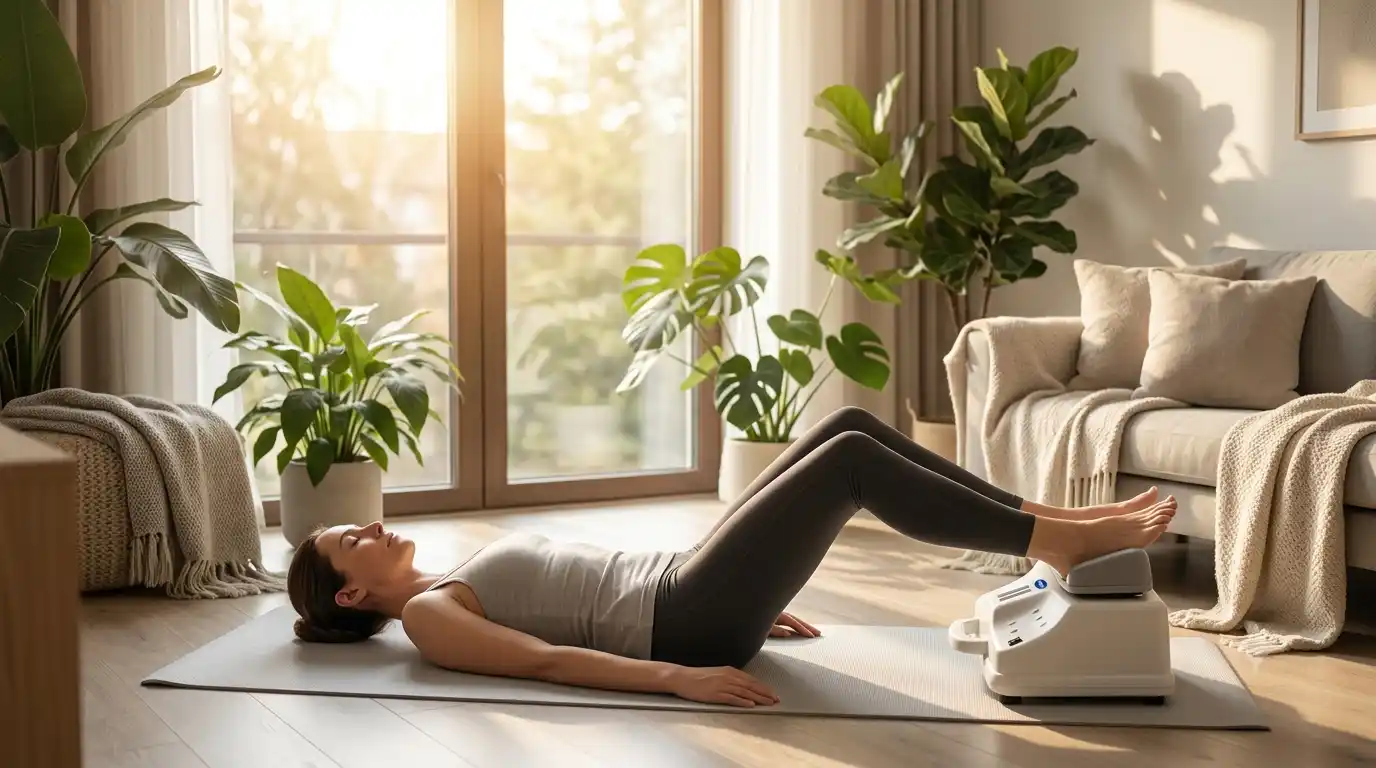
- A chi machine moves your ankles and hips side to side while you lie down, producing a passive, full-body sway rather than active exercise
- Users commonly describe the sensation as calming and similar to a gentle rocking massage, though this is a subjective response, not a clinically proven outcome
- Marketing claims about circulation, detoxification, or pain relief go well beyond what current research on the Chi Machine specifically supports
- People with back conditions, nerve issues, pacemakers, or who are pregnant should talk to a doctor before using one at home
- A realistic home routine starts at three to five minutes and treats the machine as a relaxation add-on, not a treatment
If you’re wondering whether a chi machine can genuinely help you relax at home, the honest answer is: it can produce a physical sensation many people find calming, through a simple mechanical motion — but the specific health claims attached to it (better circulation, detox, pain relief) are marketing language, not established medical fact. The device swings your ankles and lower body from side to side while you lie flat, a passive movement modeled on the way a goldfish moves through water. That’s the entire mechanism. What you make of the resulting sensation — and whether it’s safe for you — depends on your own body and, in some cases, a conversation with a doctor first.
How the Motion Actually Works
A chi machine is a small footrest unit connected to a motor that oscillates back and forth at an adjustable speed, typically somewhere between roughly 1 and 2.5 cycles per second depending on the model and setting. You lie on your back on the floor or a mat, place your ankles in the two padded cradles, and turn the unit on. As the footrest swings left and right, the motion travels up through your ankles, knees, and hips, creating a wave-like sway through the lower body and, to a lesser degree, the spine. Because you’re not contracting your muscles to produce the movement — the machine is doing all the work — this is classified as passive movement rather than active exercise, in the same category as passive range-of-motion techniques used in physical therapy for people who can’t move a limb on their own.
Most units include a rheostat or dial to control oscillation speed and a timer that shuts the machine off automatically, usually somewhere between 5 and 15 minutes. Higher-end “all-in-one” models add foot massage rollers or infrared heat to the footrest, but the core mechanism — side-to-side oscillation while lying flat — is the same across brands. Nothing about the device requires skill or training: you don’t need to time your breathing to it, hold a position, or follow instructions beyond lying still and letting your body move with the swing. That simplicity is a large part of why it’s marketed as a home relaxation tool rather than a fitness device — there’s no learning curve and no exertion involved.
What “Relaxation” Means Here — And What It Doesn’t
It’s worth separating three different things that tend to get blurred together in chi machine marketing: what the machine mechanically does, what companies claim it does, and what’s actually been shown. Mechanically, the oscillation is real and measurable — your body sways, your muscles are passively mobilized, and many people report their breathing slows down within a minute or two of the motion starting, similar to the effect of a gentle rocking chair or a car ride. That physical sensation of being rocked is plausible as a relaxation trigger on its own, independent of any deeper physiological claim.
Where the marketing overreaches is in framing that sensation as therapeutic: phrases like “detoxifies the lymphatic system,” “balances your chi,” or “cures back pain” appear frequently in product copy and are not supported by rigorous clinical evidence specific to the Chi Machine. Some small studies and clinical write-ups suggest passive oscillation exercise may help lymphatic drainage or leg swelling in specific populations under supervision, but that’s a narrow, supervised medical context — not the same as a general claim that a home unit will “improve circulation” for anyone who lies on it. If a session leaves you feeling calmer, that’s a legitimate and common experience; treating it as evidence of a physiological cure is a leap the current research doesn’t back up.
Setting Up a Session at Home
A typical home setup takes less than a minute: lie on a firm, flat surface — the floor with a mat or a yoga mat works better than a soft bed, since a mattress absorbs the oscillation instead of transmitting it through your body — and slide your ankles into the footrest cradles so they sit securely without pinching. Arms are usually left relaxed at your sides or folded loosely on your stomach; some people place a small pillow under the head or knees for comfort, though this is personal preference rather than a requirement.
Speed matters more than most first-time users expect. Starting at the lowest oscillation setting lets you gauge how your lower back and hips respond before increasing frequency — going too fast on a first session is the most common reason people report dizziness or mild nausea afterward, similar to motion sickness. Session length should build gradually: three to five minutes is a reasonable starting point, with many long-term users eventually working up to 10–15 minute sessions, but there’s no evidence that longer sessions produce proportionally greater benefit. Using it once daily, often in the evening as a wind-down before bed or after a workday, is the most common pattern reported by home users, though there’s no clinically established “optimal” frequency.
What the Evidence Actually Shows
The research picture here is thinner than the marketing suggests. There is no large, randomized controlled trial establishing the Chi Machine specifically as an effective treatment for back pain, circulation problems, or stress disorders. What does exist is a broader body of research on passive range-of-motion (PROM) exercise generally — used in rehabilitation settings for stroke patients, bedbound patients, and people recovering from surgery — showing it can help maintain joint mobility and may support circulation in people who are otherwise immobile. A small comparative study on elderly nursing home residents found passive motion exercise produced modest gait-speed improvements over 12 weeks, on par with — though generally smaller than — active exercise programs, but that study used dedicated rehabilitation equipment under supervision, not a consumer chi machine used casually at home.
Applying that research directly to a home chi machine session is a stretch the manufacturers frequently make anyway. What’s more consistently reported, even if not formally studied, is the subjective relaxation response: people who use the machine regularly often describe it as calming, in the same category as a massage chair or a warm bath — a real experience, but a wellness one, not a medical treatment. If you’re using a chi machine hoping to manage a diagnosed condition rather than simply to unwind, that’s a conversation for a doctor or physical therapist, not something to self-treat with a consumer device.
Who Should Be Cautious
Because the oscillation moves through the hips, lower back, and spine, anyone with an existing back condition — herniated disc, spinal stenosis, spondylolisthesis, or recent spinal surgery — should get clearance from a doctor before trying one at home, even at the lowest setting. The same caution applies to anyone with a nerve condition affecting the legs or lower back, since the repetitive motion could aggravate nerve irritation in ways that aren’t obvious until after a session. Pregnant users, people with a pacemaker or other implanted medical device, and anyone who has had recent abdominal or hip surgery should also check with a physician first — not because harm is proven, but because the Chi Machine hasn’t been specifically studied in these groups, and the manufacturer’s usual disclaimer language reflects that gap.
For older adults without a specific back or nerve diagnosis, the passive nature of the movement is often cited as an advantage — no standing, no balance requirement, no muscular effort — which is part of why it shows up in senior wellness settings and physical therapy offices as a supplementary tool. Even so, starting at the slowest speed and shortest duration lets you and, ideally, your doctor evaluate how your body responds before making it a regular part of your routine. A chi machine is never a substitute for prescribed physical therapy, medication, or other treatment a doctor has recommended — it sits alongside those, not instead of them.
Home Use vs. Spa or Clinic Settings
You’ll find chi machines both in consumer homes and in massage or wellness clinics, and the difference isn’t really the equipment — it’s the context. In a clinic, a chi machine session is typically supervised, time-limited, and offered alongside other modalities like massage therapy or vibration plates, with a practitioner on hand to answer questions about fit and speed. Clinics often position the device explicitly as a complement to hands-on bodywork, not a replacement for it — a detail that’s easy to lose when the same machine is marketed for solo home use.
At home, that supervision disappears, which puts more responsibility on you to start conservatively and stop if something feels wrong — sharp pain, numbness, or dizziness are signs to end the session immediately rather than push through. The tradeoff is convenience: a home unit lets you use it daily without booking an appointment, at whatever time fits your schedule, which is the main reason people buy one rather than just visiting a spa occasionally. If you’re new to passive oscillation and have any of the risk factors above, trying it once at a clinic or wellness center before buying a home unit is a reasonable way to gauge your own response under supervision first.
Building a Realistic At-Home Routine
Treating a chi machine as one small piece of a broader wind-down routine tends to produce more consistent satisfaction than expecting it to solve a specific health problem on its own. A common pattern reported by regular users: a short session in the evening, dim lighting, minimal screen use beforehand, and no expectation beyond a few calm minutes — the same logic behind a warm bath or a short walk, not a medical intervention. Pairing it with slow breathing, rather than scrolling a phone during the session, is the change most frequently mentioned as making the biggest difference in how relaxed people feel afterward.
It’s also worth being honest with yourself about diminishing returns: if a session isn’t producing any noticeable calming effect after a few consistent tries, more time on the machine is unlikely to change that, since the mechanism is simple and fixed rather than something that “builds” with practice the way strength training does. The realistic framing is a low-effort relaxation tool, not a therapy device — useful for some people as a consistent, screen-free wind-down ritual, unhelpful or even mildly uncomfortable for others, and never a reason to delay seeing a doctor about a back, nerve, or circulation issue that isn’t improving on its own.
How long should a beginner use a chi machine?
Most guidance suggests starting with three to five minutes at the lowest speed and increasing gradually over several sessions, rather than starting at a longer duration or higher speed on day one.
Can a chi machine actually improve circulation?
The specific claim that a chi machine improves circulation isn’t backed by strong clinical evidence. Broader research on passive range-of-motion exercise suggests some circulatory benefit for immobile patients under supervision, but that doesn’t translate directly into a proven claim for casual home use.
Is a chi machine safe for someone with back pain?
Not automatically. Anyone with a diagnosed back condition should get medical clearance before using one, since the oscillating motion moves through the lower back and could aggravate certain conditions.
Does using a chi machine count as exercise?
No. It’s classified as passive movement because the machine moves your body without any muscular effort on your part, which is different from active exercise in both mechanism and expected benefit.
Can I use a chi machine every day?
Many home users report using it daily, often in the evening, but there’s no clinically established optimal frequency — starting conservatively and paying attention to how your body responds is more important than following a fixed schedule.
Is a chi machine safe during pregnancy?
This should be discussed with a doctor first. The device hasn’t been specifically studied in pregnant users, and general caution around unsupervised passive movement devices during pregnancy is standard advice.
What’s the difference between a chi machine and a vibration plate?
A vibration plate is used standing up and engages muscles to stabilize against the vibration, while a chi machine is used lying down with no muscular effort involved — the two are complementary rather than interchangeable.
Sources
- Massage and Healing DFW — Chi Machines and Gentle Movement
- PMC — Passive and Active Exercises in Elderly Nursing Home Residents
- Healthline — Passive Range of Motion Explained
- Agility Health Solutions — Health Benefits of Passive Exercise
See also