
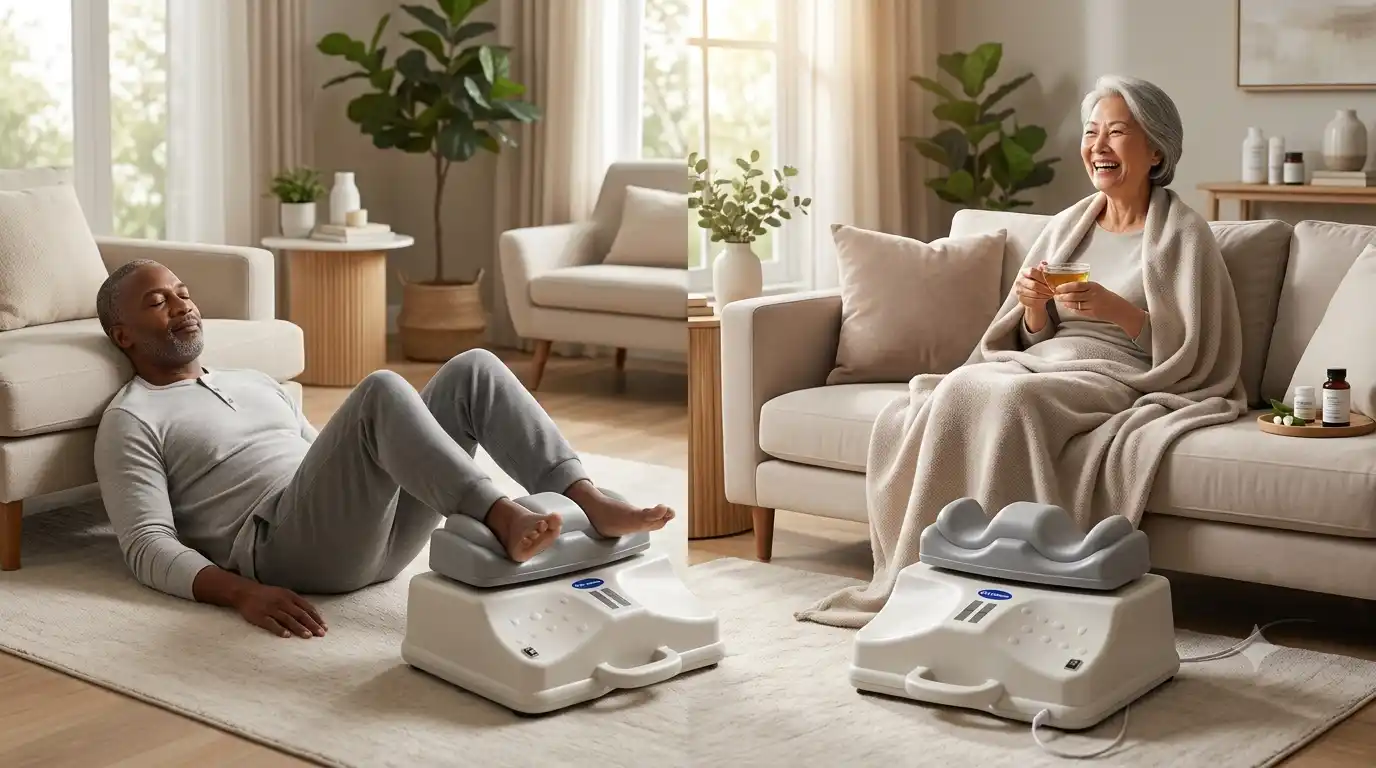
Chi Machine Benefits: What Users Experience
- Users most commonly describe a post-session “buzz,” deeper relaxation, and short-term easing of back or neck tension — described as subjective, self-reported effects, not clinically measured outcomes
- Reports are mixed on comfort: some people feel no discomfort at all, while others describe ankle, foot, or lower-back irritation during use
- Sleep quality and stress reduction are among the most frequently repeated themes across testimonials and reviews
- There is no large clinical trial specific to the chi machine — most of what circulates is personal or practitioner anecdote, not peer-reviewed proof
- People with recent surgery, fractures, heart conditions, pregnancy, or serious back/nerve problems should get medical clearance before using one
If you’re trying to figure out what people actually feel after using a chi machine — not what the box promises, but what users have experienced in practice — the honest answer is: it varies a lot, and it’s mostly relaxation and short-term tension relief rather than anything resembling a medical treatment. Reviews and testimonials describe a rhythmic, fish-tail-like oscillation of the hips and legs that some people find deeply calming and others find mildly disorienting. This article walks through the recurring patterns in what users experience — the good, the uncomfortable, and the parts where the evidence simply hasn’t caught up with the marketing — so you can weigh a chi machine against what it can realistically do for you.
The Sensation Users Describe Most Often
Across reviews, forums, and product testimonials, one experience shows up again and again: a rush of energy or lightness immediately after the machine stops. Some longtime users call this the “10-second buzz” — a wave of sensation that spreads from the feet up through the spine once the oscillation halts. This is a subjective report, not a documented physiological marker, but it’s consistent enough across accounts that it’s worth naming as a recognizable pattern rather than dismissing it outright.
During the session itself, the dominant description is of a full-body sway, sometimes compared to being gently rocked on water. Most users describe this as calming rather than stimulating, which is part of why the machine is marketed toward relaxation and stress-adjacent use rather than performance fitness. That said, not everyone reacts the same way: some reviewers of higher-speed units report that closing their eyes and fully relaxing into the motion can trigger mild dizziness, particularly during a first session or at higher oscillation speeds (some machines run in a range of roughly 78 to 156 cycles per minute, with older single-speed models fixed closer to a slower, steadier pace). This variability — calm for one person, disorienting for another — is one of the clearest patterns in the feedback, and it tracks with differences in machine wattage, motion width, and individual sensitivity to vestibular input.
Sleep and Stress: The Most Repeated Theme
If there’s one benefit that shows up more consistently than any other in user accounts, it’s improved sleep and a sense of reduced tension. Testimonials frequently mention falling asleep more easily after a session, staying asleep through the night, or simply feeling less wound up by evening. Some users frame this in terms of nervous system regulation — describing the oscillation as a kind of full-body shake that helps “discharge” stress before bed.
It’s worth being precise about what this claim is and isn’t. Some individual users, including practitioners who use the machine personally for chronic conditions, describe the effect in terms of calming an overactive stress response. That framing is a personal interpretation, not an established clinical mechanism — there is no robust research confirming that passive oscillation regulates the nervous system in a measurable way. What can be said more modestly is that lying still for several minutes while a machine gently moves your lower body is, for many people, a low-effort way to unwind, similar in effect to other passive relaxation routines like a warm bath or a slow stretch session. Whether that translates into meaningfully better sleep is going to differ from person to person, and marketing language that promises deep nervous-system healing outruns what’s actually been shown.
Back Tension and Muscle Relief: What Users Say vs. What’s Confirmed
Lower back tension is probably the second most common theme in chi machine reviews, right behind sleep. Reviewers describe using the machine after long periods of sitting — truck drivers, office workers, people recovering from long shifts on their feet — and reporting that the swaying motion loosens stiff muscles in a way that feels similar to a gentle massage. Some also mention using it for post-workout recovery, describing it as a way to “shake out” tightness in the legs and lower back after exercise.
None of this should be read as evidence that a chi machine treats back pain. The claim that’s actually supportable is narrower: passive, rhythmic movement of this kind can feel similar to other forms of gentle mobilization that some people find soothing for muscular tension, not that it corrects a structural back problem or replaces physical therapy. A handful of clinics and manufacturers point to limited research on passive oscillation devices for specific conditions like secondary leg lymphedema following cancer treatment, but that’s a narrow, specific application — it doesn’t generalize to “relieves back pain” or “fixes nerve issues” as blanket claims. Anyone with an existing back or nerve condition should treat user testimonials as anecdotal encouragement to ask a doctor about it, not as a substitute for that conversation.
Comfort Isn’t Universal — What the Mixed Reviews Show
One of the more useful things to take from aggregated user reviews is how split the comfort experience actually is. Some reviewers describe the machine as quiet, smooth, and free of any pain during use. Others, on the same models, report discomfort in the ankles or lower back, or a numb, tingling sensation in the feet by the end of a session. This isn’t a case of one bad batch of machines — it reflects real differences in body size, flexibility, existing joint issues, and how the ankle cradle fits a given user.
People with limited ankle flexibility or existing ankle, knee, or hip sensitivity are the ones most likely to report discomfort, which is consistent with guidance that recommends starting with very short sessions and placing a pillow under the knees for extra support until the body adjusts. Slower, variable-speed units are generally described as more tolerable for older users or people with limited mobility, while higher-wattage models with a wider range of motion are marketed more toward general wellness use or professional settings. If you’re considering a chi machine specifically because of back or nerve sensitivity, this variability in comfort is a good reason to start with the shortest possible session rather than assuming the “relaxing” reputation applies uniformly to everyone.
What a First Session Actually Feels Like
Based on how instructional guides and user walkthroughs describe it, a first session looks fairly modest compared to what the more enthusiastic testimonials might suggest. New users are typically advised to keep an initial session to two or three minutes, or under a minute if they’re currently dealing with a health issue, and to increase gradually in small increments as the body adjusts. The setup itself is simple: the machine sits on a firm, stable surface, the user lies flat with ankles resting in the cradle, and — for those with existing back or knee discomfort — a pillow under the knees is commonly recommended for the first few uses.
Afterward, most guidance recommends staying on the floor for a couple of minutes before standing, stretching the spine and hips, and drinking water. None of this is unusual or risky in itself, but it does underline that the “benefits” users describe are tied to a gradual, low-intensity introduction rather than an immediate dramatic effect. Manufacturers and instructional sources are also fairly consistent on when not to use the machine: within the first three months after surgery or a bone fracture, during a serious infection or bleeding injury, with existing heart disease, during pregnancy, or within thirty minutes of eating. These aren’t small print — they’re the same categories of caution that come up again and again in independent write-ups on chi machine safety, which is a signal that the precautions are taken seriously even by sources otherwise favorable to the product.
Reading Testimonials Honestly: Anecdote, Not Evidence
It’s worth stepping back and naming what these testimonials actually are: self-selected reports from people who bought the machine, used it, and were motivated enough — positively or negatively — to write about it. That’s useful information about lived experience, but it isn’t the same as clinical evidence. As of now, there’s no large, independent, randomized study specifically evaluating the chi machine’s effects on pain, circulation, or sleep. Much of what’s cited by sellers and wellness practitioners is personal account, small-scale observation, or research on passive motion devices more broadly rather than this specific product.
This matters most for the audience most likely to be drawn to a low-effort, relaxing device: older adults and people managing back or nerve issues. Passive oscillation is not the same thing as exercise in the medical sense — it doesn’t build strength, and it isn’t a verified treatment for a diagnosed condition. The more grounded way to read the testimonials is as evidence that a gentle, few-minutes-a-day habit of lying down and letting the body move passively is, for many people, a pleasant and low-risk addition to a routine — not as proof that it corrects an underlying health problem. Anyone using it alongside an existing back, nerve, or cardiac condition should treat it as a wellness accessory to discuss with their doctor, not a replacement for the care they’re already receiving.
Do chi machine benefits include real back pain relief?
Some users report feeling looser or less tense after a session, but this is a reported sensation, not confirmed clinical pain relief. Anyone with a diagnosed back condition should treat it as a possible comfort add-on, not a treatment.
How quickly do users notice chi machine benefits?
Most accounts describe noticing relaxation or a post-session “buzz” within the same session, while sleep-related benefits are usually described after repeated, regular use rather than a single try.
Is it normal to feel dizzy the first time you use a chi machine?
Some users report mild dizziness, especially at higher speeds or with eyes closed. This is why short introductory sessions of two to three minutes are commonly recommended for first-time use.
Can seniors safely use a chi machine?
Many chi machines are marketed toward older adults because of their slower speed settings, but anyone with joint issues, heart conditions, or balance concerns should confirm with a doctor first.
What’s the difference between passive exercise and regular exercise?
Passive exercise, like the oscillation from a chi machine, moves the body without muscular effort from the user, while regular exercise requires active muscle engagement. They are not interchangeable in terms of fitness or medical benefit.
Are chi machine benefits backed by scientific studies?
There’s no large, independent clinical trial specific to the chi machine. Most reported benefits come from personal testimonials and small-scale or unrelated research on passive motion devices.
Can I use a chi machine if I have a pinched nerve or existing back injury?
This should not be attempted without medical clearance first. Testimonials from other users with back issues are not a substitute for an individual medical assessment.
How long should a first chi machine session last?
Guides commonly recommend two to three minutes for a first session, less than a minute if you’re in poor health, increasing gradually in small increments as your body adjusts.
Sources
- How to Use the Chi Machine — wikiHow
- Chi Machine Review — Little Black Bag Medicine
- Chi Machines Are Gaining Popularity—But Are They Safe? — theSkimm
See also