
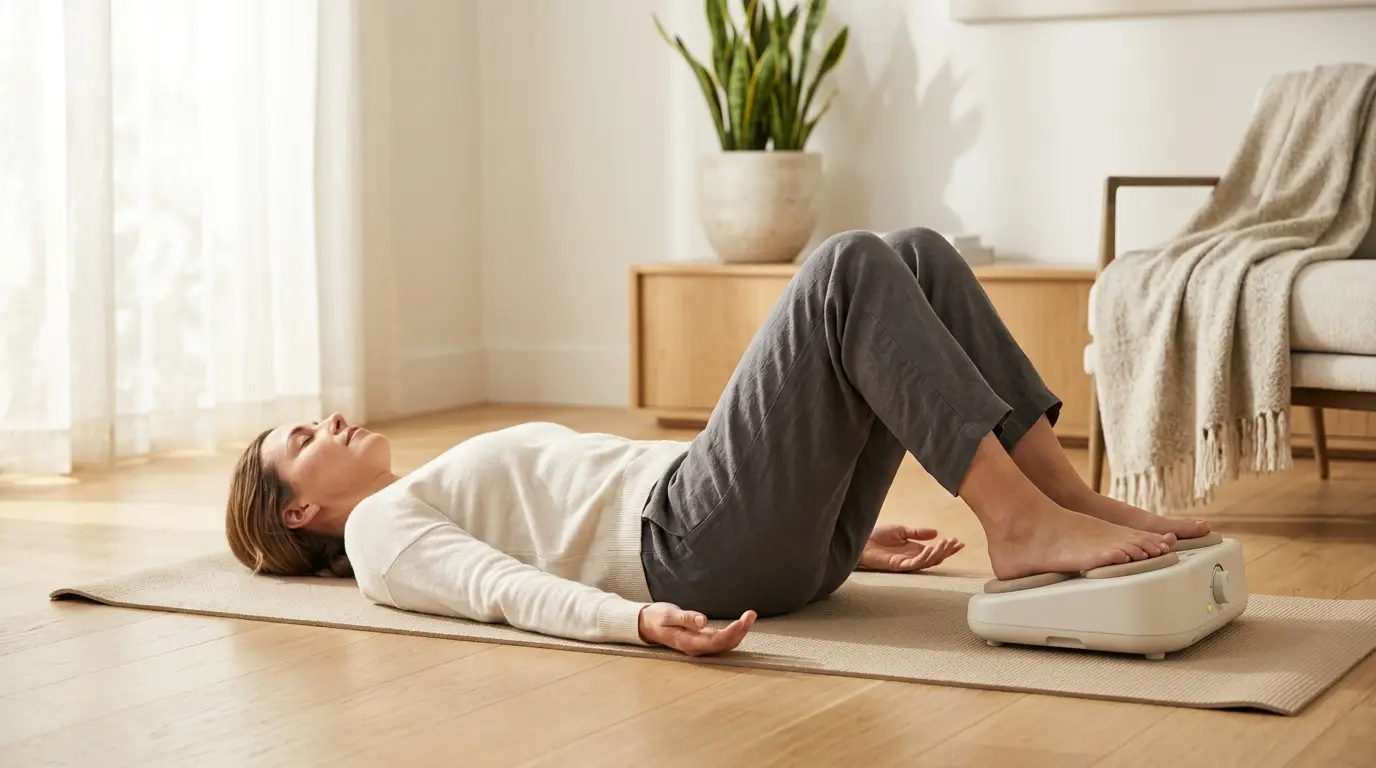
Why People Use Chi Machines Every Day
- Most regular users run a chi machine for 10–15 minutes, once or twice a day, often in the morning or before bed
- The habit persists because the machine requires no physical effort and fits into a passive daily routine rather than an active workout
- Reported daily benefits (energy, relaxation, reduced stiffness) are consistently described by users, but they remain self-reported rather than clinically confirmed
- The oscillating “goldfish motion” is a real, measurable mechanical action — what it does inside the body long-term is far less settled
- Anyone with back problems, nerve conditions, a pacemaker, or a recent surgery should check with a doctor before adopting a daily session
People use chi machines every day mainly because the routine asks almost nothing of them: lie down, place the ankles in the rests, and let the device oscillate the legs and hips for a set number of minutes. For someone managing fatigue, stiffness, or simply looking for a low-effort addition to their day, that simplicity is the whole appeal — no equipment to set up beyond the machine itself, no change of clothes, no risk of overexertion. The habit tends to form around a fixed time slot, most commonly morning or before bed, which is what turns an occasional try into a daily fixture. This article looks at what that daily routine actually involves, what users consistently report, and where the marketing language runs ahead of what’s actually been demonstrated.
The mechanical reason the habit is so easy to keep
A chi machine’s core action is straightforward: a motorized cradle moves the ankles from side to side, which passes a wave-like oscillation up through the legs, hips, and lower spine. Manufacturers commonly cite a motion frequency around 140–144 cycles per minute, producing the rhythmic “goldfish” swing the device is known for. Because the user doesn’t drive the movement — the motor does — there’s no exertion, no coordination required, and no learning curve. That matters for habit formation. Activities that demand willpower or physical effort (a walk, a stretching routine, a gym session) compete with fatigue and motivation on a given day. A chi machine session doesn’t; it can be done while reading, listening to something, or simply resting with eyes closed.
This is also why the device is frequently positioned for people who dislike or can’t tolerate vigorous exercise — those recovering from illness, managing limited mobility, or simply averse to structured workouts. The daily habit sticks not because the mechanism is dramatically more effective than other movement, but because the barrier to doing it is close to zero. That’s a genuinely different proposition from “exercise” in the conventional sense, and it’s worth being precise about the distinction: passive oscillation moves the body for you, whereas exercise requires the body to generate its own effort and adaptation. Both can have their place in a routine, but they are not interchangeable, and framing one as a replacement for the other overstates what a passive device can do.
What daily users typically report
Across product reviews, forums, and testimonials, the pattern of self-reported effects is fairly consistent: users describe feeling more alert after a session, an easier time falling asleep when using it in the evening, and a subjective sense that stiffness in the lower back and legs eases during the swing. Some describe a calming effect they attribute to the repetitive, predictable motion — similar to how a rocking chair or gentle massage can be relaxing without doing anything measurably therapeutic. Others use the daily session as a substitute for a walk on days when going outside isn’t practical, describing it as “something rather than nothing” on low-energy days.
It’s worth being clear about what these reports are and aren’t. They are consistent and widespread, which is meaningful as a signal of user experience, but they are also self-reported and largely anecdotal — the kind of testimonial evidence that shows up on manufacturer sites and social media, not in peer-reviewed research. A feeling of relaxation or reduced stiffness after 15 minutes of gentle, rhythmic motion is plausible and doesn’t require an unusual mechanism to explain; predictable, repetitive motion has a mild calming effect for many people, chi machine or not. That doesn’t make the reports false, but it does mean they shouldn’t be read as proof of a specific physiological benefit like improved circulation or lymphatic drainage.
Separating the mechanism from the marketing claim
This is where daily-use habits and marketing language tend to diverge. The mechanical fact is that the machine oscillates the lower body at a set frequency for a set duration — that part is not in dispute. What’s often layered on top is a set of claims about what that oscillation does: that it “improves circulation,” “activates the lymphatic system,” “oxygenates the blood,” or “balances the body’s chi.” These phrases show up consistently in product marketing and enthusiast content, and they are presented with much more certainty than the underlying evidence supports.
Some of these ideas have a surface plausibility — gentle movement of the legs can transiently affect local blood flow, in the same modest way that any passive limb movement might. But “improves circulation” as a durable, meaningful health outcome is a much stronger claim than “produces a temporary, localized effect during use,” and marketing copy routinely blurs that line. The honest framing is that a chi machine is marketed as supporting circulation and lymphatic flow, not that it has been shown to reliably do so at a level that changes health outcomes. Readers considering a daily habit are better served by treating these claims as unproven hypotheses attached to a real mechanical action, rather than as established facts about what the device accomplishes.
What the evidence actually shows
The honest answer here is that there isn’t a body of strong, independent, randomized clinical research specifically on chi machines. Most of what circulates — case studies, small in-house trials run by manufacturers, testimonials — falls well short of the kind of evidence that would be needed to confirm claims about circulation, lymphatic drainage, or pain relief as reliable outcomes. That’s a meaningful gap, particularly for a device marketed partly toward older adults and people managing chronic pain, groups for whom clear evidence matters more, not less.
None of this means the device does nothing. A short, gentle, low-impact movement session is unlikely to cause harm for most healthy adults, and mild relaxation effects from rhythmic motion are plausible and commonly reported. But the gap between “some users feel better after using it” and “the machine improves circulation or relieves chronic pain” is exactly where unqualified health claims tend to creep in. Articles and sellers that state these benefits as settled fact are getting ahead of the evidence. A more accurate description is that the chi machine offers a form of passive movement with a plausible, mild relaxation effect, while claims about circulation, lymphatic activation, or pain treatment remain marketing language rather than demonstrated outcomes.
How the daily routine actually looks in practice
Most guidance on frequency converges on a similar pattern: short sessions to start, building up gradually. First-time users are typically advised to begin with just two to three minutes, or even less for anyone in poor health, then add a couple of minutes at a time as the body adjusts. Once accustomed, a common recommendation is 10 to 15 minutes, once or twice a day — often once in the morning to start the day and once in the evening to wind down. Some sources also note that older adults, broadly those over 55, are advised to start with shorter 2–5 minute sessions and extend gradually over a few weeks rather than jumping straight to a 15-minute routine.
The daily habit also tends to include a few practical steps that aren’t strictly about the machine’s mechanism but do shape the routine: drinking a small glass of water beforehand, avoiding use within roughly 30 minutes of eating, and staying relaxed rather than tensing against the motion. None of these steps are about maximizing a specific physiological effect so much as making the session comfortable and sustainable as a daily practice — which, again, is a large part of why the habit persists where more demanding routines don’t.
Who should be cautious before starting a daily habit
Because chi machines are frequently marketed toward older adults and people managing back or nerve-related discomfort, it’s worth being explicit about who shouldn’t simply add a daily session without checking in with a doctor first. Common cautions include pregnancy, a pacemaker or heart condition, recent surgery or bone fracture (commonly cited as within the last three months), active bleeding injuries, or serious infection. Anyone with a diagnosed back or nerve condition — exactly the audience this kind of device is often marketed to — should get medical guidance before starting, rather than assuming a gentle mechanical motion is automatically safe for their specific condition.
This caution isn’t a formality. A device that moves the spine and hips passively can interact very differently with a herniated disc, spinal stenosis, or a nerve impingement than it does with ordinary stiffness from sitting at a desk. A chi machine is not a substitute for diagnosis or treatment of an existing back or nerve problem, and starting a daily habit without medical input is a real risk for exactly the population most likely to be drawn to the product’s promises of gentle relief.
How long should a chi machine session last?
Most guidance suggests starting with just 2–3 minutes for first-time users, then gradually increasing in small increments as the body adjusts, working up to roughly 10–15 minutes per session.
How many times a day should you use a chi machine?
A common recommendation is once or twice daily, often morning and evening, though people new to the device or managing a health condition are usually advised to start with shorter, less frequent sessions.
Does using a chi machine every day actually improve circulation?
Some users report feeling warmer or looser in the legs during and after use, but claims of measurably improved circulation are marketed rather than confirmed by strong independent clinical evidence.
Is a chi machine safe to use daily if I have back pain?
Not automatically. Back pain has many underlying causes, and passive spinal movement isn’t appropriate for all of them, so a doctor should confirm it’s suitable before adding it to a daily routine.
Can older adults use a chi machine every day?
Many older adults do, often starting with shorter 2–5 minute sessions and extending gradually over a few weeks, but anyone with a heart condition, pacemaker, or recent surgery should get medical clearance first.
Is a chi machine session the same as exercise?
No. It’s passive movement generated by the machine rather than active physical exertion, so it shouldn’t be treated as a replacement for exercise in the medical sense.
Why do people prefer a chi machine over other daily movement routines?
Mainly because it requires no coordination or physical effort — users lie down and let the motor do the work, which lowers the barrier to doing it consistently compared to routines that demand active exertion.
Sources
- How to Use the Chi Machine (frequency, session length guidance)
- Chi Machine and its Important Benefits (mechanism, cycles per minute)
- Sunshine Chi Machine — usage recommendations
- Chi Machines Are Gaining Popularity—But Are They Safe?
See also