
Can Chi Machines Improve Body Awareness? What the Evidence Suggests
- Body awareness (proprioception) is your brain’s sense of where your limbs are without looking — chi machines don’t directly train it the way active balance exercises do
- Some passive-movement research suggests repetitive joint motion can modestly improve position sense, but no study has tested this on Chi Machine devices specifically
- The rhythmic, side-to-side oscillation may promote a calming, present-moment body awareness similar to rocking-chair motion, distinct from clinical proprioceptive training
- People with back or nerve conditions should treat any body-awareness benefit as a secondary, unproven effect — not a reason to skip medical guidance
- The honest answer: the machine may support attentiveness to bodily sensation, but “improved proprioception” is not a claim backed by dedicated clinical trials
If you search for whether a chi machine can improve “body awareness,” you’re likely asking one of two things: does the oscillating motion train your brain to sense your body’s position better (proprioception), or does lying still while your legs sway just make you feel more attuned to your body in a general, relaxed sense. The honest answer sits between the two. There is no published clinical research testing Chi Machine devices specifically on proprioception or body awareness outcomes. What exists is adjacent research on passive limb movement and rhythmic motion more broadly, some of which points to modest, plausible mechanisms — and some of which simply doesn’t apply to a device where you remain passive throughout. This article breaks down what body awareness actually means, what the passive-movement research says, and where the manufacturer’s framing outpaces the evidence.
What “Body Awareness” Actually Means
Body awareness is often used loosely, but in physiology it usually refers to proprioception: the sense that tells your brain where your limbs are in space without needing to look at them. It’s what lets you touch your nose with your eyes closed, walk down stairs without staring at your feet, or catch yourself before a fall on uneven ground. Proprioception depends on receptors in your muscles, tendons, and joints feeding constant position and movement data to your nervous system.
There’s also a broader, more subjective use of the term — the kind referenced in mind-body and occupational therapy literature — describing conscious attention to internal bodily sensations: noticing tension, breath, weight distribution, or comfort. Research on this dimension (sometimes called “interoceptive” or phenomenological body awareness) links it to practices like body scanning, qigong, and mindful movement, and associates it with reduced pain perception and improved emotional regulation in some clinical populations.
These are two different things, and it matters which one a chi machine might plausibly influence. The mechanical oscillation of a chi machine is a passive input — your muscles aren’t actively contracting to hold a position or correct a movement, which is the primary mechanism through which most active proprioceptive training works. That doesn’t rule out an effect on the second, more subjective kind of body awareness, but it does mean the two shouldn’t be conflated when evaluating a marketing claim.
How the Chi Machine’s Motion Might Interact With Your Nervous System
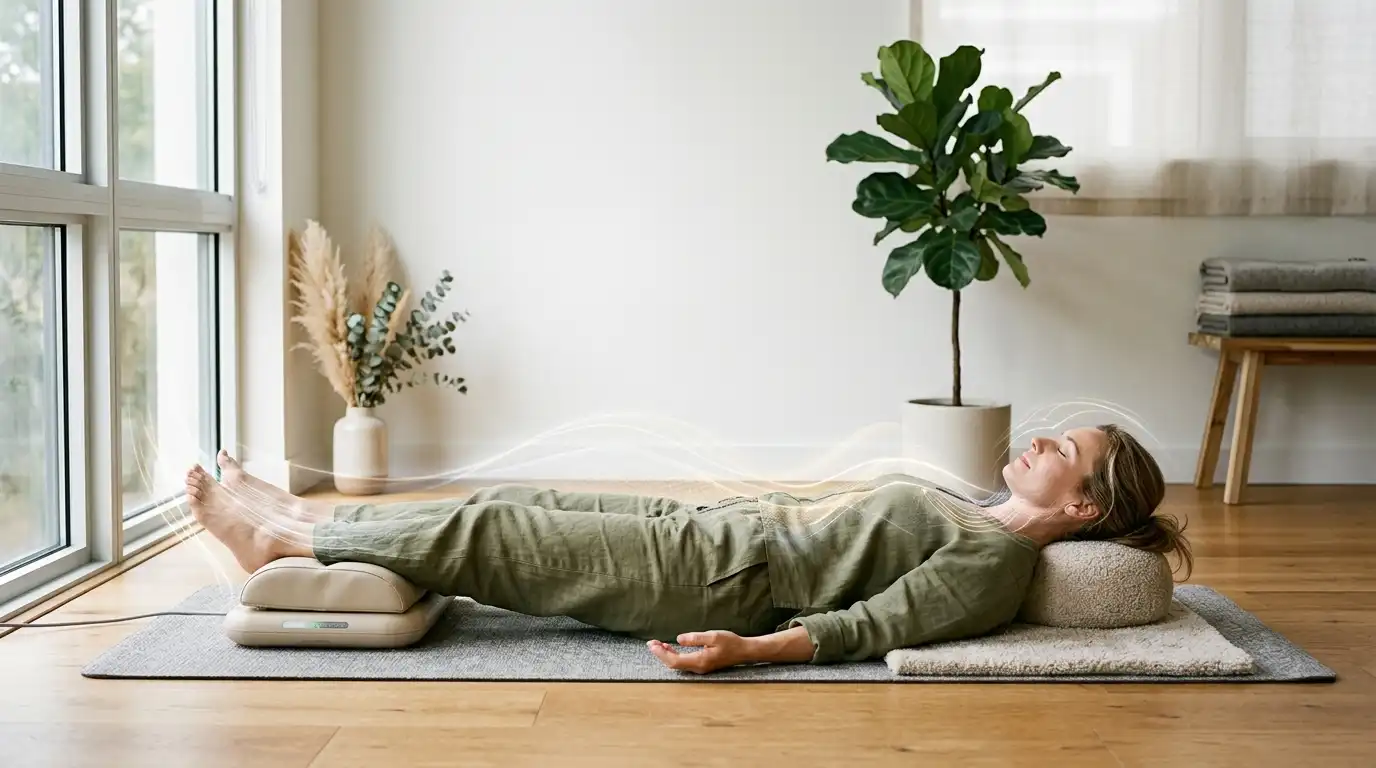
The chi machine works by cradling your ankles and swinging your legs side to side in a rhythmic, fish-tail motion — often described as the “goldfish exercise.” Mechanically, this is a form of passive limb movement: your muscles and joints are moved for you rather than by voluntary effort.
Passive movement isn’t inert from a sensory standpoint. Research on passive movement training — using devices that move a single joint through a repeated range of motion — has found it can stimulate the same mechanoreceptors involved in position sense, since these receptors respond to joint angle and stretch regardless of whether the motion is active or externally applied. One study comparing repetitive passive and active movement in the forearm found that repetitive passive movement produced a measurable improvement in joint position accuracy, in some cases outperforming active movement for that specific joint and population. That’s a meaningful finding, but it was conducted on young, healthy forearms using a targeted single-joint device — not a whole-body reclining machine, and not on older adults or people with back or nerve impairment, which the study’s own authors flagged as a limitation.
Separately, rhythmic whole-body motion — the kind associated with rocking chairs — has a documented calming effect via the vestibular system, the inner-ear network that senses motion and balance. Gentle, predictable rocking is thought to signal safety to the nervous system, slow breathing, and shift attention toward bodily sensation rather than external stressors. A chi machine’s oscillation shares some of this rhythmic, predictable quality, which may explain why users often describe a sense of “settling into their body” during a session — a subjective, relaxation-linked form of body awareness rather than a trained proprioceptive skill.
What the Actual Research Shows (and Doesn’t)
It’s worth being direct about the evidence gap. No peer-reviewed study has tested a Chi Machine device against proprioception, body awareness, or balance outcomes. The research base for the product’s core claims is thin enough that even wellness-oriented physicians who are generally open to complementary approaches have publicly noted the absence of studies validating or disproving the manufacturer’s claims about circulation, lymph flow, or internal organ function.
What does exist is a body of adjacent research: systematic reviews of proprioceptive training generally, studies on device-assisted passive joint movement, and separate literature on active mind-body practices like Tai Chi and Qi Gong. Tai Chi in particular has a much stronger evidence base, with systematic reviews linking it to measurable improvements in balance, fall risk, and physical function in older adults — but Tai Chi is an active practice requiring voluntary muscle control, weight-shifting, and conscious coordination, which is mechanistically very different from lying passively while a machine moves your legs. One neuroscience study using Tai Chi practitioners even found no significant change in an objective measure of proprioceptive accuracy after Tai Chi training, despite improvements in subjective bodily awareness during a sensory illusion task — a reminder that even in active practices, “feeling more aware of your body” and “measurably better position sense” don’t always move together.
Applying Tai Chi’s evidence to a chi machine, or applying single-joint passive-movement research to a full-body oscillating device, is a stretch that the current literature doesn’t support. Any body-awareness claim for the Chi Machine should be understood as plausible but unproven, not established.
Passive Motion vs. Active Exercise: Why the Distinction Matters Here
This is the crux of most inflated claims around passive-exercise devices: passive motion is not the same as exercise, and the body-awareness benefits associated with “exercise” in the research literature are largely tied to the active, effortful component — balance challenges, weight-bearing, muscular correction — that a chi machine doesn’t provide.
Proprioceptive training programs used in physical therapy typically involve tasks like standing on unstable surfaces, single-leg balance work, or resisted joint-matching exercises, where the nervous system has to actively interpret sensory feedback and generate a corrective motor response. That feedback loop — sense, interpret, correct — is thought to be central to how proprioception improves over time. A chi machine removes the “correct” step entirely, since your legs are being moved for you rather than responding to a balance challenge you’re actively managing.
This doesn’t mean the passive input is meaningless. The mechanoreceptor stimulation from passive movement is real, and some passive-movement studies do report modest position-sense gains. But it does mean the mechanism is narrower and less well-established than what’s driving proprioceptive gains from active balance training, Tai Chi, or targeted physical therapy. If body awareness in the fuller sense — balance, fall prevention, confident movement — is your actual goal, a chi machine session is not a substitute for active balance or strength work, and shouldn’t be marketed or understood as one.
Who Should Be Cautious About This Claim
Because the target audience for chi machines skews toward older adults and people managing back or nerve issues, it’s worth being explicit: an unproven body-awareness or proprioception benefit is not a reason to use a chi machine without first checking with a doctor, particularly if you have a diagnosed back condition, nerve impairment, a pacemaker, are pregnant, or have had recent spinal or joint surgery. The oscillating motion moves the lower back and hips passively, and for someone with an unstable spinal condition, sciatica, or a healing nerve injury, that motion could aggravate symptoms rather than help them, regardless of any relaxation or awareness benefit reported by other users.
It’s also worth noting that improved subjective body awareness — feeling more relaxed or “in tune” with your body — is not the same as improved proprioceptive accuracy or reduced fall risk, and shouldn’t be treated as evidence that balance or coordination has objectively improved. For people already managing balance concerns, a chi machine session is not a validated substitute for physical therapy, supervised balance training, or a home exercise program prescribed by a clinician.
A Realistic Way to Think About What You’re Getting
Given the evidence, the most accurate framing is this: a chi machine session may plausibly support a relaxed, present-moment attentiveness to bodily sensation — similar in mechanism to rhythmic rocking — and may provide some mechanoreceptor stimulation comparable to passive-movement research on single joints. What it has not been shown to do is measurably improve proprioceptive accuracy, balance performance, or fall risk, which is what “body awareness” means in the clinical and rehabilitation literature that manufacturers often gesture toward.
If your interest is in the calming, attention-shifting effect of rhythmic motion — the same effect people describe from rocking chairs — that’s a reasonable and modest expectation to bring to a session. If your interest is in genuinely training your nervous system’s sense of joint position and balance, the stronger evidence points toward active approaches: Tai Chi, targeted balance exercises, or physical therapy protocols specifically designed and tested for that purpose, ideally chosen in consultation with a healthcare provider familiar with your back or nerve history.
Does a chi machine actually improve proprioception?
There’s no published research testing chi machines against proprioception outcomes. Adjacent research on passive single-joint movement suggests a modest effect is plausible, but it hasn’t been demonstrated for this device or this population.
Is body awareness the same as proprioception?
Not exactly. Proprioception is the physiological sense of limb position and movement. “Body awareness” often refers more broadly to conscious attention to bodily sensation, which is a related but distinct concept in the research literature.
Can passive movement improve balance?
Some passive-movement studies show gains in joint position sense, but balance improvement in the research literature is mostly linked to active training that includes a correction or feedback component, which passive devices don’t provide.
Is Tai Chi’s evidence relevant to chi machines?
Not directly. Tai Chi is an active practice with a stronger evidence base for balance and fall prevention, but its mechanism relies on voluntary muscle control and weight-shifting that a passive chi machine doesn’t replicate.
Why does a chi machine feel calming even without active exercise?
The rhythmic, side-to-side motion resembles rocking, which is associated with vestibular stimulation and a shift toward a calmer nervous system state — a relaxation effect distinct from proprioceptive training.
Should someone with back problems use a chi machine for body awareness?
Any potential body-awareness benefit is unproven and shouldn’t outweigh medical caution. People with back or nerve conditions should consult a doctor before using a chi machine, regardless of claimed wellness benefits.
Are there age-related considerations for proprioceptive claims?
Most passive-movement research on proprioception has been conducted on young, healthy adults, and study authors note results may not generalize to older adults or people with joint or nerve impairment.
Sources
- Proprioception Exercises for Better Balance and Body Awareness — Healthline
- The Effectiveness of Proprioceptive Training for Improving Motor Function — PMC
- The Effect of Repetitive Passive and Active Movements on Proprioception Ability — PMC
- Proprioception: What It Is, How To Improve It & Disorder — Cleveland Clinic
- Contemplating Chi Machines? — DrWeil.com
- Mind and Body Practices — NCCIH
See also