
Why Chi Machines Are Different From Other Wellness Devices
- A chi machine moves the legs and lower body in a passive, side-to-side oscillation (often described as a “goldfish motion”) — it does not vibrate, knead, or require any muscle effort from the user
- Vibration plates use rapid mechanical vibration to trigger involuntary muscle contraction, which is a mechanically different stimulus than the slow rocking of a chi machine
- Massage chairs and handheld massagers apply direct, localized pressure (rollers, nodes, percussion) to specific muscle groups, while a chi machine works the whole body passively and at once
- None of these categories are supported by strong clinical evidence for treating back pain or nerve conditions — they are marketed as wellness tools, not medical devices
- People with back injuries, nerve conditions, pacemakers, or recent surgery should check with a doctor before using any of these devices, chi machines included
People searching for why chi machines are different from other wellness devices are usually comparing three things at once: a chi machine, a vibration plate, and a massage chair or massager, trying to figure out which one actually matches what they need. The short answer is that these devices don’t do the same job. A chi machine produces a slow, passive side-to-side oscillation of the legs and lower body while you lie flat — no vibration, no kneading, no muscle effort required. Vibration plates work through fast mechanical vibration that makes muscles contract involuntarily. Massage chairs and handheld massagers apply direct, localized pressure to specific spots. The distinction matters most for older adults or people with back or nerve issues, since “passive” and “gentle” are not the same as “medically proven,” and the right device depends on what your body can safely tolerate.
The Passive Motion Mechanism Behind a Chi Machine
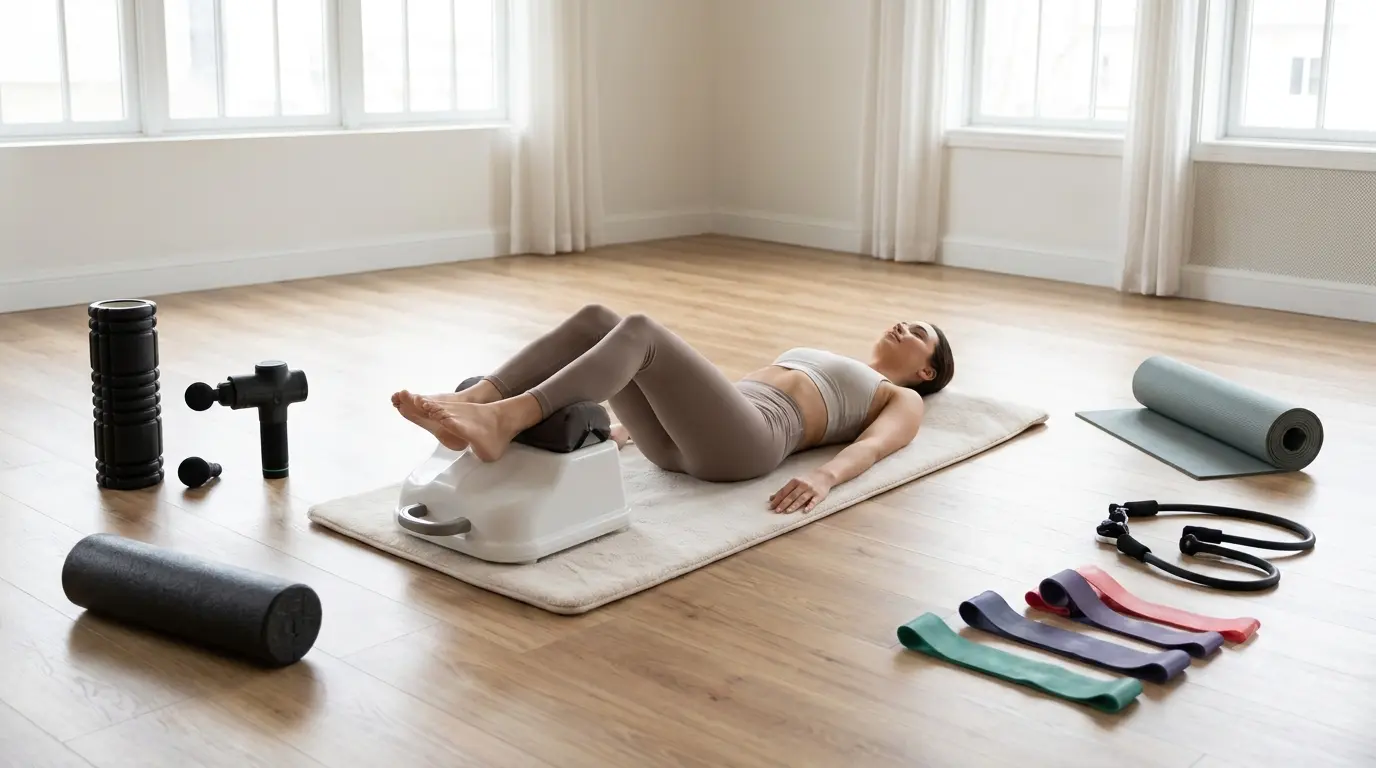
A chi machine is built around one specific motion: you lie on your back, rest your ankles in a padded cradle, and a motor swings your legs from side to side in a rhythmic, wave-like pattern. Most consumer models run at a fairly constant pace, and the movement travels up through the hips and lower spine as the legs sway. This is often compared to a goldfish swimming — a smooth, continuous figure-eight motion rather than a jolt or a bounce.
The key word here is passive. You do not contract your muscles to produce the movement; the machine does the work while your body stays relaxed. That’s fundamentally different from every device that relies on you generating force, and it’s also different from vibration-based tools, which stimulate muscle contraction rather than bypassing it. Because the motion is so gentle and the user stays reclined, chi machines are frequently positioned for people who cannot stand for long periods, cannot tolerate a workout, or are looking for a low-effort way to introduce some form of movement into a sedentary day.
It’s worth being precise about what this mechanism does and doesn’t do. The oscillation moves the lower body and, by extension, applies gentle motion to the hips and lower back. Manufacturers frequently describe this as supporting circulation or lymphatic flow, and the general physiological logic — that rhythmic movement can assist fluid movement in the body — isn’t controversial in itself. But that is a mechanical description, not a guarantee of a specific health outcome, and it should be read as such.
Chi Machine vs. Vibration Plate: Oscillation Is Not Vibration
The comparison people ask about most often is chi machine versus vibration plate, and the confusion is understandable — both are passive-feeling devices you stand or lie on rather than actively exercising with. But the physical inputs are quite different. A vibration plate delivers rapid, small-amplitude vibrations, frequently in a range that some research settings measure between roughly 20 and 100 hertz, through a platform you stand on. That vibration forces a reflexive muscle contraction as your body tries to stabilize itself, which is why vibration plates are marketed around muscle activation and bone-density support, particularly for people who cannot do traditional weight-bearing exercise.
A chi machine, by contrast, doesn’t ask your muscles to do anything. The oscillation is slow — commonly cited around 140-plus cycles per minute on many consumer models — and horizontal rather than vertical, and you’re lying down rather than standing and balancing. There’s no reflexive contraction to speak of, which is precisely why chi machines are often positioned as more accessible for people who can’t safely stand on a vibrating platform, including some older adults or people with balance concerns.
Neither device should be treated as interchangeable with the other, and neither should be treated as a proven treatment. Research on whole-body vibration includes some clinically supervised studies using calibrated equipment, and experts in that field have specifically cautioned that consumer vibration plates sold online are often not built to the same specifications as the devices used in those studies. Chi machines have even less of a dedicated clinical research base — most of what’s written about them comes from manufacturer material and anecdotal user reports rather than controlled trials. If your goal is bone density or muscle stimulation specifically, a chi machine’s oscillation is not designed to produce that effect the way a vibration plate’s contraction-triggering vibration is claimed to.
Chi Machine vs. Massage Chairs and Handheld Massagers
Massage chairs and handheld massagers solve a different problem than a chi machine does. Their mechanism is direct pressure: rollers tracking along the spine, kneading nodes working the shoulders, or a percussion head hammering into a single tight muscle. That makes them effective for targeting a specific sore spot — a stiff neck, a knotted upper back, a tight calf — in a way a chi machine simply isn’t built to do, since a chi machine’s motion is diffuse and whole-body rather than localized.
A chi machine’s advantage is the opposite one: it’s hands-free, requires no adjustment of intensity or targeting, and moves the whole lower body and spine gently at once rather than concentrating force on one area. Where a massage chair session might run 15 to 20 minutes with the user actively choosing a program, a chi machine session is typically shorter and simpler — lie down, set a timer, let the legs sway. That simplicity is part of the appeal for people who find massage chairs too intense, too loud, or too complicated to operate, and it’s also why some people use the two devices for different purposes rather than choosing one over the other — a chi machine for a nightly wind-down routine, a massager for a specific ache earlier in the day.
Neither category should be assumed safe by default for people managing an existing back condition. The pressure from a massage chair roller or a percussion massager can aggravate an existing disc issue or nerve irritation if used on or near the wrong spot, and the oscillating motion of a chi machine, while gentle, still moves the lower spine and hips — which is exactly why anyone with a diagnosed back or nerve condition should get a doctor’s input before regular use of either device, not just one of them.
Passive Exercise vs. Active Exercise Equipment
This is where the “different from other wellness devices” question gets most important, because chi machines are sometimes marketed alongside treadmills, exercise bikes, or resistance equipment — and that framing is misleading. Active exercise equipment requires voluntary muscle contraction: pedaling, walking, pushing against resistance. A chi machine involves none of that. It falls into the category clinicians describe as passive exercise — movement performed on the body by an external force, without the user’s own muscular effort.
That distinction isn’t just semantic. Passive and active exercise are studied as genuinely different interventions in rehabilitation settings, and research in elderly populations has found passive motion approaches and active motion approaches can produce comparable improvements in certain functional fitness measures for people who are otherwise limited in their ability to move. That’s a meaningful, if narrow, finding — it applies to specific rehabilitation contexts with supervised protocols, not to a general claim that a consumer chi machine at home replaces walking, strength training, or prescribed physical therapy.
For someone who is mobile and capable of active exercise, a chi machine is not a substitute for it — it doesn’t build strength, doesn’t meaningfully raise heart rate the way sustained active movement does, and doesn’t carry the cardiovascular training effect that walking or cycling does. Where it may have a legitimate role is for people who genuinely cannot tolerate active exercise: someone recovering from a procedure, someone with severe mobility limitations, or someone whose doctor has specifically restricted activity. In those cases, a passive device that introduces some gentle movement without strain has a different purpose than a treadmill — but that purpose should be defined with a healthcare provider, not assumed from marketing copy.
Who a Chi Machine Is Actually Designed For
Chi machines are consistently marketed toward older adults, people managing chronic pain, and people who struggle with standing or active movement — and the passive, reclined nature of the device does make it more physically accessible than a vibration plate you have to stand on or a treadmill you have to walk on. For someone who spends most of the day seated or in bed, a few minutes of gentle leg oscillation is a lower barrier to entry than almost any other wellness device on this list.
But “accessible” is not the same as “appropriate for everyone in that group,” and this is precisely where caution matters most. People with back injuries, herniated discs, or diagnosed nerve conditions should not start using a chi machine without checking with a doctor first — the oscillating motion moves the hips and lower spine, and what feels gentle to one person’s back can aggravate a compressed nerve or an unstable disc in another. The same caution applies to pregnancy, a pacemaker or other implanted device, recent spinal or abdominal surgery, and uncontrolled blood pressure conditions. None of these are edge cases; they’re common enough in the exact demographic chi machines are marketed to that skipping the doctor conversation is a real risk, not a formality.
What the Evidence Actually Shows
It’s worth being direct about the research gap here, because it’s the single biggest difference between how chi machines are marketed and what’s actually been established. There is no strong, randomized clinical trial specifically evaluating chi machines for circulation, back pain, or lymphatic function. What exists is mostly manufacturer material, wellness-practitioner testimonials, and general physiological reasoning about how rhythmic movement can support fluid flow in the body — reasoning that is plausible but not the same as proof.
Vibration plates have somewhat more clinical grounding, with some research-grade devices studied for bone and muscle health, but even there, experts have pointed out that findings are mixed and that consumer products sold online often don’t match the specifications of the equipment used in studies. Massage chairs and massagers have the most immediate, easily verified benefit — most people can feel localized muscle tension ease during use — but physical therapists are consistent in saying that a massage chair is not a substitute for evaluating and treating an actual injury.
Put together, none of these three categories should be marketed or chosen as a treatment for a diagnosed condition. They’re best understood as wellness tools that may support comfort and routine, not medical devices, and the honest answer to “which one works” depends more on what mechanism your body can tolerate — pressure, vibration, or passive oscillation — than on which product’s marketing sounds most convincing.
Is a chi machine the same thing as a vibration plate?
No. A chi machine produces slow, horizontal side-to-side oscillation of the legs while you lie down, with no muscle contraction involved. A vibration plate delivers rapid vertical vibration through a platform you stand on, which triggers reflexive muscle contraction. They use different mechanisms and are generally marketed for different goals.
Can a chi machine replace a massage chair?
Not really — they solve different problems. A massage chair applies direct, targeted pressure to specific sore spots using rollers or kneading nodes. A chi machine moves the whole lower body gently and passively but doesn’t target a single tight muscle the way a massage chair can.
Is a chi machine considered active or passive exercise?
Passive exercise. The machine moves your legs; you don’t contract your muscles to produce the motion. This is a distinct category from active exercise equipment like treadmills or exercise bikes, which require voluntary effort.
Is it safe to use a chi machine if I have back pain?
Not automatically. The oscillating motion moves the hips and lower spine, which can help some people relax but can also aggravate a disc issue or nerve irritation in others. Anyone with a diagnosed back or nerve condition should check with a doctor before using a chi machine regularly.
Do chi machines actually improve circulation?
Manufacturers claim this, and the general logic of rhythmic movement supporting fluid flow is plausible, but there’s no strong clinical trial specifically confirming this effect for chi machines. It’s best treated as a marketed claim rather than an established fact.
Who should avoid using a chi machine?
People with pacemakers or other implanted devices, recent spinal or abdominal surgery, unstable back or nerve conditions, pregnancy, or uncontrolled blood pressure should speak with a doctor before use. These aren’t rare exceptions — they’re common enough in the age group chi machines target that the conversation shouldn’t be skipped.
Which is better for seniors — a chi machine or a vibration plate?
It depends on mobility. A chi machine is used lying down and requires no standing or balancing, which can make it more accessible for seniors with limited mobility. A vibration plate requires standing on a moving platform, which may not be appropriate for someone with balance concerns. Either choice should factor in any existing back, nerve, or cardiovascular conditions.
Sources
- Vibration Plates and Chi Machines Supporting Healing — Connective Integration Massage Therapy
- Chi Machine vs Traditional Massagers — Zenchi
- Vibration plates: Are there health benefits? — UT MD Anderson
- Active vs. Passive Exercise for Stroke Recovery — Flint Rehab
- Passive and active exercises are similarly effective in elderly nursing home residents — NCBI
- Chi Machine and its Important Benefits — Austin Ozone
See also