
Chi Machine Safety and Proper Usage: Who Should (and Shouldn’t) Use One
- The Chi Machine moves the legs and hips passively at a set oscillation speed; it is not a substitute for active exercise or medical treatment.
- Recent surgery, bone fractures, epilepsy, severe infections, cardiac conditions, and pregnancy are consistently listed as contraindications across manufacturer documentation.
- People with implanted devices such as pacemakers should get explicit medical clearance before use, given general precautions around electrical and magnetic household devices.
- Back and nerve conditions require caution, not automatic exclusion — start at the lowest speed and stop immediately if pain increases.
- No large-scale clinical trial has established the Chi Machine’s therapeutic effectiveness; claims about circulation, detox, or pain relief remain marketing language, not established medical fact.
If you’re considering a Chi Machine, or already own one, the question that matters most before your first session isn’t “does it work” — it’s “is it safe for me.” The device oscillates your legs and hips side to side at a fixed rhythm while you lie on the floor, and for most healthy adults that motion is low-risk. But the same rocking action that feels relaxing to one person can be inappropriate for someone recovering from surgery, living with epilepsy, or wearing a pacemaker. This article lays out who should avoid the Chi Machine, what precautions apply to back and nerve conditions, and how to set up and run a session correctly — based on manufacturer safety documentation and general medical guidance on passive movement devices, not on marketing copy.
How the Chi Machine Actually Moves Your Body
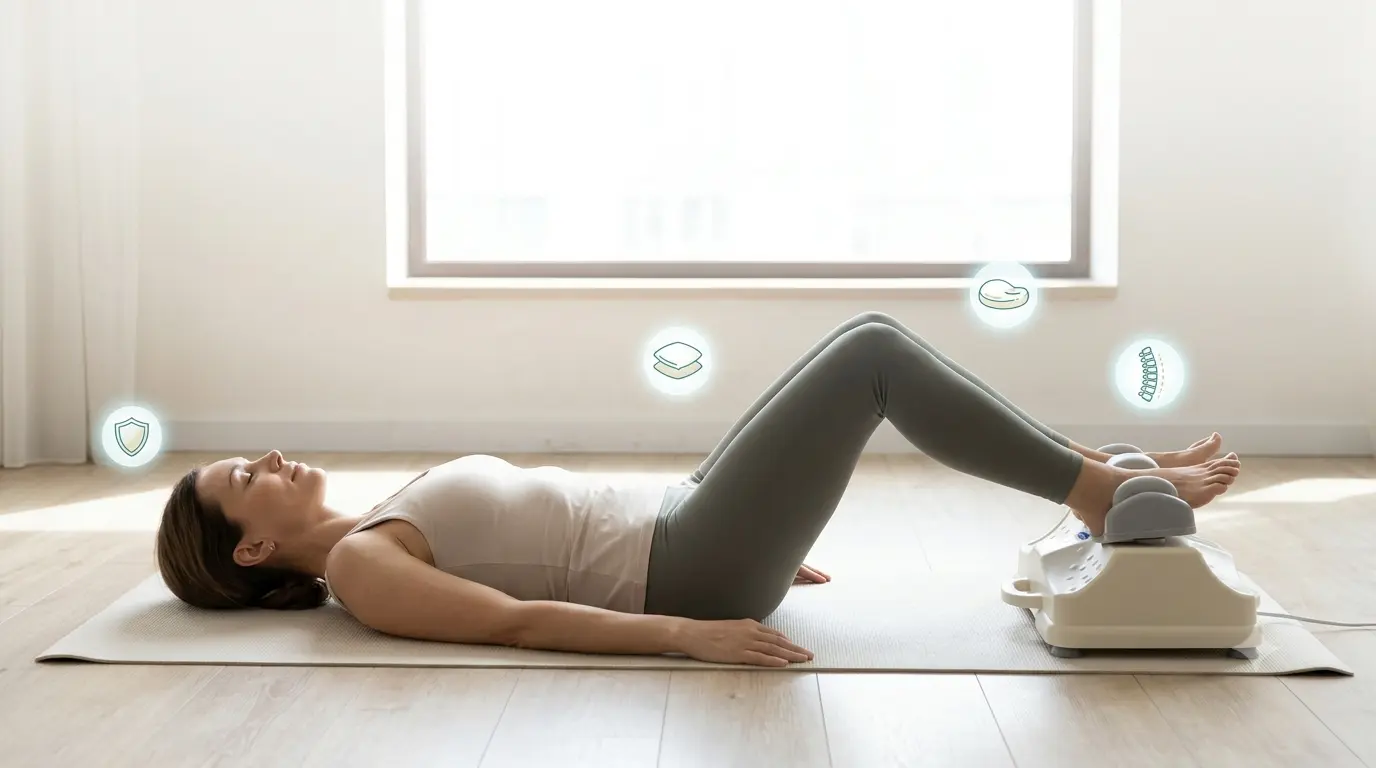
Before getting into safety rules, it helps to understand what the machine physically does, because the precautions only make sense in that context. You lie on your back on the floor and rest your ankles in two padded cradles attached to a motorized base. Once switched on, the base swings side to side, which translates into a lateral rocking motion that travels up through your ankles, hips, and lower spine — often described by manufacturers as a “goldfish” or “figure-8” motion, referencing a Japanese exercise technique. Typical devices run at a fixed or adjustable speed, commonly cited around 140–150 oscillations per minute, and sessions are usually capped at 15 minutes by an automatic shut-off.
This is entirely passive movement: your muscles aren’t contracting to produce the motion, the motor is doing the work. That distinction matters for two reasons. First, it’s why the machine is marketed to people who can’t or don’t want to do active exercise — the effort required is close to zero. Second, and more relevant to safety, it means the machine can move joints and soft tissue that are still healing, inflamed, or structurally compromised, without the protective feedback your own muscles would normally provide during voluntary movement. A muscle contracting under your own control will typically stop before it strains itself further; a passive external force does not have that built-in limit.
Who Should Avoid Using a Chi Machine: Contraindications
Across manufacturer safety documentation and instructional sources, the same list of contraindications appears with notable consistency, which suggests these aren’t arbitrary liability disclaimers but reflect genuine mechanical risk. You should not use a Chi Machine within roughly three months of surgery or a bone fracture, or before a doctor confirms the area has fully healed — the oscillation can stress a joint or bone that hasn’t regained its structural integrity, even if it no longer hurts at rest.
Other commonly listed contraindications include:
- Epilepsy, unless specifically cleared by a physician, due to concern that rhythmic stimulation could act as a trigger for some individuals
- Serious or active infections, and any open wounds or bleeding injuries
- Cancer with known or suspected bone metastasis, since mechanical oscillation near affected bone carries added risk
- Severe cardiac conditions, including a recent heart attack
- Pregnancy, particularly the first trimester, as the rocking and any associated detox claims are considered unsuitable for a developing pregnancy
- A damaged or sensitive coccyx (tailbone), since it sits in direct contact with the movement
If you fall into any of these categories, the right move is a conversation with your doctor before your first session, not a workaround like reducing the speed or shortening the session. Several manufacturer guides also recommend waiting at least 30 minutes after eating, and at least 30 minutes after taking medication or receiving an injection, before using the machine.
Pacemakers, Implants, and Electrical Devices: A Special Caution
Chi Machines are electrical devices with motors, and some models include magnetic or far-infrared components built into the leg cradles as an added feature. If you have a pacemaker, an implantable cardioverter-defibrillator (ICD), or another implanted electronic device, this deserves specific attention rather than being lumped in with general cardiac precautions.
General medical guidance on pacemakers recommends keeping a distance of at least six inches from devices with electrical components or magnetic fields, since interference can temporarily disrupt how the device reads or paces your heartbeat — often without you being able to tell it’s happening in the moment. This guidance is written for household electrical devices broadly, not the Chi Machine specifically, and no dedicated safety data exists on Chi Machine use with implanted cardiac devices. Given the leg cradles’ proximity to the body during use and the presence of a motor and, on some models, magnetic components, the cautious approach is the same one applied to other unstudied electrical devices near a pacemaker: check with your cardiologist first, rather than assuming a “gentle wellness device” is automatically exempt from the concerns that apply to other motorized or magnetic equipment.
If you’re at all unsure whether your specific implanted device model is sensitive to this kind of exposure, ask your cardiology team directly — they can tell you what your particular device tolerates, which generic online guidance cannot.
Back Pain and Nerve Conditions: What to Know Before You Start
Because the Chi Machine is frequently marketed toward people with back pain, this deserves a clear, non-promotional breakdown. Manufacturer guidance draws a real distinction between mild, chronic muscular back discomfort and acute or severe back problems. Mild muscle tightness is generally treated as compatible with use, provided you start at the lowest available speed and increase gradually as your body adapts. Acute severe back pain, herniated discs, recent spinal injury, or any condition involving active muscle spasm is treated differently — the same guidance describes these as situations where the motion may be uncomfortable at best and aggravating at worst, since spasm-affected muscles don’t respond well to being moved by an external force they can’t resist or control.
The same logic extends to nerve conditions such as sciatica or peripheral neuropathy. Some users report the sensation of gentle movement as soothing to nerve-related discomfort, but this is anecdotal, not clinically established, and a rocking motion applied near an irritated nerve root can just as easily worsen symptoms in someone else. There is no dedicated clinical research isolating Chi Machine use in people with diagnosed disc pathology or nerve impingement, so recommendations here are extrapolated from general contraindication lists rather than condition-specific studies.
If you have a diagnosed back or nerve condition, the responsible sequence is: get your doctor or physical therapist’s input first, then — if cleared — start at the slowest speed for a short session (a few minutes) and stop the moment discomfort increases rather than pushing through it hoping it will “loosen up.”
Setting Up for a Safe Session
Correct setup reduces avoidable risk and makes it easier to judge how your body is responding. Place the machine on a firm, level floor — not carpet thick enough to let it shift, and not a soft mattress — with clear space underneath for the motor to move freely. Lie down with your lower back stretched out first rather than dropping straight into position, and center your ankles in the cradles so the motion pulls evenly rather than at an angle.
If you have any pre-existing knee sensitivity, placing a small pillow or rolled towel under your knees is commonly recommended until your body is used to the motion — this reduces strain on the knee joint during the oscillation. Keep the room free of distractions: you want to be able to notice how your body responds without being pulled away by a phone call or a TV show, since the ability to stop the moment something feels wrong depends on paying attention while it’s happening. After the machine’s automatic shut-off ends the session, stay on the floor for two to three minutes before standing, then roll to one side before getting up, rather than sitting straight up — this gives your inner ear and spine a moment to readjust after several minutes of rhythmic motion.
Speed, Duration, and Building Up Gradually
Even for people with no contraindications, starting cautiously is the safer default rather than jumping to a full-length session at top speed. If your model has adjustable speed, begin at the lowest setting and increase only after your body has had a few sessions to adapt, rather than judging comfort on the first try alone. Most devices are pre-set to shut off automatically after around 15 minutes, and there’s no established benefit to manually overriding that limit or running back-to-back sessions — more oscillation time has not been shown to produce proportionally more benefit, and the auto-off exists specifically as a safety boundary, not an arbitrary inconvenience.
People prone to vertigo, motion sickness, or general dizziness should treat the first few sessions the way they would a new physical activity: short duration, low intensity, and a clear plan to stop early if nausea or lightheadedness develops. This isn’t unique to the Chi Machine — any rhythmic, repetitive motion can trigger motion sickness in susceptible individuals — but it’s worth naming explicitly since sessions happen lying down, where dizziness on standing afterward can catch you off guard.
Warning Signs During Use: When to Stop
A short list of signals should prompt you to stop the session immediately and reassess before trying again, rather than continuing through discomfort in the hope it will pass. These include: sharp or increasing pain anywhere in the back, hips, or legs; numbness or tingling that wasn’t present before starting; dizziness or nausea beyond mild initial unfamiliarity; and any sensation near a pacemaker or implanted device site that feels different from normal.
If pain occurs during a session, the correct response is to investigate the cause before your next use, not to push through it or simply lower the speed and continue. This applies whether the pain is new or a flare-up of an existing condition — either way, it’s a signal that this particular session’s conditions (speed, duration, positioning, or an underlying issue) weren’t appropriate, and repeating the same conditions without adjustment risks repeating the problem. If discomfort recurs across multiple sessions even after adjusting speed and duration, that’s a reason to stop using the machine and discuss it with a healthcare provider rather than continuing on the assumption that “it just needs time.”
What the Evidence Actually Says (and Doesn’t)
It’s worth being direct about the state of the research, because it directly informs how cautiously the device should be approached. There is no large, randomized, peer-reviewed clinical trial establishing the Chi Machine’s effectiveness for pain relief, circulation, lymphedema, or the broader wellness claims commonly attached to it. Some smaller or industry-linked sources reference improvements in leg lymphedema or general circulation, but this is not the same standard of evidence as a controlled clinical study, and it should not be read as proof the device treats any medical condition.
What can be said with more confidence is mechanical, not medical: the machine produces a consistent, low-effort, passive oscillation of the legs and lower body, and for people without contraindications, that motion is generally well tolerated. Whether it delivers the circulation, detox, or nerve-pain benefits attributed to it in marketing material is a separate question the current evidence doesn’t answer. Framing the Chi Machine as a relaxation and passive-movement tool — rather than a medical treatment — is both more accurate and safer, since it avoids the temptation to use it as a substitute for actual diagnosis or care when something is genuinely wrong.
Can I use a Chi Machine every day?
Manufacturer guidance doesn’t set a strict daily limit for healthy users, but sessions are generally capped at the auto-off duration (commonly around 15 minutes), and there’s no evidence that longer or more frequent use produces greater benefit. If you have any contraindication or an unresolved health concern, check with a doctor about frequency, not just whether to use it at all.
Is the Chi Machine safe for people with a pacemaker?
There is no dedicated safety data on Chi Machine use with implanted cardiac devices specifically. Because the device is electrical and some models include magnetic components, the same general caution applied to other electrical or magnetic household devices near a pacemaker applies here: get explicit clearance from your cardiologist before using it.
Can I use a Chi Machine if I have sciatica or a herniated disc?
This falls under conditions requiring medical clearance first, not automatic use or automatic avoidance. Mild, chronic back discomfort is generally treated as compatible with cautious, low-speed use, but acute pain, spasm, or a diagnosed disc issue should be discussed with a doctor or physical therapist before trying the machine.
How soon after surgery can I use a Chi Machine?
Manufacturer safety documentation consistently advises waiting a minimum of three months after surgery, or until a doctor confirms the area has fully healed, whichever is longer — this applies especially to hip, knee, and spinal procedures.
What should I do if I feel dizzy during or after a session?
Stop the session immediately. Stay lying down for a few minutes rather than standing up right away, and if dizziness persists or recurs across sessions, discontinue use and mention it to a healthcare provider, since it may signal motion sensitivity or an unrelated issue worth checking.
Is the Chi Machine safe during pregnancy?
No. Pregnancy, particularly the first trimester, is consistently listed as a contraindication in manufacturer safety documentation, due to the rocking motion and associated claims not being considered appropriate during pregnancy.
Does the Chi Machine replace physical therapy or medical treatment?
No. It is a passive-movement wellness device, not a medical treatment. There is no strong clinical evidence establishing it as a treatment for back pain, nerve conditions, or circulation problems, and it should not be used as a substitute for prescribed physical therapy, medication, or professional medical care.
Sources
- IMPORTANT NOTICES — Chi Exercise Machines (manufacturer safety documentation)
- How to Use the Chi Machine — wikiHow
- Use Chi Massage / Chi Vitalizer Machine — Chimassage.nl
- Pacemakers — Living With a Pacemaker, NHLBI/NIH
- Pacemaker precautions in the age of electrification — Harvard Health
See also