
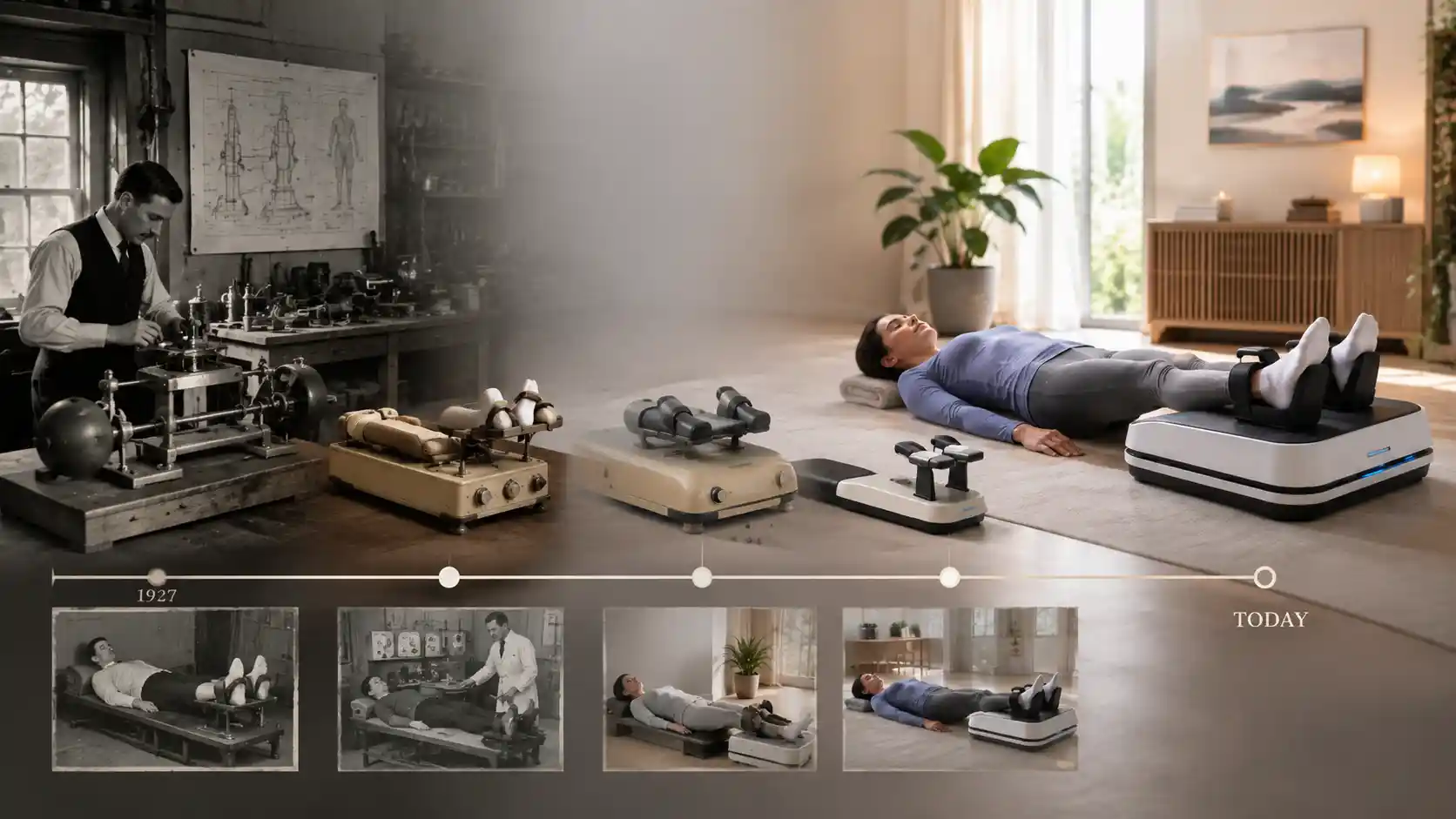
The History and Evolution of Chi Machines
- The Chi Machine’s oscillating motion traces back to a 1927 Japanese exercise system, not to a single 1980s “invention”
- Engineer Keiichi Ohashi patented the modern device in Japan in 1990, building on ideas from researcher Shizuo Inoue
- The device is classified as a medical device in a small number of countries, which is a regulatory classification, not proof of the health claims made around it
- Clinical research on the Chi Machine specifically remains limited to a handful of small studies, most notably on secondary leg lymphedema
- Today’s market includes many non-original variants, and buyers should distinguish marketing history from mechanical fact
If you’ve searched for the history of the Chi Machine, you’ve probably run into two different stories: one that credits a single Japanese inventor in the late 1980s, and another that traces the motion back to a 1920s health system. Both are partly right. The oscillating, side-to-side “goldfish” motion used by every Chi Machine on the market today did not appear out of nowhere in 1988 — it was adapted from an exercise developed decades earlier, then engineered into a standalone device by a specific person, at a specific company, with a specific patent date. Understanding that sequence matters, because it separates the mechanical facts (who built what, and when) from the marketing narrative (what the device is said to do for the body). This article walks through that timeline, then looks at what independent research has and hasn’t confirmed since.
A 1920s Health System, Not a 1980s Invention
The motion that defines a Chi Machine — feet elevated, ankles resting on a padded cradle, the body swaying gently side to side — did not start as a wellness product. It started as one exercise within a broader personal health system created in 1927 by Katsuzo Nishi, a Japanese engineer who had also worked on infrastructure projects including sections of the Tokyo subway system. Nishi’s system, sometimes called the Nishi Health System, consisted of six exercises intended to be practiced together. One of them, known in Japanese as kingyo undo (“goldfish exercise”), involved lying down and generating a fish-like undulation through the spine and hips.
That specific exercise had a second life outside Nishi’s system: it was adopted into Aikido training under the same “goldfish” name, where practitioners used it as a warm-up and spinal-mobility movement. This is the direct mechanical ancestor of the modern Chi Machine’s oscillation — the device essentially mechanizes a movement a person would otherwise have to perform actively on the floor. Recognizing this lineage matters for a simple reason: it means the Chi Machine’s core motion is not a proprietary breakthrough discovered through clinical trials, but an adaptation of a pre-existing manual exercise, engineered so the body doesn’t have to do the work itself.
Shizuo Inoue and the Oxygenation Theory
The next link in the chain is Shizuo Inoue, a Japanese researcher who had reportedly served as Nishi’s secretary before pursuing his own work. Inoue spent decades researching how oxygen levels in the body relate to illness, eventually chairing Japan’s Oxygen Health Association. His central hypothesis, as described by companies that later sold Chi Machine products, was that insufficient oxygenation in body tissue is a contributing factor in a wide range of health problems.
It’s worth being precise about what this represents historically: Inoue’s oxygenation research provided the theoretical justification that later marketing built on — the idea that a device replicating the goldfish motion could help “oxygenate” the body more effectively than passive rest. This framing is why Chi Machines are still described today as promoting “passive aerobic exercise” rather than simply “relaxation” or “massage.” It’s an important distinction for readers to hold onto: the oxygenation theory behind the device predates any clinical validation of the device itself, and it should be read as the historical rationale a device was designed around, not as an established medical finding.
Keiichi Ohashi and the First Patented Design
The person credited with turning this concept into an actual manufactured machine was Keiichi Ohashi, an engineer and president of a company called Skylite Industry. Ohashi developed and first manufactured the device in 1988, and the design was granted a patent by the Japanese Patent Office on December 18, 1990. This is the point where “goldfish exercise as a manual movement” became “goldfish motion as a powered, standalone device” — a motorized wedge that oscillates the ankles and lower body without any active muscular effort from the user.
Skylite Industry launched the device commercially in Japan in the early 1990s. Notably, the Japanese market at the time did not use the term “Chi Machine” at all — that name, with its explicit reference to the Chinese concept of “chi” (vital energy), came later, once the device was positioned for international and particularly Western markets, where “chi,” “energy centers,” and “meridians” carried more marketing resonance than they did in the original Japanese engineering and oxygenation framing. This naming shift is a useful reminder that the story of the Chi Machine has always run on two parallel tracks: a mechanical/engineering history in Japan, and a wellness-marketing history built for export.
From Sun Harmony to Sun Ancon
Once commercialized, the device went through a rebrand that’s often glossed over in shorter histories. It was initially marketed under the name Sun Harmony before being renamed Sun Ancon — the brand name still used today by companies claiming to sell the “original” Chi Machine, as distinct from later imitations built by other manufacturers once the core motion was no longer protected in every market.
This distinction matters practically for anyone researching the product today: a large share of what’s sold under generic names like “swing machine” or “leg swing exerciser” are mechanically similar devices built by different manufacturers, not the original Skylite/Sun Ancon design. The underlying oscillation principle is the same, but build quality, motor durability, and the specific range and rhythm of motion can vary meaningfully between the original design and later copies. None of this changes the basic mechanical description of the device — it moves the ankles and lower body side to side while the user lies passively — but it does mean “Chi Machine” functions today more as a category name than a single traceable product line.
Medical Device Status in a Handful of Countries
One historical detail frequently cited in marketing is that the original Chi Machine has been classified as a medical device in Japan, Australia, and Canada. This is accurate as a regulatory fact, but it’s worth being clear about what that classification does and doesn’t mean. A “medical device” designation in these jurisdictions typically reflects manufacturing and safety-standard compliance for a device intended to be used in relation to a health condition — it is a regulatory category, not a certification that a specific health benefit (improved circulation, pain relief, immune support) has been proven through clinical trials.
This distinction is where the site’s broader skepticism about Chi Machine health claims comes from: regulatory classification and clinical evidence are two different things, and conflating them is one of the most common ways this product category has been oversold historically. A device can be legitimately classified as safe for its intended mechanical use — gentle, passive oscillation — without that classification validating every therapeutic claim that has since been attached to it in retail marketing.
How the Device Reached Western Wellness Markets
The Chi Machine’s move from a Japanese engineering product into North American and European alternative-health and chiropractic circles happened gradually through the 1990s and 2000s, often through practitioner networks rather than direct consumer advertising. Chiropractors and wellness clinics were among the first to adopt it in the West, using it as an in-office relaxation and mobility tool before home units became widely available for personal purchase. Some users report first encountering the device in a chiropractor’s office in the mid-2000s, years before buying a personal unit for home use — a pattern that shows up repeatedly in user accounts of how they were introduced to the product.
This practitioner-first adoption path shaped how the device is talked about today. Terminology borrowed from traditional Chinese medicine — “chi,” “energy centers,” “meridians” — became attached to a product whose original Japanese framing was really about oxygenation and passive spinal movement. That layering of vocabulary is a marketing history, not a mechanical one, and it’s a useful thing to separate out when evaluating any specific claim made about the device.
What Clinical Research Has Actually Shown
Independent clinical research on the Chi Machine specifically is limited, and it’s important to say so plainly rather than imply otherwise. The most frequently cited study is a clinical trial published in the journal Lymphology in 2004, examining the Sun Ancon Chi Machine as a home-based adjunct therapy for people with chronic secondary leg lymphedema — swelling that can follow cancer treatment affecting the lower body. That trial found the device useful as a supportive, at-home tool for a specific condition in a specific patient population, with some improvement in lymphatic transport observed in a sub-group of participants, though effects were not fully sustained a month after treatment stopped.
That single trial is frequently generalized in marketing into much broader claims — better circulation for anyone, pain relief for any back condition, general “detoxification” — that the research doesn’t actually support. There is no large-scale, randomized controlled trial establishing the Chi Machine as an effective treatment for chronic back pain, nerve conditions, or general wellness outcomes in the broader population. This is precisely why any article on this device needs to keep separating three things: what the machine mechanically does (oscillates the lower body), what manufacturers claim it does (oxygenates, stimulates energy centers, aids circulation), and what has actually been studied (a narrow, specific benefit in a narrow, specific patient group). None of this means the device is useless for relaxation — many users describe it as a pleasant, low-effort way to unwind — but it does mean the historical health claims have consistently outpaced the historical clinical evidence.
The Passive Exercise Category Today
The Chi Machine’s history also mirrors a broader pattern in passive-exercise devices generally, a category that includes everything from oscillating tables to motorized rocking chairs marketed for circulation. These products share a common structural argument: mechanical movement, without active muscular effort from the user, is framed as a substitute or supplement for the kind of movement that would otherwise require deliberate physical exertion. The Chi Machine’s specific contribution to this category was combining an existing manual exercise (the goldfish motion), a specific research framework (Inoue’s oxygenation theory), and a patented mechanical design (Ohashi’s device) into a single branded product that then outlasted most of its contemporaries in the passive-exercise market.
Today, buyers researching this history will find dozens of manufacturers producing mechanically similar devices under different names, alongside companies still marketing “original” Sun Ancon units built on the 1990 patent lineage. For anyone using or considering one of these devices — particularly older adults or people managing back or nerve conditions — the practical takeaway from this history is straightforward: the mechanism is simple and old, the marketing language around it is newer and broader than the underlying research, and any existing back, nerve, cardiac, or post-surgical condition should be discussed with a doctor before use, since passive oscillation is not a substitute for medical evaluation or treatment.
Who invented the Chi Machine?
Keiichi Ohashi, a Japanese engineer and president of Skylite Industry, developed and first manufactured the device in 1988, receiving a Japanese patent for the design in 1990. The concept built on earlier oxygenation research by Shizuo Inoue.
What is the “goldfish exercise”?
It’s a spinal-mobility exercise from the 1927 Nishi Health System, created by Katsuzo Nishi, later adopted into Aikido training. The Chi Machine’s oscillating motion is a mechanized version of this manual movement.
Is the Chi Machine a certified medical device?
The original design is classified as a medical device in Japan, Australia, and Canada. This reflects regulatory compliance for safety and manufacturing standards, not a clinical proof of the specific health benefits marketed alongside it.
What’s the difference between Sun Harmony and Sun Ancon?
Sun Harmony was the original commercial name used by Skylite Industry before the product was rebranded as Sun Ancon, the brand name still associated with the “original” Chi Machine lineage today.
Is there scientific evidence the Chi Machine works?
A 2004 clinical trial in the journal Lymphology found some benefit as a home-based adjunct therapy for secondary leg lymphedema. Broader claims about circulation, pain relief, or general wellness are not supported by comparable large-scale research.
Why is it called a “Chi Machine” if the concept is Japanese?
The name references the Chinese concept of “chi” (vital energy) and was adopted mainly for Western marketing. The original Japanese product and research framing centered on oxygenation, not on traditional Chinese medicine terminology.
Can someone with back or nerve problems use a Chi Machine safely?
Only after consulting a doctor. The device’s passive oscillation is not a treatment for back or nerve conditions, and anyone with an existing condition, recent surgery, or a pacemaker should get medical clearance before use.
Are all “Chi Machines” sold today the original design?
No. Many manufacturers now produce mechanically similar oscillating devices under different names. Only products tracing back to the Skylite/Sun Ancon patent lineage are considered the “original” design.
Sources
- The Chi Machine Swing Message — Philadelphia Holistic Clinic
- The Chi Machine by Sun Ancon — Harvest Haven
- Where did the Chi Machine concept originate? — Energy for Health
- The Sun Ancon Chi Machine Aerobic Exerciser: a home-based therapy for chronic secondary leg lymphedema — PubMed / Lymphology
See also