
What Happens If You Do Tai Chi Every Day?
- Daily practice of 10 to 30 minutes is generally considered safe and sustainable for most age groups.
- Research suggests significant improvements in balance and a reduction in fall risk, particularly in older adults, after several months.
- Cognitive benefits, including increased prefrontal cortex activity and memory improvement, have been observed in studies lasting 12 weeks or more.
- Physical gains in strength and flexibility are often compared to moderate resistance training or brisk walking.
- It is not a substitute for medical treatment and requires professional consultation for individuals with pre-existing health conditions.
Tai chi is often described as “meditation in motion,” a low-impact, self-paced system of gentle physical exercise and stretching that originated in China as a martial art. Because the movements are slow, graceful, and non-strenuous, many people wonder whether they can practice tai chi every day without the recovery time required by more intense workouts. The short answer is yes — daily practice is not only possible but commonly recommended, with sessions ranging from 10 to 30 minutes depending on individual circumstances.
What changes over time, however, is the depth of the effects: early shifts tend to be psychological — feeling calmer, more grounded — while measurable physical and cognitive changes typically require consistent practice over months or years. This article breaks down what happens at the one-month, three-month, one-year, and multi-decade marks, distinguishing between what practitioners report, what clinical interventions measure, and where the evidence remains thin.
Can you do tai chi every day?
Tai chi qualifies as a mind-body exercise precisely because it does not tax the cardiovascular or musculoskeletal systems in the way that resistance training or high-intensity interval work does. The practice consists of a series of postures that flow into one another without pause, keeping the body in constant motion while emphasizing technique over strength.
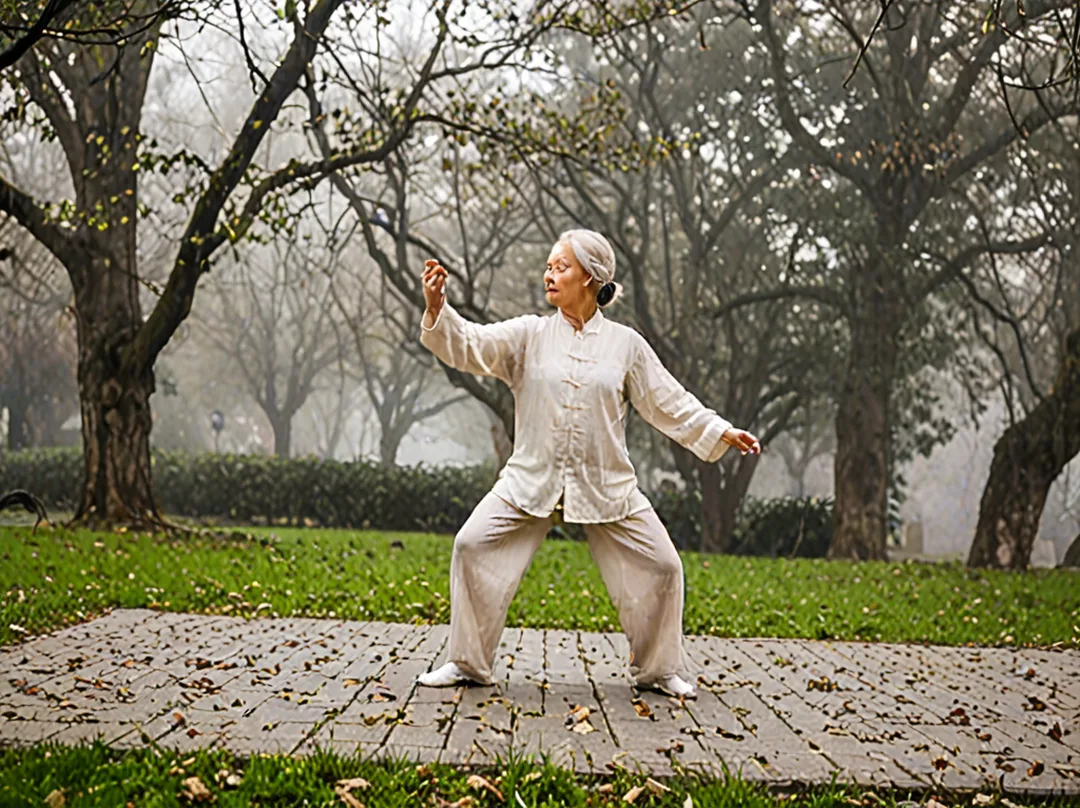
This low-impact nature means the body typically does not require a recovery day between sessions; many people safely do 20 minutes of tai chi every day, and some extend that to 30 minutes or more. The Tai Chi for Health Institute notes that practicing every day for at least 10 minutes helps establish a routine, and this is generally achievable even on busy days.
Flexibility of practice is a hallmark: a beginner might start with a 10-minute sequence to build the habit, while more experienced practitioners may explore longer forms containing over 100 possible movements and positions across different styles. Regardless of duration, two core principles guide the quality of practice. The first is Song (pronounced “soong”), often translated as “loosening the joints” — not to the point of floppiness, but a conscious, gentle stretching of the joints from within.
Proponents explain that qi (vital energy) can only flow smoothly when joints are Song, and that this state also strengthens internal ligaments and muscles, enhancing joint function. The second principle is Jing, a state of mental quietness or mindfulness in which the practitioner becomes more aware of the present moment and the self. These principles are not optional add-ons; they are the mechanism by which tai chi distinguishes itself from simple slow dancing or stretching.
- Beginner routine: at least 10 minutes daily to build consistency
- Common daily duration: 20 to 30 minutes for general well-being
- Advanced practice: can extend beyond 30 minutes depending on individual fitness
What happens if you do tai chi every day for a month?
The first 30 days of daily practice represent an adaptation phase. Because tai chi is not strenuous, the body does not undergo the kind of acute muscular breakdown and repair cycle seen in strength training; instead, the nervous system begins to recalibrate. Many practitioners report feeling calmer, more grounded, and subjectively “healthier” within this window.
A study of healthy but stressed individuals found that 12 weeks of tai chi significantly lowered anxiety levels, and the mindfulness component — focusing on breath and movement — can produce a palpable sense of relaxation even after a single session. The Mayo Clinic notes that this mind-body focus creates a state of calm whose effects may last well after the session ends.
However, it is important to distinguish subjective feelings from structural change. Significant physical adaptations — such as measurable improvements in muscle strength, flexibility, balance, or aerobic capacity — are unlikely to manifest within the first month. Clinical interventions typically run for at least 12 weeks before assessing outcomes.
What the first month reliably delivers is habit formation: the establishment of a daily rhythm that makes longer-term adherence possible. The Harvard Health Publishing guide emphasizes that by the end of a 12-week program, you should know whether you enjoy tai chi and may already notice positive physical and psychological changes — implying that the one-month mark is primarily about showing up.
The 12-week milestone: Physical and cognitive shifts
The 12-week milestone aligns with the standard duration of clinical tai chi interventions in medical research. Most beginning programs tested in studies last at least 12 weeks, with instruction once or twice a week and daily practice at home. At this point, several measurable shifts have been documented.
Researchers found that older adults who practiced tai chi daily for 12 weeks had increased activity in the prefrontal cortex, the brain region responsible for higher-level thinking skills such as task-switching and reacting to changing demands. This cognitive boost is consistent with broader systematic reviews indicating excellent evidence for improved cognitive capacity in older adults.
Mental health benefits also crystallize around this timeframe. The same body of research showing prefrontal cortex changes also documented significantly lowered anxiety levels in healthy but stressed participants after 12 weeks. The mechanism is attributed to mindfulness: the focus on breathing and movement displaces rumination.
Physically, the impact on proprioception — the ability to sense body position in space, which declines with age — becomes clinically relevant. Tai chi trains this sense through the inner ear’s sensory neurons and stretch receptors in muscles and ligaments, while simultaneously improving muscle strength and flexibility.
The result is a documented reduction in fall frequency: a review of 10 studies found that people who practiced tai chi had up to 50% fewer falls than those who did not, and a 2018 JAMA Internal Medicine trial reported 58% fewer falls compared to stretching and 31% fewer than a combined exercise regimen in older adults over six months. These figures represent relative risk reductions in studied populations, not guarantees for every individual.
| Metric | Observed Effect | Duration/Condition |
|---|---|---|
| Fall Risk | Up to 50% reduction | General practitioners |
| Brain Activity | Increased prefrontal cortex activity | Daily for 12 weeks (older adults) |
| Anxiety | Significantly lowered levels | 12 weeks (stressed individuals) |
| Memory | Significantly improved | 3 times a week for 6 months |
Long-term commitment: What happens if you do tai chi every day for a year or 20 years?
When the timeline extends to years or decades, the narrative shifts from adaptation to accumulation. Long-term practitioners often describe an evolution from learning “dance steps” — the external choreography of forms — to mastering the flow and depth of movement, a process one instructor likened to spending a lifetime mastering a dance. This deepening practice correlates with measurable physiological maintenance.
A meta-analysis of long-term practitioners (average 10.5 years of practice) found a very large effect on forced vital capacity, a marker of respiratory function, with a mean difference of 670 mL compared to non-practitioners. Balance, lower-limb strength, and aerobic capacity in those with poor baseline fitness also show excellent evidence of benefit in systematic reviews.
Yet a skeptical perspective is warranted. Claims that tai chi “heals the body and soul” or “makes you live longer” venture beyond what controlled studies support. The evidence base — over 500 trials and 120 systematic reviews in the past 45 years — shows excellent evidence for fall prevention, osteoarthritis symptom management, Parkinson’s disease rehabilitation, COPD rehabilitation, and cognitive capacity improvement in older adults. There is good evidence for depression, cardiac and stroke rehabilitation, and dementia.
Fair evidence exists for quality of life in cancer patients, fibromyalgia, hypertension, and osteoporosis. Crucially, current evidence indicates no direct benefit for diabetes, rheumatoid arthritis, or chronic heart failure. No studies have found that tai chi worsens a condition, and adverse events are typically minor and musculoskeletal. But the gap between “documented physical maintenance” and “healing the soul” remains wide, and long-term practitioners should be cautious about attributing health outcomes solely to tai chi when lifestyle, genetics, and medical care all play roles.
- Muscle strength: regular practice may become comparable to brisk walking or resistance training
- Joint health: continuous stretching of ligaments and tendons to protect joints
- Cognitive maintenance: potential for sustained improvements in memory and task-switching
Precautions and medical guidance for daily practice
Despite its gentleness, tai chi is not universally appropriate without qualification. It is a complementary practice, not a substitute for traditional medical care. Individuals with severe balance disorders, recent surgeries, or significant musculoskeletal conditions should seek medical clearance before starting daily practice. The CDC and American Geriatric Society recognize tai chi as effective for fall prevention, but this does not mean it is safe for someone with acute vertigo or an unhealed fracture to begin unsupervised.
Modified versions exist — seated tai chi, for example — which can make the practice accessible to those with limited mobility. Professional instruction is strongly advised, particularly in the early stages, because incorrect posture sustained over thousands of repetitions can lead to musculoskeletal strain. The safety data are reassuring: a recent systematic review found no intervention-related serious adverse events. But “generally safe” is not the same as “safe for everyone without assessment.”
- Consult a doctor if you have chronic joint instability
- Seek guidance for severe cardiovascular conditions
- Verify safety with a physician after recent orthopedic surgery
How many times a week should you do tai chi?
While some people practice 3 times a week for memory benefits, daily practice of 10-30 minutes is often recommended to establish a routine and maximize flexibility and stress reduction.
Can you do tai chi every day?
Yes, because Tai Chi is a low-impact and non-strenuous activity, most people can safely practice it daily without needing recovery days.
How long does it take to see results from Tai Chi?
While some feel calmer immediately, most clinical research shows significant physical and cognitive benefits after at least 12 weeks of regular practice.
Are there any disadvantages of tai chi?
Adverse events are typically minor and musculoskeletal, usually resulting from incorrect form. It is not a replacement for medical treatment.
Is tai chi better than stretching for fall prevention?
Some studies suggest that Tai Chi is more effective than stretching alone, with one study showing significantly fewer falls in the Tai Chi group over six months.
Does the chi machine offer the same benefits as Tai Chi?
No. Tai Chi is an active mind-body exercise requiring focus and movement, whereas a Chi Machine provides passive oscillation. They are different modalities of movement.
Sources
- Cleveland Clinic – Health Benefits of Tai Chi
- Harvard Health – The Health Benefits of Tai Chi
- AARP – Tai Chi and Healthy Aging
- NCBI – Effectiveness of Tai Chi for Older Adults – pmc.ncbi.nlm.nih.gov
- Tai Chi for Health Institute – What is Tai Chi
See also
- Chi Machine Technology Explained
- What Happens During a Chi Machine Session?
- How Chi Machines Support Relaxation and Balance
- Understanding the Infinity Motion of Chi Machines